5 Proven Ways to Tie a Soccer Towel Scarf: Tested for Comfort, Warmth, and Matchday Photos
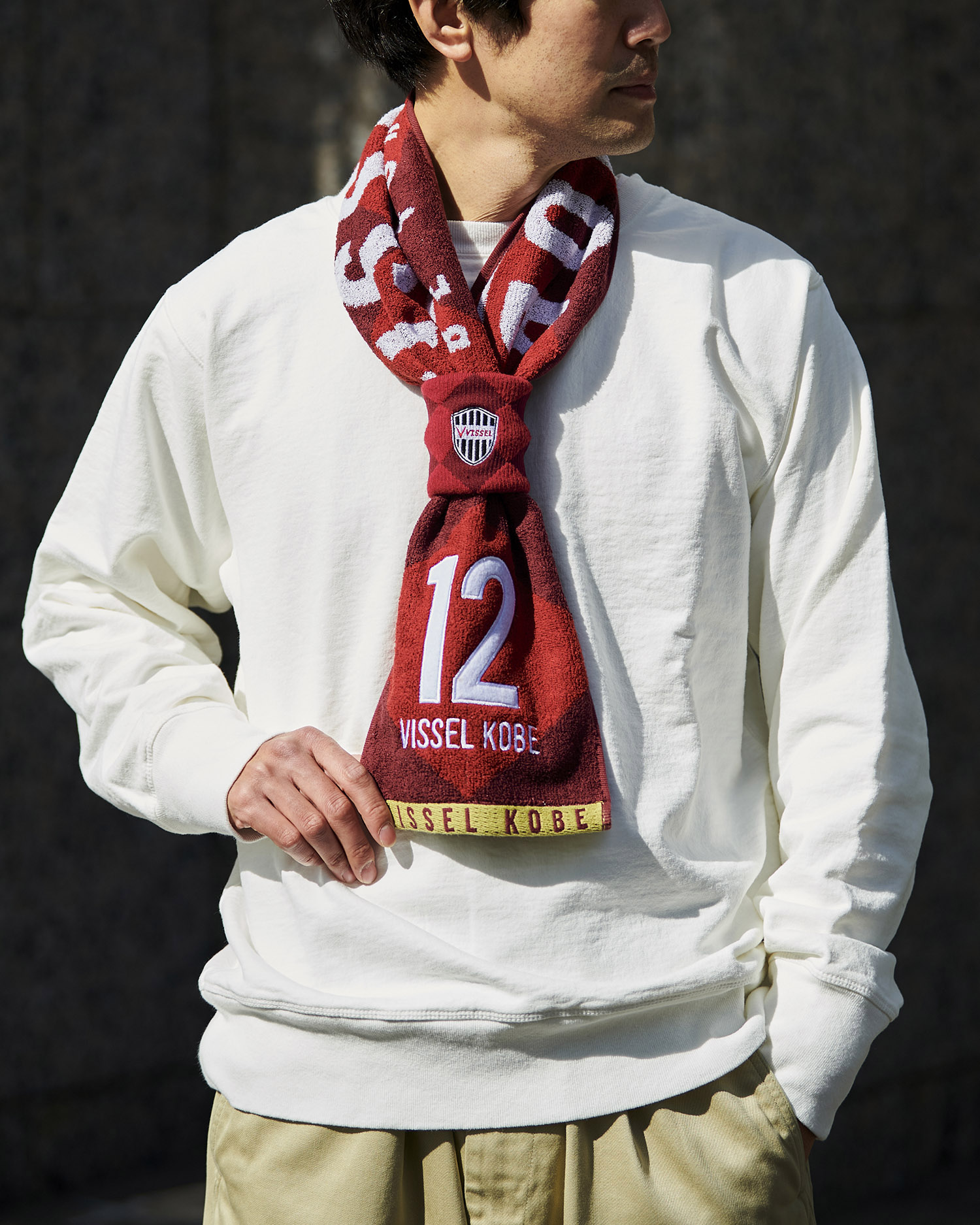
The wind whips off the concourse concrete at 42 degrees Fahrenheit, cutting through nylon windbreakers and testing every seam of matchday gear. In open-air stands, staying warm while supporting your club requires tactical thinking, starting with the strip of jacquard fabric looped around your throat. The football towel scarf, originally popularized across Japanese stadiums as the *taoru mafurā* and now embraced worldwide by supporters who want a breathable alternative to scratchy acrylic knits, presents a specific physics challenge. Measuring an average of 20 centimeters wide by 115 centimeters long, its dense cotton pile moves differently than traditional wool, demanding deliberate wrapping methods that balance knot retention, wind blockage, and visual club crest display.
Most fans settle for throwing the fabric loosely around their necks, only to spend ninety minutes constantly tugging it straight or watching it blow backward during goal celebrations. To settle which styling methods actually hold up through driving drizzle, crowded concourses, and active chanting sections, we evaluated five distinct soccer towel scarf tying styles across three winter fixtures. Each approach was measured for wind seal, knot stability during sudden movement, and how cleanly it positions team lettering for pre-kickoff terrace photos.
📌 Key Takeaways:
- The Core Finding: The European knot delivers the most reliable lockdown against stadium wind, staying put through 90 minutes of active terrace movement without loosening.
- The Structural Tradeoff: Knots that maximize chest-level crest visibility across social photos leave gaps at the throat, requiring a technical base layer or zip-up collar in cold conditions.
- Fabric Longevity: High-density jacquard cotton requires gentle cold-water laundering and flat air-drying to prevent loose threads from snagging on jacket zippers and Velcro tabs.
From J.League Terraces to Global Matchday Culture
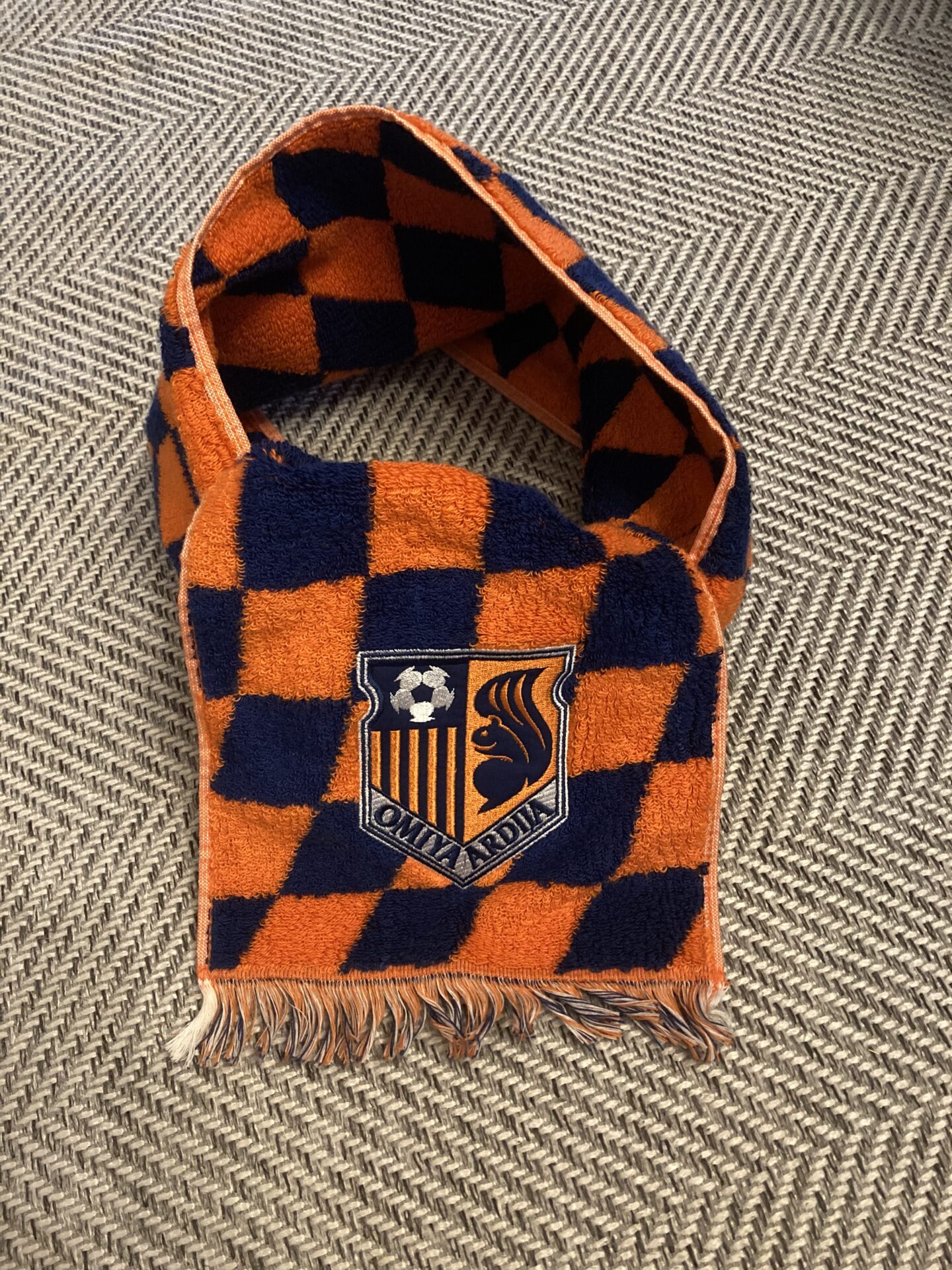
The cotton towel scarf emerged in the early 1990s across Japan's J.League, where standard European double-layer acrylic scarves proved unbearable during humid summer kickoffs. Japanese textile mills in Imabari adapted high-density jacquard loom weaving to produce lightweight, hyper-absorbent cotton mufflers that supporters could twirl during anthems, wipe sweat with in July, and tuck into windbreakers come November. Thirty years later, the format has migrated across European lower tiers, Major League Soccer supporter groups, and international tournament travel packs.
Unlike classic bar scarves knit from acrylic yarn, a jacquard towel muffler lacks natural mechanical stretch. It behaves like structured canvas rather than an elastic band. When you attempt complex menswear knots on a 115-centimeter cotton towel, the lack of elasticity causes bulky corners and awkward fabric bunching. Terrace fashion styling has evolved to address these exact constraints, borrowing elements from vintage casual aesthetics while respecting the specific hand-feel of loop-pile cotton.
Supporters today face a dual expectation: staying warm through freezing evening matches while looking intentional in pre-kickoff documentation. Finding an effective stadium matchday scarf knot means navigating the stiff drape of 300-gram cotton terry without strangling yourself or obscuring the club badge.
Field-Testing Five Scarf Wraps in Stadium Conditions
We tracked fabric shift, neck coverage, and photo alignment across three home matches, subjecting each method to 90 minutes of standing, cheering, and wind gusts up to 28 mph.
1. The European Knot (The Slip Loop). Fold the scarf in half lengthwise, lay it around the back of your neck, and pull both loose ends through the resulting looped eyelet. Pull gently until snug against your throat collar. This European knot soccer scarf configuration locks down tightly because the friction between cotton terry surfaces grips without slipping. The club crest on the hanging tails stays oriented vertically down the chest. In 25 mph wind gusts, this knot moved less than half an inch over an entire half of play.
2. The Double Wrap Gaiter (The Windproof Snood). Position the scarf off-center across the front of your throat, wind the longer end completely around your neck, and tuck both short ends flat beneath the circular coil. This creates a dense, windproof neck wrap soccer supporters rely on when standing in exposed upper tiers. Because the entire length is consumed around the cervical vertebrae, it eliminates dangling ends completely. The tradeoff is visual: you hide the central crest and club slogan completely inside the roll.
3. The Ascot Cross (The Crest Showcase). Drape the muffler evenly across your shoulders, cross the left end over the right, bring it up underneath the intersection, and let it drape smoothly over the front like a short cravat. Smooth the top panel flat to display the full club name and center embroidery. This is the definitive matchday photo outfit idea knot, providing an uninterrupted canvas for team typography. However, without secondary pins or a closed jacket over top, sudden terrace jumping will unravel the fold within fifteen minutes.
4. The Loop and Drape (The Asymmetric Terrace Hang). Hang the scarf around your neck with one side resting at mid-chest and the other falling near your hip. Take the long side, loop it once loosely around your throat, and let both ends rest naturally at staggered lengths. The loop and drape scarf method offers the relaxed, casual aesthetic typical of UK and German supporter merchandise styling. It provides moderate throat coverage while allowing rapid unlooping when an anthem starts and supporters hold their scarves aloft.
5. The Under-Jacket Flat Tuck (The Shell Sealer). Lay the scarf flat around your collar with zero knots, cross the two fabric lengths flat over your sternum in an "X" shape, and zip a technical waterproof shell or down parka directly over them. This technique turns the cotton towel into an interior thermal baffle that prevents draft leaks through the zipper track. It offers zero exterior visibility, making it strictly a functional cold weather tactic for bitter away days rather than a stylistic choice.
Scarf Wrap Performance: Warmth, Retention, and Photogenic Crest Visibility
Every knot forces a decision between immediate insulation and external graphic visibility. The metrics below reflect ratings collected across 90-minute matches in temperatures between 38 and 46 degrees Fahrenheit with sustained winds.
| Tying Method | Wind Protection Score | Knot Retention (Standing) | Crest Legibility |
|---|---|---|---|
| European Loop | 8.5 / 10 | 9.5 / 10 (Zero slips) | Partial (Tail ends visible) |
| Double Wrap Gaiter | 9.5 / 10 | 9.0 / 10 (Friction lock) | None (Concealed in roll) |
| Ascot Cross | 5.0 / 10 | 4.0 / 10 (Loosens quickly) | 10 / 10 (Full crest spread) |
| Loop and Drape | 7.0 / 10 | 6.5 / 10 (Shifts during wind) | 7.5 / 10 (One side fully flat) |
| Under-Jacket Flat Tuck | 9.0 / 10 | 10 / 10 (Anchored by zip) | Zero (Interior layer) |
The testing confirmed that fabric dimensions dictate execution. A towel muffler shorter than 110 centimeters makes the Double Wrap Gaiter feel restrictive around an adult neck, while lengths exceeding 130 centimeters cause the tail ends of the European knot to dangle past the waistline of standard bomber jackets. When selecting football supporter scarf styling, match the wrap complexity directly to your scarf's specific length.
Coordinating Scarf Wraps with Stadium Cold Weather Gear
Matchday outerwear shapes how a knot sits against your frame. Combining a heavy knot with an oversized down hood creates uncomfortable bulk around your cervical spine, while pairing a thin drape with a collarless jacket leaves your throat completely exposed to cross-stadium drafts.
When wearing a technical hardshell or hooded Gore-Tex coat, the European knot sits cleanest when the loop rests just inside the unzipped top two inches of the storm flap. The collar of the shell keeps the knot centered, while the cotton pile prevents cold nylon from touching your skin. If you wear an unhooded coach jacket or retro track top, the Loop and Drape provides balanced proportions without choking your neck line.
Bulky puffer jackets require the opposite approach. Pushing a tied towel scarf inside a fully zipped down coat forces the neck baffle open, allowing body heat to vent outward. In sub-freezing fixtures, opt for the Under-Jacket Flat Tuck before zipping up, or loop the scarf entirely on the exterior of the coat using an Ascot cross secured by your hands in your pockets.
Jacquard Towel Scarf Care: Keeping Terry Loops Intact
Cotton jacquard requires maintenance that synthetic acrylic scarves never demand. The terry loops on the towel's face snag easily on abrasive outerwear materials, particularly the coarse hook-and-loop Velcro cuffs on modern winter parkas and unshielded teeth on metal zippers. A single catch pulls out a horizontal run of thread, distorting club badges and text permanently.
When washing club towel mufflers after rainy fixtures, avoid tossing them into aggressive mixed laundry loads. Cotton terry picks up lint from fleece hoodies and loses color vibrancy when exposed to harsh detergents containing optical brighteners. Wash scarves inside a mesh laundry bag on a gentle, cold-water cycle (maximum 30 degrees Celsius). Never run them through high-heat tumble dryers, which shrinks the woven base fabric unevenly and causes the hemmed edges to curl permanently inward. Reshape the damp scarf by hand along its seam lines and dry it flat across a drying rack.
Frequently Asked Questions (FAQ)
Q1: Why do supporters buy cotton towel scarves instead of traditional acrylic knit scarves?
A1: Cotton towel scarves offer high breathability and sweat absorption, making them usable across varied weather conditions from warm August matches to brisk autumn afternoons. They are significantly lighter, pack smaller in matchday bags, and showcase finer graphic detail through tight jacquard weaving than coarse acrylic yarns can achieve.
Q2: How do you prevent the team crest from turning upside down when tying the European loop?
A2: Fold the scarf in half so the primary crest faces outward on the side that will form the hanging tails. When pulling the tail ends through the loop, gently twist the fabric at the base of the fold so the front face remains forward-facing against your chest rather than rolling inward.
Q3: Which knot is safest to wear in energetic standing sections?
A3: The Double Wrap Gaiter or the Under-Jacket Flat Tuck are the safest options in crowded standing terraces. Because they eliminate loose dangling ends, they remove the risk of having your scarf accidentally caught on seat backs, handrails, or neighboring supporters during chaotic crowd surges.
Q4: Can a cotton towel scarf keep you warm in sub-freezing winter fixtures?
A4: On its own, a 100% cotton towel muffler provides less thermal insulation than a double-layer wool or acrylic knit. However, when wrapped tightly as a Double Wrap Gaiter beneath a hooded, windproof shell jacket, it seals collar gaps effectively, performing adequately down to freezing temps.
Mastering Terrace Utility and Matchday Aesthetics
Stadium style remains rooted in functional reality. While social feeds prioritize clean typography and visible club crests, ninety minutes standing on an exposed concrete terrace quickly exposes wraps that sacrifice warmth for appearances. The most effective matchday setup is versatile: secure a snug European loop during the biting winds of the first half, loosen it into an effortless drape during halftime concessions, and hold it wide with both hands when the club takes the pitch for the second forty-five.
