Complete Guide to Japanese Surnames Starting With 'A': Meanings, Origins, and Top Lists
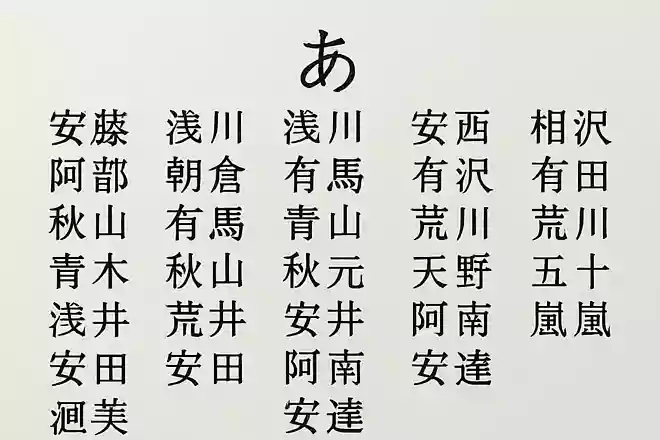
Open syllables hold a privileged position in the phonology of Japan. Among the phonetic characters of the Japanese syllabary, names starting with the vowel "あ" (A) command outsized cultural and historical weight. Across government registries and school attendance sheets, families bearing names like Abe, Arai, and Asano consistently stand at the front of the line. Modern media reflects this exact resonance: an investigative 静岡新聞SBS Report analyzing approximately 1,650 anime productions released since the start of Japan's Reiwa era revealed that roughly one in ten fictional protagonists carries a surname that begins with "あ" and ends with "野" (no).
Japanese family names are windows into geography, imperial power struggles, and linguistic engineering. From deep-rooted samurai bloodlines to agrarian markers created overnight during the Meiji period, surnames starting with the first hiragana character showcase the mechanics of Japanese naming conventions.
📌 Key Takeaways:
- Phonetic Dominance: Surnames beginning with "A" dominate both real-world registries and narrative fiction due to vocal clarity, alphabetical front-row positioning, and open vowel resonance.
- Feudal Inheritance: Foundational lineages like the Abe clan and the Asano samurai house trace their roots back to the classical Asuka period and the Edo era's most volatile political conflicts.
- Topographical Architecture: Over 80% of common Japanese family names starting with "A" derive from direct environmental markers, including clear water, new wells, and shallow fields.
The Topographical Roots and Geography of Hiragana 'A' Surnames
The overwhelming majority of Japanese surnames starting with A are topographical. Before 1875, when the Meiji government passed the Family Register Act (Heimin Myōji Kyoyōrei) ordering commoners to register hereditary family names, rural peasants identified themselves by local geography. When village scribes and local elders formalized these registries, they drew heavily on the physical surroundings of each household.
The character "浅" (asa, meaning shallow) produced names like 浅野 (Asano, shallow field) and 浅井 (Asai, shallow well). These markers indicated settlers living near wetlands or shallow river crossings. Similarly, names built around "青" (ao, blue or green) reflected natural vegetation: 青木 (Aoki, green tree) and 青山 (Aoyama, blue-green mountain).
Water access defined survival, giving rise to names containing "荒" (ara, wild or rough) and "新" (ara, meaning new). Surnames such as 荒井 and 新井 (Arai) designated families living near volatile riverbanks or fresh irrigation springs. These characters carried immediate practical context for neighboring communities, establishing a geographic footprint that persists in national population maps today.
Aristocrats and Warriors: The Abe Clan and Asano Samurai Lineage
Two major houses dominate the historical record of "A" surnames: the Abe and the Asano. Their trajectories illustrate the dual paths of Japanese power, imperial court service and provincial military dominance.
The Abe clan (written as 安倍 or 阿部) claims direct descent from the eighth Emperor of Japan, Emperor Kōgen. By the Heian period (794, 1185), the Abe branch operating in northern Honshu controlled extensive territories in Mutsu Province. They fought the imperial court during the Early Nine Years' War (1051, 1062). Another branch of the Abe clan served as imperial astrologers and masters of Onmyōdō (esoteric cosmology), producing the legendary Heian court seer Abe no Seimei. In modern politics, the lineage maintained its presence through figures such as Shinzo Abe, Japan's longest-serving prime minister.
Imperial Court Era (Asuka / Heian)
└─ Abe Clan (Imperial administration & Onmyōdō astrology)
│
Edo Shogunate (1603, 1867)
├─ Asano Lineage (Daimyo of Hiroshima and Ako Domains)
└─ Rural Samurai Castes (Adachi, Akiyama regional retainers)
│
Modern Era (1875, Present)
└─ Standardized Civil Registries (Abe, Arai, Aoki rank in Top 50)
The Asano samurai lineage carved out an equally consequential legacy in military history. Descendants of the Minamoto clan, the Asano rose to prominence under Toyotomi Hideyoshi during the late 16th century. Awarded rule over the Hiroshima Domain and the Akō Domain during the Edo period, their name became permanently tied to the legendary Forty-Seven Ronin incident. In 1701, Lord Asano Naganori drew his blade inside Edo Castle against court official Kira Yoshinaka. His forced seppuku triggered the vendetta that came to define the bushido ethos across Japanese popular culture.
Real-World Distribution: Data Metrics of the Most Common 'A' Surnames
According to demographic records consolidated in the Japanese surname ranking database, family names beginning with "A" account for several million citizens nationwide. While Sato and Suzuki lead the national tables overall, "A" surnames consistently fill the upper quartile of common Japanese family names.
| Surname (Romaji / Kanji) | Kanji Surname Meanings | National Rank | Estimated Population |
|---|---|---|---|
| Abe (阿部 / 安倍) | Abundant peace / Slanted corner | #25 | ~470,000 |
| Arai (新井 / 荒井) | New well / Wild well | #44 | ~280,000 |
| Aoki (青木) | Green or blue tree | #41 | ~330,000 |
| Akiyama (秋山) | Autumn mountain | #92 | ~195,000 |
| Asano (浅野) | Shallow open field | #114 | ~160,000 |
Regional concentrations show sharp geographic variation. Abe is heavily concentrated in northeastern Tohoku, particularly in Miyagi and Iwate Prefectures. By contrast, Arai appears frequently in central Honshu and Tokyo's surrounding prefectures, especially Gunma and Saitama.
The Scriptwriter’s Playbook: Anime Protagonists and the 'A' Trend
Fiction rarely selects names by accident. Creative teams in manga and animation studios deploy specific phonetic tools to establish emotional rapport with their audiences.
The SBS study evaluating 1,650 Reiwa anime releases confirmed a distinct creative preference: protagonist names lead disproportionately with the open vowel "A." Characters such as Amano (天野), Asahina (朝比奈), and Aizawa (相沢) recur constantly across shonen, slice-of-life, and mecha genres.
Three functional reasons explain why creative directors lean on these names:
- Phonetic Clarity: Linguistic studies confirm that open vowels, specifically the low central vowel /a/, carry higher acoustic volume and project greater clarity than closed vowels like /i/ or /u/. An anime hero calling out their family name cuts through heavy action soundscapes.
- Everyman Archetypes: Japanese school registries arrange students phonetically according to the Gojūon order (A-I-U-E-O). A student whose name begins with "A" sits at the front desk or tops the classroom roster. Writers assign "A" surnames to protagonists to underscore an active, unpretentious posture in everyday life.
- Contrast Dynamics: Writers frequently pair a grounded "A" protagonist (such as Amano) with an eccentric foil carrying a heavy, consonant-loaded surname starting with K, G, or Z.
From Obscure Dialects to Endangered Characters: Rare Japanese Last Names Starting with 'A'
At the opposite end of the spectrum from ubiquitous names like Abe and Aoki lie rare Japanese last names. Many are held by fewer than one hundred people across the entire country.
Consider Akegarasu (明烏), literally meaning "crow at dawn." The name evokes classical waka poetry and is carried by an estimated 50 individuals, concentrated in Ishikawa Prefecture. Another striking example is Ajisaka (網坂 or 鰺坂), derived from coastal harbor operations or steep coastal hills where fishermen hauled their catches.
Some rare surnames feature phonetic readings that defy standard character pronunciation. The name Aozora is occasionally written with the characters 青空 (blue sky), but historical documents also record the variant Akisora (秋空), which shifts pronunciation depending on local prefectural customs. In extreme cases, hyper-rare names like A (written as single kanji like 阿 or 亜) exist in isolated pockets of Kyushu. These names survived because local village records avoided the standardized character consolidations mandated by Tokyo during the early 20th century.
Structural Rules of Japanese Naming Conventions
Understanding the composition of "A" surnames requires examining the two core types of Japanese family nomenclature: Uji (clan designations denoting ancient lineage) and Myōji (family names denoting geographic branches).
Prior to the 1875 Meiji decree, clan titles like Minamoto, Taira, Fujiwara, and Tachibana dominated aristocratic circles. These four great clans held administrative and ceremonial power, but as families expanded, distinct myōji were invented to differentiate branch households. Retainers took names like Akashi (明石) based on the Akashi Strait, or Akishino (秋篠) based on temple districts in Nara.
Ancient Clan (Uji/Kabane) → Geographic Branch (Myōji) → Modern Legal Surname (Sei)
Example: Fujiwara Lineage → Settles in Akashi Region → Akashi (明石, Est. 1875)
Modern naming law strictly regulates these names under the Japanese Civil Code. Every household registered in the official Koseki (family registry system) must choose a shared family name upon marriage. The kanji selected must come from the Ministry of Justice's approved lists of Jōyō kanji (regular use characters) and Jinmeiyō kanji (characters designated for personal names). This administrative framework keeps the structural origins of these centuries-old surnames intact.
Frequently Asked Questions (FAQ)
Q1: Why are there so many different kanji variations for the surname 'Abe'?
A1: The surname Abe is primarily written as 阿部 or 安倍. The variation stems from clan branching in early medieval Japan. The 安倍 spelling traces directly to the ancient aristocratic and court astrologer lineages in central Japan, while 阿部 developed as a military clan spelling in northeastern Japan. Both remain in common use, with 阿部 ranking among the top 30 surnames nationwide.
Q2: Did all Japanese families with 'A' surnames belong to the samurai class?
A2: No. While houses like Asano and Abe possessed prestigious samurai genealogies, the vast majority of citizens carrying names like Arai, Aoki, or Akiyama received their surnames during the Meiji period in 1875. Rural farming and fishing families selected names based on local topography, nearby temples, or village landmarks.
Q3: How does the Japanese alphabetical order affect people with 'A' surnames in daily life?
A3: Japanese administrative lists, classroom rosters, and medical clinics typically organize individuals according to the Gojūon (the 50-sound chart starting with A-I-U-E-O). As a result, individuals with surnames beginning with "あ" almost always appear at the top of attendance rolls, seating charts, and presentation schedules.
The Cultural Durability of 'A' Surnames
Japanese family names beginning with "A" bridge the gap between ancient court politics and modern pop culture. The names survive because their components, wells, trees, autumn hills, and open clearings, reflect the permanent geography of the Japanese archipelago. Whether cataloged in digital databases, filed in municipal registries, or spoken across broadcast media, the open vowel "A" remains the foundational starting point of Japanese identity.
