Complete JR Yokosuka Line Guide: Full Station List, Express Stops, and Travel Tips
Tokyo Station's deepest subterranean platforms anchor one of the capital region's most heavily traveled transit corridors. Stretching south from the central business district through Kanagawa Prefecture to the naval docks of Kurihama, the JR Yokosuka Line connects high-density urban office zones with historic coastal retreats. Commuters frequently encounter unexpected route mechanics, such as the train veering away from the coastal mainline to loop through suburban Kanagawa.
As documented in an investigative Excite エキサイト Report, the Yokosuka Line bypasses Kawasaki completely, taking a structural detour through Musashi-Kosugi that adds three kilometers and six minutes of travel time compared to the parallel Tokaido Main Line. Understanding these engineering choices, along with the line's deep underground terminals and bi-level premium cars, separates frustrated tourists from efficient transit riders.
📌 Key Takeaways:
- The Route Detour: Between Shinagawa and Yokohama, Yokosuka Line trains divert westward along the historic Hinkaku freight bypass, skipping Kawasaki Station entirely.
- Platform Relief: Heavy congestion at Musashi-Kosugi prompted JR East to construct a dedicated outbound platform, operating since December 18, 2022, to split commuter traffic.
- Dual Identity: The service runs as a high-speed express bypass through central Tokyo before converting to a local stopping pattern past Ofuna along the Miura Peninsula.
Full Station Directory and Operational Mechanics
The Yokosuka Line officially spans 23.9 kilometers of dedicated track between Ofuna and Kurihama. Operational practice tells a different story. JR East operates the line as a continuous 73.8-kilometer commuter service running directly from Tokyo Station down to the southern tip of Kanagawa, with most services running through-service onto the Sobu Rapid Line toward Chiba and Narita Airport.
North of Ofuna, Yokosuka Line trains run parallel to regional commuter corridors, serving designated rapid stops:
Tokyo to Ofuna (Rapid Corridor):
- Tokyo (JO 19): Deep underground terminus (B5F) connecting to Shinkansen and regional JR lines.
- Shimbashi (JO 18): Subterranean platforms serving Tokyo's primary white-collar commercial district.
- Shinagawa (JO 17): Surface-level junction connecting to the Tokaido Shinkansen and Haneda Airport rail links.
- Nishi-Oi (JO 16): Elevated residential stop where Yokosuka trackage splits toward western Tokyo.
- Musashi-Kosugi (JO 15): Major Kanagawa transit interchange serving high-density residential towers.
- Shin-Kawasaki (JO 14): Suburban stop adjacent to JR East's sprawling freight classification yards.
- Yokohama (JO 13): Premier regional hub connecting to Keikyu, Sotetsu, and Tokyu networks.
- Hodogaya (JO 12): Valley residential district bypassed by parallel Tokaido mainline trains.
- Higashi-Totsuka (JO 11): Mountain pass commuter community built around hillside retail centers.
- Totsuka (JO 10): Cross-platform transfer node offering direct hops to Tokaido Main Line services.
- Ofuna (JO 09): Operational boundary separating mainline operations from the Miura Peninsula branch.
Ofuna to Kurihama (Peninsular Local Corridor):
- Kita-Kamakura (JO 08): Forested valley station providing immediate access to historical Zen temples.
- Kamakura (JO 07): Former samurai capital hub and gateway to the Enoshima Electric Railway (Enoden).
- Zushi (JO 06): Critical operational yard where 15-car trains decouple down to 11 or 4 cars.
- Higashi-Zushi (JO 05): Quiet residential stop serving northern Miura hiking trails.
- Taura (JO 04): Valley stop featuring tunnels so short that train car doors remain manually locked.
- Yokosuka (JO 03): Flat-access station situated directly opposite US and Japanese naval facilities.
- Kinugasa (JO 02): Inland residential district serving central Miura bus transit links.
- Kurihama (JO 01): Southern terminal offering transfers to the Keikyu Kurihama Line and Tokyo Bay ferries.
The Shinagawa-to-Yokohama Detour and the Kawasaki Bypass
Passengers traveling from Tokyo to Yokohama often wonder why the Yokosuka Line runs westward while the Tokaido Line cuts a straight path south. The physical tracks separate right after Shinagawa. While Tokaido trains rocket straight through Kawasaki along Japan's original 1872 rail corridor, Yokosuka trains veer west into eastern Kawasaki City, stopping at Musashi-Kosugi and Shin-Kawasaki before curving back southeast to rejoin the mainline at Yokohama.
This routing dates back to the national railway era. During the late 1970s, extreme commuter congestion paralyzed the Tokaido Main Line. Freight trains competed directly with passenger traffic on shared tracks. Japan National Railways resolved the crisis through the "SM Separation" project, formalized in October 1980.
Engineers redirected passenger trains onto the Hinkaku Line, an underutilized freight bypass constructed in 1929. The rerouting liberated massive capacity on the Tokaido tracks, but introduced physical trade-offs. The detour adds 3.1 kilometers of physical track. Yokosuka trains require roughly 20 to 22 minutes to travel between Shinagawa and Yokohama, whereas Tokaido Line trains complete the run in 16 to 17 minutes. Passengers heading directly between Shinagawa and Yokohama should always board the Tokaido Line to save transit time.
Musashi-Kosugi Congestion and the Platform Expansion
The decision to route Yokosuka trains along the freight bypass generated an unexpected commuter crisis decades later. In March 2010, JR East opened Yokosuka Line platforms at Musashi-Kosugi Station to serve the exploding redevelopment of the area. Scores of 50-story residential towers transformed Musashi-Kosugi into a commuter bedroom community.
The station became a severe passenger chokepoint. Peak morning surges forced thousands of commuters onto a single, narrow island platform handling both northbound trains toward Tokyo and southbound trains toward Yokohama. Queues during morning rush hours extended down stairways, out the ticket gates, and onto neighborhood sidewalks.
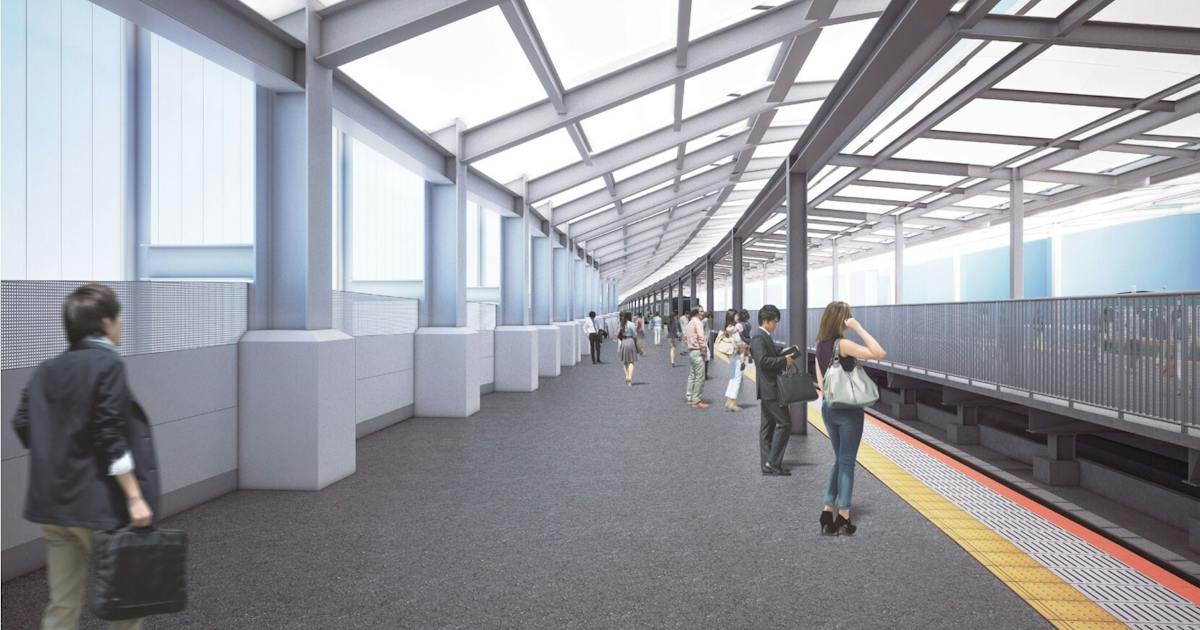
To resolve the hazard, JR East initiated a multi-year engineering overhaul. On December 18, 2022, the railway officially brought a newly constructed outbound platform (Track 2) into commercial service. Northbound passengers to Tokyo retained exclusive use of the original platform, while southbound passengers shifted to the new facility. The physical separation permanently eliminated opposing commuter flows, stabilizing boarding safety during peak morning travel windows.
Comparing Tokyo, Yokohama Corridor Services
Choosing the correct train line through southern Tokyo requires matching operational speed against specific transfer requirements. The Yokosuka Line shares trackage with the Shonan-Shinjuku Line between Nishi-Oi and Totsuka, while running parallel to the high-speed Tokaido Main Line.
| Transit Route | Shinagawa, Yokohama Time | Kawasaki Station Access | Primary Transfer Terminal |
|---|---|---|---|
| Tokaido Main Line | 16, 17 minutes | Direct Stop | Tokyo Station (Surface 7, 10) |
| JR Yokosuka Line | 20, 22 minutes | Bypassed via Musashi-Kosugi | Tokyo Station (Deep B5F) |
| Shonan-Shinjuku Line | Bypasses Shinagawa | Bypassed via Musashi-Kosugi | Shinjuku / Shibuya / Osaki |
| Keikyu Main Line (Limited Express) | 17, 19 minutes | Direct Stop (Keikyu Kawasaki) | Shinagawa (Keikyu elevated) |
Passengers traveling from Shinjuku, Shibuya, or Ikebukuro should board the Shonan-Shinjuku Line directly rather than crossing central Tokyo to access the Yokosuka Line. Note that only Shonan-Shinjuku trains displaying "Via Yokosuka Line" or terminating at Zushi serve all local stops through Kamakura. Shonan-Shinjuku services bound for Odawara run on the Tokaido tracks, bypassing historical stops like Kita-Kamakura.
Navigating the Tokyo Station Underground Platforms
Transferring to the Yokosuka Line inside Tokyo Station catches unhurried travelers off guard. The line does not use the primary ground-level platforms. Instead, it operates out of the Sobu Underground Platforms, situated five stories below street level (B5F) on the western Marunouchi edge of the complex.
Walking between the surface-level Tokaido Shinkansen platforms and the subterranean Yokosuka tracks takes between 10 and 15 minutes at a steady stride. Navigating this deep concrete vault requires specific spatial awareness:
- Follow the blue "JO" circle badges and downward escalator banks labeled for the Sobu/Yokosuka Line.
- Pass under the Central Underground Passage, descending past the basement dining concourses.
- Take the double-length structural escalators spanning levels B3F down to platform floor B5F.
- Platforms 1 and 2 service northbound Sobu Rapid trains bound for Funabashi, Chiba, and Narita Airport.
- Platforms 3 and 4 service southbound Yokosuka trains heading toward Shinagawa, Yokohama, Kamakura, and Kurihama.
For passengers pushing heavy luggage from the Shinkansen gates, using the central elevator banks near the South Court concourse cuts out multiple escalator transfers, though boarding queues for these lifts remain long during holiday travel windows.
Green Car Seating Rules and Boarding Mechanics
Every 11-car and 15-car train running on the Yokosuka Line includes two double-decker Green Cars located at Cars 4 and 5. These cars feature reclining seats, footrests, fold-out work trays, and dedicated onboard attendant beverage carts. Unlike express bullet trains, Green Car seats on the Yokosuka Line operate on an unreserved, tap-to-seat allocation system.
Boarding successfully requires completing two separate payment steps:
First, travelers must possess a valid baseline rail ticket or tap an IC card (Suica or Pasmo) at the turnstile. Second, riders must purchase a Green Car ticket prior to boarding. Buying the Green Car fare via the Mobile Suica application or at ticket machines on the station platform is considerably cheaper than purchasing it inside the train from a conductor, who levies an in-car operational surcharge.
Once inside the upper or lower deck, tap the physical IC card or smartphone against the glowing reader panel positioned directly above an unoccupied seat. The overhead sensor indicator switches instantly from red to green. The green light reserves that physical space for your trip duration. If you decide to change seats within the car, tapping the new sensor moves your reservation instantly without extra charges.
Frequently Asked Questions
Why do some Yokosuka Line trains terminate before reaching Kurihama?
Track configurations south of Zushi Station cannot accommodate 15-car trainsets due to short platforms and narrow mountain tunnels like those at Taura. Trains originating in Tokyo with 15 cars decouple their front four cars at Zushi. Only the remaining 11 cars, or independent 4-car local shuttles, proceed onward to Yokosuka and Kurihama.
Can I use a Japan Rail Pass on the Yokosuka Line?
Standard Japan Rail Passes cover all regular commuter carriages across the entire Yokosuka Line network without surcharges. However, standard passes do not cover the Green Car supplement. Riding in Cars 4 or 5 requires purchasing the local Green Car ticket before boarding.
What is the difference between the Sobu Rapid Line and the Yokosuka Line?
They represent two halves of a single continuous rail corridor. Southbound trains originating in Chiba operate as the Sobu Rapid Line until reaching Tokyo Station's underground tracks, where the train service changes identity to the Yokosuka Line without requiring passengers to disembark.
Why does my train stop short of the platform at Taura Station?
Taura Station sits wedged between two rock tunnels. The platform measures slightly shorter than an 11-car train. When an 11-car train arrives, the doors of the leading car remain locked by an automatic cut-out system. Commuters must walk back to the second car to exit.
Transit Upgrades on the Modern Yokosuka Line
Commuters across Kanagawa and Tokyo are experiencing the final phases of a generational fleet turnover. JR East's deployment of the stainless-steel E235-1000 series trainsets has largely replaced the aging 1990s-era E217 fleet. The newer trainsets feature on-board digital displays in four languages, power outlets in every Green Car seat row, and upgraded emergency battery packs capable of driving trains out of long underwater tunnels during power grid failures.
Understanding the operational structure of the Yokosuka Line saves considerable time. Travelers bound directly for Kawasaki or seeking the fastest route between Tokyo and Yokohama should stay on the surface platforms for the Tokaido Line. Those heading into the temple gardens of Kamakura, transferring toward Narita Airport, or seeking a quiet ride in an unreserved bi-level Green Car will find the Yokosuka Line an indispensable component of the Tokyo metropolitan rail web.
