Culms, Sheaths, and Vein Grids: Visual Evidence to Differentiate Bamboo from Sasa
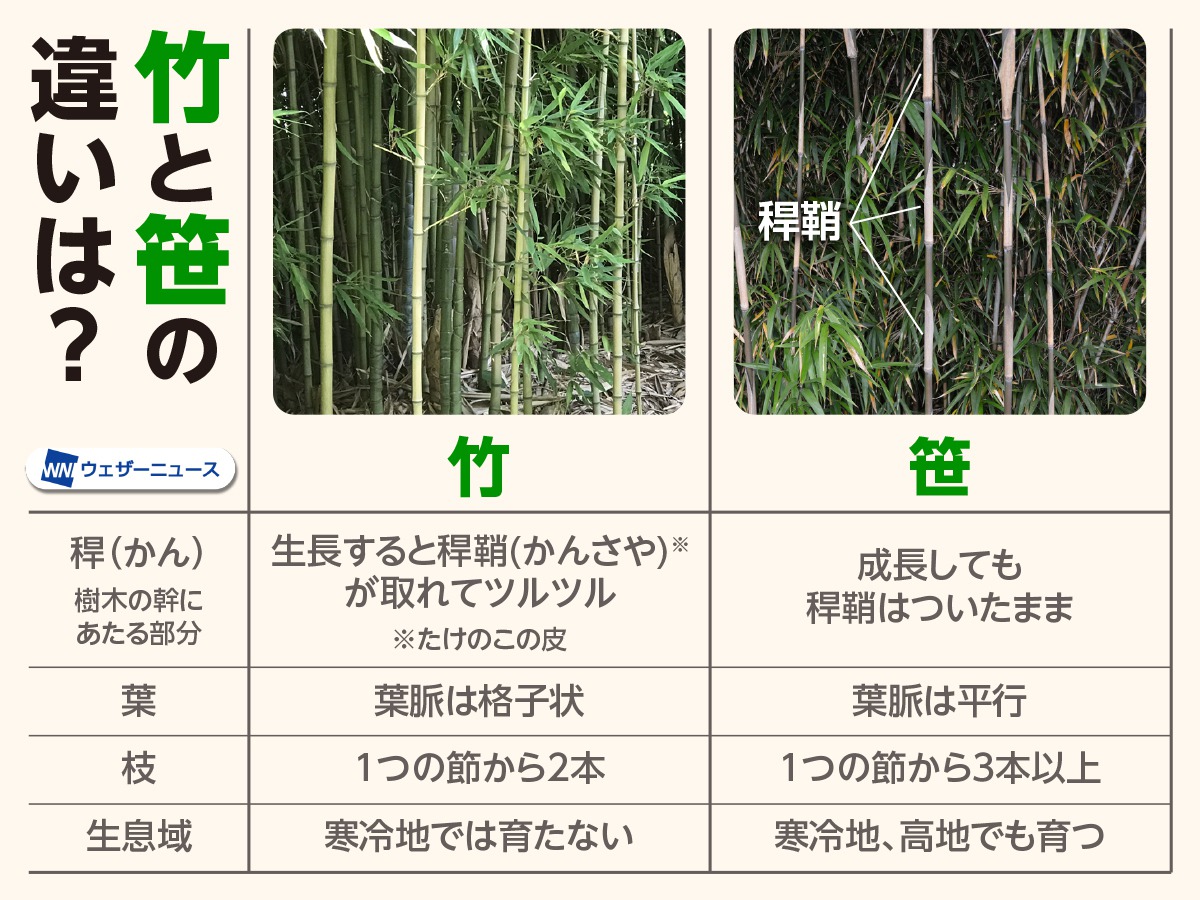
Culms, Sheaths, and Vein Grids: Visual Botanical Proof Separating Bamboo from Sasa
Every July across Japan, millions of handwritten wishes flutter from slender green boughs during Tanabata festivities, yet almost nobody notices whether they are tying paper strips to bamboo or sasa. Most casual observers assume the distinction comes down to scale, that towering stalks belong to bamboo while low-growing foliage is sasa. That assumption collapses under botanical inspection. As reported in an authoritative MSN Report featuring Yoshihiro Yamagishi, fourth-generation president of Yamagishi Bamboo Shop (Taketora), height is one of the least reliable ways to separate the two. Both belong to the Poaceae grass family, but their biological architecture follows distinct rules.
Identifying the plants accurately requires looking past physical height and focusing on cellular growth patterns. The answer rests on three observable anatomical markers: culm sheath shedding, leaf vein patterns, and the branch count emerging from each culm node. Once you understand how these woody grass species form their protective husks and distribute fluids through their leaves, telltale visual clues appear within seconds.
📌 Quick Summary:
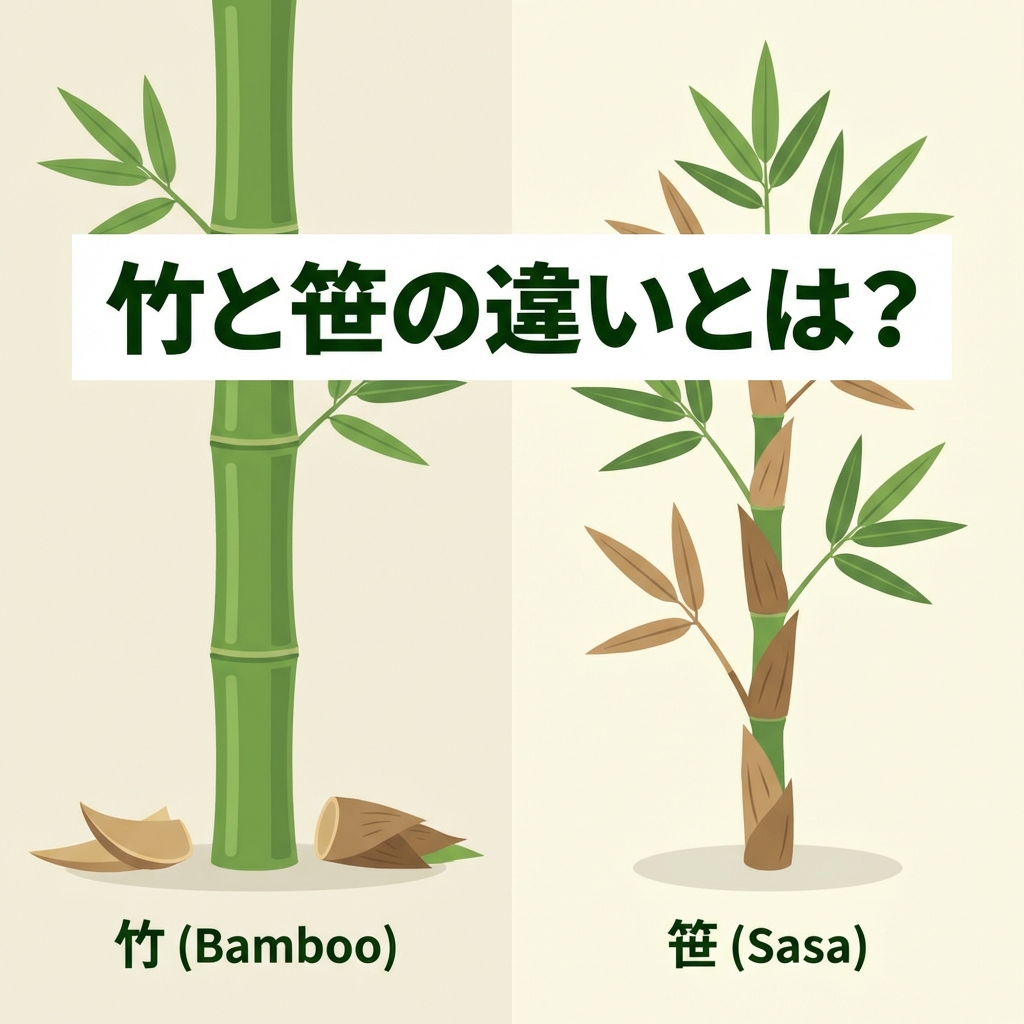
- Core Anatomical Divider: Bamboo sheds its culm sheaths during active spring growth, leaving smooth, bare internodes. Sasa retains persistent culm sheaths that dry into a paper-like covering clinging to the stem.
- Microscopic Leaf Diagnostic: Bamboo leaves exhibit linear, parallel venation, whereas sasa leaves reveal a distinct checkerboard grid known as tessellate venation when held up to the sun.
- Branching Configuration: True bamboo species produce two or more lateral branches at each mature node, while true sasa produces a solitary branch per node.
The Deceptive Metric of Plant Height in East Asian Woody Grasses
Gardeners routinely mislabel dwarf bamboo identification because they equate height with classification. Walk through an old Japanese stroll garden and you will encounter Okamezasa (Shibataea kumasasa), an ornamental hedge rarely exceeding 1 to 1.5 meters in height. Visitors identify it as sasa because of its diminutive stature. Botanically, it is true bamboo. Conversely, Sasa kurilensis (known locally as Nemagaridake) thrives in snowy subalpine zones and sends up thick shoots reaching heights between 2 and 4 meters, dwarfing many small bamboo cultivars.
Yoshihiro Yamagishi points out that relying on height creates constant confusion during seasonal festivals. Traditional Tanabata bamboo traditions originally called for sasa because of its accessibility along rural foothills and its sacred reputation as a purifying vessel. Yet modern displays frequently use whatever running bamboo culms nursery suppliers cut down that week. When the culms sit out under summer sun, real sasa curls its leaves inward within hours to prevent moisture loss, while mature bamboo stems retain their leafy architecture for days longer.
Both groups share aggressive, monopodial rhizomes, underground runners that spread horizontally beneath soil layers before pushing up vertical culms. Because their root architectures operate similarly, landscapers cannot distinguish them by excavating the dirt. The visual clues sit above ground on the culm internodes and the margins of the foliage.
Culm Sheath Shedding: The Primary Physical Diagnostic
The single most reliable indicator separating bamboo from sasa occurs during shoot emergence. As a new bamboo sprout bursts from the soil, it wears protective, layered husks known botanically as culm sheaths (takinoko no kawa). In true bamboo, such as the widespread temperate genus Phyllostachys, these sheaths serve a temporary protective role. As the culm expands upward and cell walls lignify, culm sheath shedding takes place. The husks loosen, dry, and fall away completely to the ground, leaving behind a polished, bare green culm.
Sasa takes an entirely different evolutionary route. It produces persistent culm sheaths that never drop. As the young culm matures, the husks dry out, turn a pale tan or gray, and remain tightly adhered to the culm internodes for the entire life of the shoot. If you run your hand down a mature stalk and feel papery, brittle sheaths wrapped around the base of each segment, you are examining sasa. If the green culm is bare, glossy, and shed its original growth sheaths, it is bamboo.
This shedding mechanic changes how craftsmen treat the materials. Bamboo craftsmen prize the bare internodes of Phyllostachys bambusoides (Madake) for weaving baskets and architectural joinery because the culms dry into a clean, durable exterior. Sasa culms, bundled with their clinging husks, trap moisture along the internodes, making them susceptible to mold if not stripped manually by hand.
Backlit Tessellate Venation and Leaf Grid Diagnostics
When you encounter a cut stem or an isolated leaf without an intact culm, the leaf vein patterns supply definitive proof. Pluck an intact leaf and hold it against direct sunlight or a smartphone flashlight. Look closely at how the secondary veins branch off from the central midrib.
Bamboo foliage features parallel venation characteristic of most standard monocots. The primary and secondary veins run strictly lengthwise from the leaf base to the apex in uninterrupted parallel lines. If you look through a hand lens, cross-veins are barely visible or spaced so widely that the overall pattern looks like smooth cords pulled taut across the leaf surface.
Sasa leaves feature striking tessellate venation. Perpendicular cross-veins bridge the parallel strands at tight, regular intervals, creating an intricate, visible checkerboard grid. This structural mesh allows sasa leaves to maintain structural integrity across harsh mountainous environments. The grid-like structure provides substantial physical rigidity, which explains why sasa foliage is traditionally chosen for wrapping food, such as Niigata’s famous sasa-dango and traditional sushi presentations. The leaf holds its shape without shredding along the grain.
A secondary clue appears during winter dormancy. Many sasa species, notably Sasa veitchii (Kuma-zasa), undergo edge chlorosis as temperatures plunge. The leaf margins turn dry, papery, and strikingly white, creating a variegated border around deep green centers. While true bamboo leaves may curl or drop entirely during harsh freezes, they do not produce this uniform, bleached margin.
Branch Node Count and Structural Internode Mechanics
The skeletal junctions along the culm provide a third diagnostic marker. Every woody grass culm is punctuated by nodes, the raised rings that separate hollow culm internodes. How branches emerge from these nodes differs sharply between the genera.
Examine the node where lateral foliage stems push out from the main culm:
- True Bamboo (Phyllostachys): Produces exactly 2 branches per node of unequal thickness. In tropical or subtropical clumping bamboo genera like Bambusa, nodes may produce three to dozens of clustered branches, but they rarely form a solitary branch.
- Dwarf Bamboo (Sasa): Produces only 1 solitary branch per node. The branch ascends at an acute angle, giving the plant a sparser, more direct outward reach.
- Pleioblastus (Intermediate Bamboo): Produces 3 to 5 branches per node. While commonly sold as decorative groundcover, botanists classify Pleioblastus closer to true bamboos than to true sasa due to its multi-branch habit and shedding husks.
This node architecture directly alters the plant's flexural strength. The dual-branch arrangement of Phyllostachys balances wind resistance across the upper canopy, allowing tall stalks to sway during typhoons without snapping. Sasa, with its single-branch geometry, stays low to the forest floor, relying on ground-level flexibility beneath heavy winter snowpacks.
Visual Diagnostic Matrix: Bamboo vs. Sasa
Differentiating these woody grass species in the field comes down to a systematic check of four botanical traits. The following table highlights the exact mechanical and structural differences observed across mature specimens.
| Botanical Marker | True Bamboo (Phyllostachys & Allies) | Sasa (True Dwarf Bamboo) |
|---|---|---|
| Culm Sheath Retention | Deciduous: Sheaths dry and fall off as shoots expand, leaving clean stalks. | Persistent: Sheaths cling tightly to the culm, drying into a gray papery sheath. |
| Leaf Venation Pattern | Parallel: Long parallel veins running from base to tip without visible cross-grids. | Tessellate: Grid or checkerboard venation visible when held to backlighting. |
| Branch Node Count | 2 branches per node in temperate Phyllostachys; 3+ in clumping species. | 1 single branch per node emerging at an acute angle. |
| Typical Stem Diameter | Broad: 20, 120 mm in timber varieties (e.g., Mosochiku, Madake). | Slender: 2, 15 mm, rarely exceeding thumb thickness even in montane forms. |
| Winter Foliage Response | Uniform green or general yellowing/leaf curl during freezing conditions. | Margins desiccate into prominent white, paper-like borders (kuma-dori). |
Cultural Selection: Food Preservation and Craft Traditions
Japan’s material history split bamboo and sasa along functional lines dictated by their biology. Traditional artisans never treated them as interchangeable commodities. Bamboo supplied tensile strength for load-bearing items: scaffolding, sweeping brooms, umbrella ribs, and tea whisks (chasen). The bare culm of Madake splits cleanly down its vertical grain with predictability, allowing craftsmen to shave fibers down to hair-thin dimensions.
Sasa filled a biochemical niche. The leaves contain high concentrations of organic acids, including benzoic acid and volatile chlorophyll derivatives, which suppress bacterial growth. For centuries before commercial refrigeration, mountain travelers and merchants wrapped perishable rice balls and raw fish directly in broad sasa leaves. The iconic masuzushi (trout sushi) of Toyama relies on sasa lining wooden round boxes to impart a crisp herbal scent while inhibiting food spoilage.
During Tanabata preparations, the choice between the two changes the display's longevity. Sasa was historically gathered from nearby hillsides the morning of the festival because its dense foliage accommodated hundreds of paper wishes. However, cut sasa transpires water rapidly; within 12 to 24 hours out of water, the leaf edges curl into tight needles. When public shrines and city squares erect festival decorations intended to stand for a week, coordinators source mature bamboo branches, which withstand direct sunlight far longer before desiccating.
Frequently Asked Questions (FAQ)
Q1: Can you tell bamboo from sasa simply by looking at the thickness of the shoot?
A1: No. While timber bamboo like Phyllostachys edulis produces massive shoots, smaller bamboo species like Okamezasa produce shoots narrower than a pencil. Conversely, subalpine sasa shoots like Nemagaridake can be thicker than many cultivated bamboo varieties. You must check whether the sheath falls off or remains attached.
Q2: Why do sasa leaves curl up so quickly compared to bamboo when cut?
A2: Sasa has a thinner protective cuticle layer on its leaf surface and a high surface-area-to-mass ratio. Under direct sun or dry indoor air, the plant rapidly loses internal moisture through transpiration, causing its tessellate grid to fold inward into needle-like cylinders to conserve water.
Q3: Are bamboo shoots and sasa shoots both safe to eat?
A3: Yes, the emerging shoots of both plants are edible, but preparation varies. Bamboo shoots (takenoko) from large varieties contain high concentrations of homogentisic and oxalic acids, requiring boiling with rice bran (nuka) to strip bitterness. Sasa shoots, particularly Nemagaridake, contain far fewer bitter compounds and can be roasted or grilled directly over open coals with minimal processing.
Applying Botanical Markers in Field Identification
Distinguishing bamboo from sasa does not require lab equipment or genetic sequencing. The next time you walk past an ornamental border, cut a branch for a midsummer festival, or select plants for a landscape project, ignore height entirely. Look at the lower half of the culm internodes to see if dried papery sheaths remain attached. Pluck a single leaf and inspect it against the sunlight for the telltale checkerboard grid of tessellate venation. Count the secondary branches springing from the nodes.
These visible markers clarify an old botanical puzzle. By relying on sheath retention, leaf venation, and nodal branching, anyone can make a definitive identification within seconds.
