Elecom Unveils Key Paletto Stickers as Musical Typing Goes Mainstream
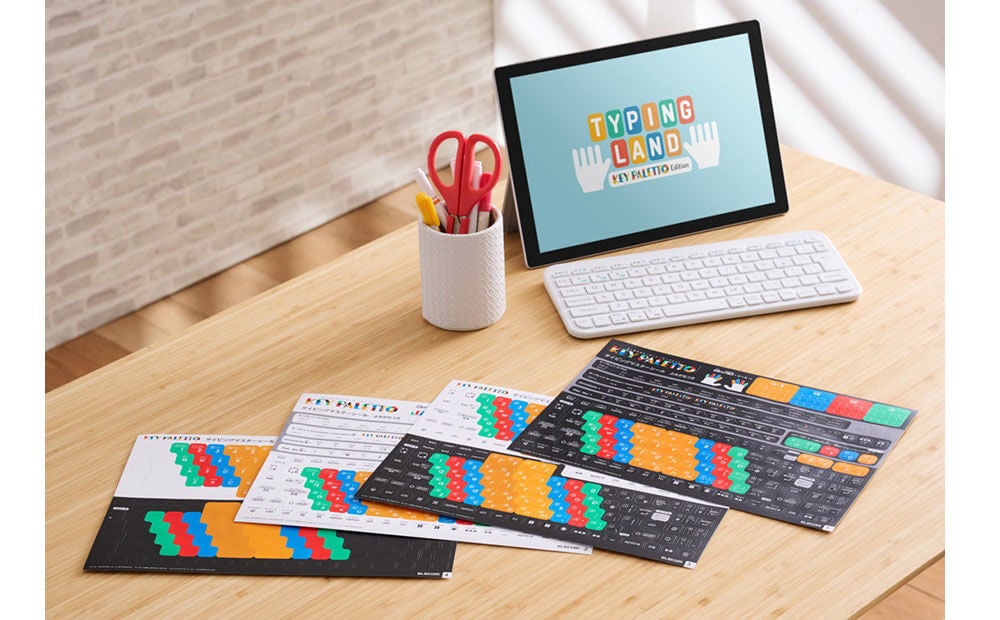
Rhythm typing has crossed from niche web subculture into mainstream computer education. Millions of students and desktop enthusiasts now practice keystrokes to high-tempo pop tracks, turning mechanical speed runs into synchronized audio-visual play. Capitalizing on this momentum, Osaka-based hardware manufacturer Elecom announced a dedicated rollout of its KEY PALETTO keyboard sticker guides, designed to turn standard laptop keys into color-coded instructional hubs. As detailed in the official PR TIMES Report, the company, led by President and CEO Koichi Iwami, scheduled the release for late April to address a persistent hurdle in modern computing: building tactile muscle memory without forcing users to glance down at their hands.
📌 Key Takeaways:
- Hardware Rollout: Elecom expands its KEY PALETTO line with specialized, residue-free keyboard sticker guides engineered for both standalone desktop boards and compact laptop keyboards.
- Methodological Shift: The launch aligns with the global rise of gamified typing practice, where learners use rhythm typing games and song-synced platforms to build speed.
- Classroom Reality: Elementary keyboard education programs face significant touch-typing deficits in students raised on touchscreens, prompting a surge in color-coded touch typing tools.
The Cultural Phenomenon of Typing to the Beat
Practicing keystrokes against a metronome or backing track is not entirely new, but streaming platforms and browser-based rhythm typing games have fundamentally reshaped the practice. The trend known across Japanese web communities as "曲 に 合わせ て タイピング", typing directly to the rhythm of popular music, has accumulated tens of millions of views across video platforms. Rather than transcribing dry paragraphs from a textbook, users sync their input to vocal lines and drum fills on community hubs like Typing Tube and Ankey. The pace demands intense focus. Missing a consonant disrupts the lyrical flow, providing instantaneous auditory feedback that sterile software tests fail to replicate.
The practice turns rote memorization into sensory immersion. High-BPM tracks push users past normal cognitive bottlenecks. Instead of processing individual letters, fingers begin executing entire syllable clusters as unified muscle movements. Speed enthusiasts report breaking plateaus that had stalled their progress for months. Yet, this high-speed environment penalizes poor habits. Hunt-and-peck typists who look back and forth between screen and keys quickly fall behind the beat, hitting an impassable barrier when songs exceed 130 BPM.
Inside Elecom’s Color-Coded Hardware Intervention
Elecom designed the KEY PALETTO typing master stickers to solve that exact visual dependency. Rather than requiring families or school districts to purchase expensive specialized keyboards, the company developed high-durability laptop keyboard decals that apply directly over existing keys. The design uses discrete pastel palettes to map the operational zone of each individual finger, anchoring the user's hands cleanly on the home row finger placement markers without visual clutter.
The system assigns distinct, non-distracting colors to each column of keys. The index fingers handle the central columns, while outer fingers manage modifying keys and punctuation. By mirroring the visual zones displayed in modern gamified typing software, the physical stickers eliminate the cognitive lag between seeing an on-screen prompt and placing a finger on the hardware. Elecom selected low-tack, high-durability adhesive materials, ensuring the decals peel off without sticky residue once a learner masters the physical layout.
Rhythm Gaming Meets Ergonomics: A Methodological Comparison
The convergence of audio pacing and tactile guidance marks a clean departure from legacy PC literacy tools. Previous educational approaches relied heavily on repetitive transcription drills, which suffered from high drop-off rates among younger students. Integrating musical timing with structured physical cues reshapes how quickly learners reach basic entry-level competence.
| Instructional Method | Visual Guidance Mechanism | Target Benchmark | Typical Practice Retention |
|---|---|---|---|
| Legacy Transcription Drills | Textbook diagrams / On-screen virtual hands | Raw accuracy on static text blocks | Low (steep drop-off after 2, 3 weeks) |
| Unguided Rhythm Typing | Lyric scrolling / Falling note streams | Song completion at target BPM | Moderate (high enthusiasm, frequent finger errors) |
| Color-Guided Musical Practice | Physical key decals matched to rhythm prompts | Fluid touch typing at 120+ BPM / 40+ WPM | High (reinforced through multi-sensory feedback) |
Solving the Post-Tablet Keyboard Literacy Deficit
The timing of this release highlights an escalating tension in elementary keyboard education. Over the past five years, public schools across Japan, North America, and Europe distributed millions of tablets and touchscreen laptops under digital modernization programs. While primary school students display advanced fluency with swipe navigation and touch keyboards, secondary educators report a sharp decline in physical typing competence. Many students arrive in middle school executing search queries exclusively with their index fingers.
Two-finger pecking creates an ergonomic ceiling. It limits input speeds to roughly 20 to 25 words per minute and causes significant neck strain as users drop their chins toward the keyboard deck. When schools transition students to standardized digital essays or coding exercises, slow typing speeds strangle academic output. Physical aids like KEY PALETTO operate as low-friction training wheels, allowing institutions to retrofit existing hardware inventories without buying replacement machines.
From Keystroke Cadence to WPM Speed Training
Beyond elementary classrooms, rhythm-based methods have gained traction within adult WPM speed training circles. Speed-typing forums and competitive typing leaderboards increasingly emphasize stroke cadence over raw burst speeds. Erratic typists often rush through simple words only to stall abruptly on complex letter patterns, a stop-and-go habit that degrades accuracy and exhausts hand tendons.
Practicing against structured drum tracks trains the nervous system to maintain an even interval between strokes. When paired with muscle memory keyboarding guides, typists eliminate hesitation pauses on lesser-used keys like Q, Z, and P. Community speed trials show that typists maintaining an unbroken tempo achieve superior overall throughput compared to erratic sprinters. By combining hardware-level spatial orientation with rhythm-based web software, users systematically rewire their finger mechanics.
Frequently Asked Questions (FAQ)
Q1: Do KEY PALETTO stickers leave adhesive marks when removed?
A1: Elecom engineered the stickers with a low-tack, residue-resistant backing designed specifically for smooth laptop keycaps and ABS desktop keys. They peel away cleanly without leaving adhesive residue or stripping standard printed key legends.
Q2: How does typing to music improve real-world words per minute?
A2: Typing to a steady rhythm trains users to eliminate variable pauses between keystrokes. By matching input to consistent musical tempos, typists smooth out their input cadence, which elevates accuracy and raises baseline speed across varied vocabularies.
Q3: Are these keyboard sticker guides compatible with both ANSI and JIS layouts?
A3: The stickers are tailored around Japanese JIS key arrangements commonly found across domestic hardware, but the primary alphanumeric and home-row decals transfer cleanly to standard US ANSI keyboards due to shared keycap dimensions across letter rows.
The Next Wave of Physical-Digital Literacy Tools
The broader push toward interactive, gamified typing signals an important shift in how fundamental computing skills are taught. For years, basic keyboarding was treated as an afterthought, eclipsed by tablets and voice interfaces. The reality of modern software development, academic writing, and office production shows that typing fluency remains indispensable. Physical modifications like Elecom’s decal series acknowledge that learning physical skills requires tangible, spatial guidance. Blending tactile hardware adjustments with song-driven digital pacing provides learners with a direct, engaging path to typing fluency.
