Fact Check: Does Your Driver's License Secretly Track Your Exam Failure Margin?
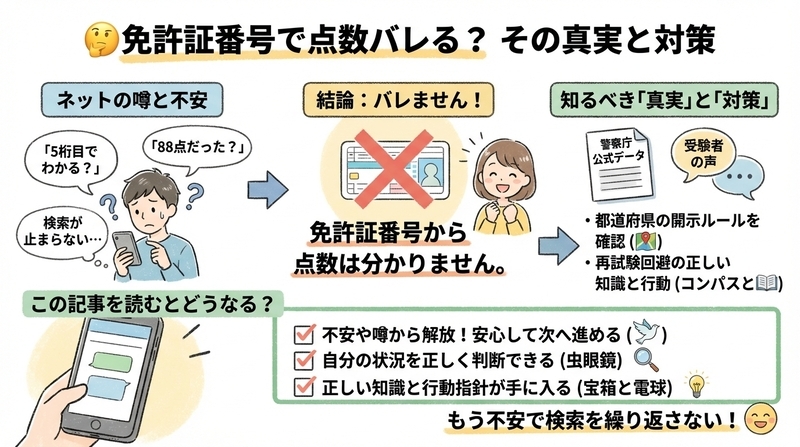
Social media forums have buzzed for years with a persistent claim: the string of digits printed across your driver's license quietly flags your driving competence, encoding your written test score or the exact number of times you failed the road exam. Drivers anxious to know their official testing marks often stumble across these urban legends when searching for a way to verify their driver's license exam results. Public agencies have repeatedly pushed back against algorithmic surveillance and record-keeping conspiracies; as detailed in a recent hometownnewsnow.com Report covering bureau pushback against automated vehicle monitoring rumors, state motor vehicle administrations frequently find themselves untangling viral fiction from regulatory reality.
The reality behind driver licensing records is mundane, technical, and heavily governed by state and national privacy statutes. State motor vehicle agencies assign license numbers using strictly administrative formulas designed for identity verification, collision tracking, and anti-fraud deduplication. Police officers running your plates on roadside terminals do not see a hidden failure counter embedded in your card serial, nor does the Department of Motor Vehicles broadcast your written test margin to insurance carriers through a secret sequence.
📌 Key Takeaways:
- The Core Finding: Driver's license numbers rely on jurisdictional checksums, Soundex demographic hashes, or random generation, carrying zero indicators of your written test score or failure margin.
- The Myth Origin: Viral rumors trace back to misinterpretations of reissuance counters on Japanese licenses and old administrative overflow digits in early American DMV databases.
- Legitimate Verification: Drivers seeking their exact test scores must file a formal motor vehicle record request or review their original road test scoring sheet before physical records archive.
How Driver License Numbering Systems Actually Work
Cardholder numbers follow rigid statutory formats developed decades before modern internet gossip existed. In states like Washington, Florida, and Illinois, agencies historically implemented variations of the Soundex indexing system. This algorithm converts an applicant's legal surname, first initial, middle initial, and birth year into an alphanumeric string. Florida, for example, encodes the applicant's birth month and day through a mathematical formula that adjusts for gender markers.
Other jurisdictions rely entirely on sequential, randomized identifiers managed by centralized database mainframes. When an agency assigns a nine-digit number, that sequence serves as a primary key tying the individual to their motor vehicle record request files, title registrations, and judicial suspension notices. Modern American Association of Motor Vehicle Administrators (AAMVA) standards establish universal specifications for barcode formats, magnetic stripes, and security chips. These specifications mandate uniform storage for identity verification data: legal name, residential address, physical traits, organ donor status, and issuance dates. Test percentages, points docked for parallel parking errors, and missed multiple-choice questions never enter the card's production sequence.
The Anatomy of the Viral "Failure Digit" Myth
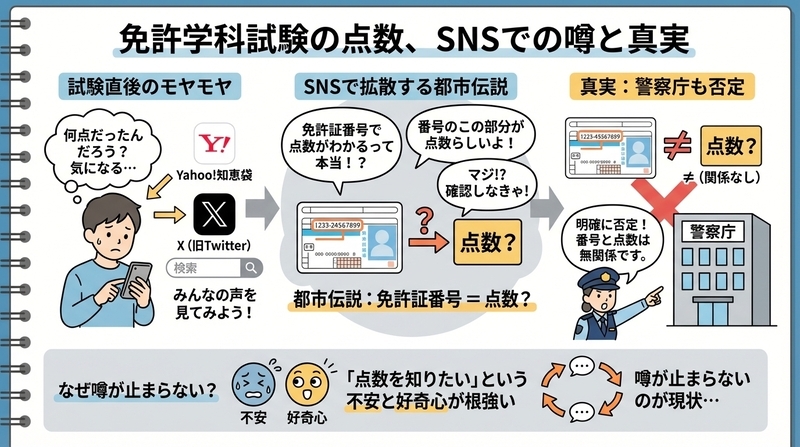
The belief that license numbers leak test scores is an international rumor that mutates across borders. In Japan, drivers frequently search for ways to check their testing marks under the impression that the final digit of the National Public Safety Commission's 12-digit license number tracks how many times they failed the written exam. Official National Police Agency coding manuals show that the final digit is merely a standard mathematical check digit (Luhn-style verification algorithm) used to prevent input errors, while the second-to-last digit tracks the number of times a card has been reissued due to loss or theft.
In the United States, variations of this myth claim that state troopers read the last two digits of a license to see if a motorist passed by the skin of their teeth. Similar rumors have surfaced around retail parking lots and municipal traffic monitors; Snopes addressed parallel panics in late 2026 regarding license-plate readers deployed at commercial centers, separating automated license surveillance reality from internet panic. Administrative clerks do not penalize drivers on the physical plastic for needing multiple attempts to clear the road circuit. Once an applicant satisfies passing score requirements, the testing system records a binary outcome: pass or fail.
Exam Records vs. Physical Plastic: What Databases Actually Retain
State driver testing agency records maintain a sharp technical separation between initial licensing qualification logs and ongoing driving records. The scoring tally sheet compiled by an examiner during a road test records minor infractions, speed variances, and lane position deductions. That physical or tablet-based road test scoring sheet remains part of an internal intake file during the provisional period, but it does not merge into the publicly accessible driver transcript.
| Record Category | Data Points Tracked | Third-Party Accessibility |
|---|---|---|
| Physical Driver's License | Document discriminator, checksum, real ID compliance flag, facial profile vector | Visible on card face; machine-readable via AAMVA barcode |
| Official Driving Transcript | Active convictions, moving violations, administrative suspensions, revocations | Insurers, employers, law enforcement via certified state portal |
| Initial Examination Log | Raw computer exam score, road test scoring sheet, examiner badge number | Restricted internal archive; purged after statutory retention window (1, 5 years) |
Insurance underwriting algorithms scrutinize moving violations, at-fault accidents, and license tenure. They do not request or receive exam point totals. An individual who passed the knowledge test with a 100% score pays the identical baseline rate as someone who cleared the 80% passing threshold on their fourth attempt, provided both drivers hold clear safety profiles.
How to Conduct a Legitimate Driver Licensing Score Inquiry
Drivers looking to confirm their historical testing marks must navigate formal administrative channels rather than looking for hidden codes on driver's license credentials. Most state DMV exam verification systems operate on immediate-feedback software: applicants receive a printed completion receipt the moment they finish terminal testing. If you misplaced that receipt and wish to view your specific testing marks, procedures vary by jurisdiction.
A standard DMV written test score lookup is rarely available through an automated public web search. Because state portals treat testing failures and exam points as internal administrative files, accessing them typically requires submitting an open records or privacy act request directly to the regional licensing headquarters. When submitting a driver licensing score inquiry, applicants supply their social security number, full legal name, and the specific testing date. Be advised that many state branches purge raw written exam scores within 12 to 36 months after issuing a full license, retaining only the permanent pass certification status.
Why Public Agencies Keep Passing Scores Binary
State agencies enforce passing score requirements as absolute safety thresholds. If a state sets the bar at 80%, achieving an 82% carries the identical legal authority as achieving a 98%. Bureaucratic architecture intentionally treats this benchmark as binary. Recording degrees of competence on permanent cards would invite legal chaos, exposing licensing boards to civil liability and arbitrary administrative discrimination.
The rumor mill thrives on the assumption that government databases maintain elaborate, punitive classifications against citizens. Government agencies regularly find themselves addressing public anxieties fueled by online message boards; in early 2025, VA Secretary Doug Collins addressed Veterans benefits rumors through public broadcasts to correct similar distortions regarding agency record handling. The administrative truth is that agencies prioritize automated efficiency. Generating complex, personalized codes to brand drivers based on test margins would require software engineering resources that no state budget justifies, especially when traffic citations and moving violations already serve that supervisory role.
Frequently Asked Questions (FAQ)
Q1: Can an employer or insurer see how many times I failed the driving exam?
A1: No. Certified copies of your public records driving history list active licenses, moving violations, suspensions, and commercial endorsements. Internal attempts to pass written or practical driving exams remain sealed in testing archives and do not appear on employment or underwriting background checks.
Q2: What do the extra small numbers printed near my license photo mean?
A2: These small numbers represent document discriminators (DD). They track the physical card's specific print run, branch office location, and inventory batch. If a license is replaced or updated, the document discriminator changes while your core license number stays the same.
Q3: How can I obtain a physical copy of my road test scoring sheet?
A3: You can generally request your scoring sheet at the testing station immediately following your practical evaluation. If you want a historical copy, you must contact your state driver testing agency records division and file a formal driver licensing record request within your state's document retention window.
Navigating Licensing Records With Factual Clarity
Searching for hidden patterns on physical credentials reflects widespread curiosity about how public records driving history systems operate behind closed doors. Driver licensing numbers fulfill one operational requirement: linking an individual to an administrative file with mathematical certainty. They do not conceal secret ratings, track road evaluation mistakes, or reveal test point deductions.
Motorists wanting to inspect their credentials should bypass viral decoder guides and order an official driving transcript directly through their state bureau portal. Understanding the distinction between internal licensing intake files and public records protects drivers from persistent folklore while providing an accurate view of the state files that actually govern their time on the road.
