Fact-Checking Japan's 2026 Away Jersey: Separating Official Releases from Online Concepts
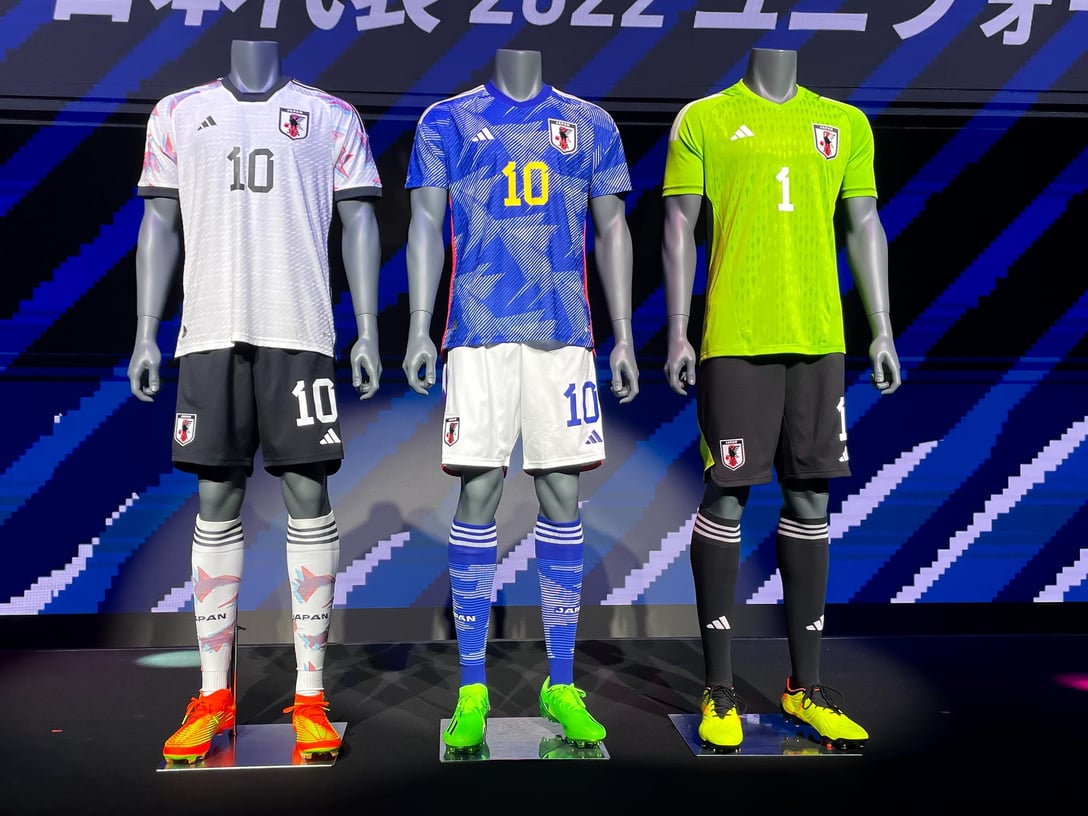
Every major international tournament cycle triggers an avalanche of speculative jersey renders across social media, and the lead-up to the 2026 tournament in North America pushed that cycle into overdrive. Mockups featuring intricate ukiyo-e woodblock waves, neon-drenched cyberpunk skylines, and full-panel manga illustrations collected tens of millions of views on TikTok and X. Thousands of supporters treated these digital mockups as genuine previews of what Hajime Moriyasu's squad would wear. Yet the reality of international soccer apparel is governed by strict governing-body rulebooks, manufacturing cycles, and functional athletic demands. The squad's evolving roster, highlighted during competitive preparation windows monitored in a Yahoo Sports Report tracking talent like goalkeeper Zion Suzuki, requires matchwear engineered for elite performance rather than algorithmic engagement.
The curtain lifted definitively on March 20, 2026, when official catalog previews and verified imagery confirmed the real Japan 2026 World Cup away kit. Separating the verified Adidas Japan national team jersey from months of internet fabrications clarifies how modern federation kits move from design labs to the pitch.
📌 Quick Summary:
- Official Reveal: Industry monitors and retail documentation confirmed the genuine Samurai Blue away uniform following an official release window in late March 2026.
- Myth Dismissal: Viral renders covered in dense anime graphics or black-and-gold dragons were unauthorized digital art projects that directly violate FIFA kit regulations.
- Technical Reality: The official design prioritizes lightweight breathability and minimalist contrast, balancing national symbolism with elite competition standards.
How Social Media Concept Renders Distorted Fan Expectations
The explosion of accessible 3D modeling tools and generative image platforms created an unprecedented marketplace for fictional sportswear. Throughout late 2024 and 2025, independent digital artists routinely stamped legitimate federation badges and manufacturer logos onto unauthorized digital apparel. These creators pursued social engagement rather than retail feasibility. Fans eager for an avant-garde Samurai Blue away uniform shared these images without verifying their lineage.
One particular concept gained massive traction: an off-white shirt wrapped in dramatic charcoal brushstrokes reminiscent of classical ink wash paintings, accented with iridescent crimson numbering. Another viral variant imagined a pitch-black foundation flooded with electric-pink cherry blossom branches. Both concepts looked stunning on phone screens. Neither possessed any link to the Japan Football Association official merchandise pipeline. Independent designers do not have to account for dye-sublimation factory tolerances, global distribution logistics, or sweat-wicking textile elasticity. The viral phenomenon established an artificial standard of ornamental complexity that official retail apparel was never intended to replicate.
FIFA Regulations and the Boundaries of Federation Design
Behind every kit produced for international competition sits the FIFA Equipment Regulations manual, a dense document that immediately disqualifies 95% of social media concept art. Under FIFA's uniform guidelines, each competing team must possess two distinct kits: one predominantly dark and one predominantly light. This requirement guarantees clear visual contrast for match officials, spectators in cavernous stadiums, and broadcast cameras.
The regulations impose severe constraints on decorative graphics. Pattern work must remain tonal or non-dominant across the torso so that front and back squad numbers remain immediately legible at high velocity. Full-bleed illustrations across the midriff, high-contrast character art, and chaotic sleeve gradients are strictly barred from sanctioned match play. When Adidas set out to balance innovation and national pride across all FIFA World Cup 2026 jerseys, corporate designers worked within these precise guardrails. A tournament away shirt must serve first as high-visibility tactical equipment and second as a cultural canvas.
Verifying the Official Timeline: From First Rumor to Pitch Debut
The pipeline for international match apparel operates on an eighteen-month manufacturing calendar. While fans debated fake concepts online during mid-2025, production facilities in Southeast Asia were already finalizing yarn specs and heat-seal matrices based on pre-approved JFA style guides.
| Phase | Online Concept Narrative | Verified Official Record |
|---|---|---|
| Mid, Late 2025 | Viral posts claim "leaked JFA designs" featuring neon trim and full-chest manga collages. | Adidas internal teams finalize global federation blueprints adhering to FIFA gear parameters. |
| Early 2026 | Social accounts claim production delays due to radical design overhauls. | Catalog codes surface inside distribution networks; preliminary color palettes get cataloged. |
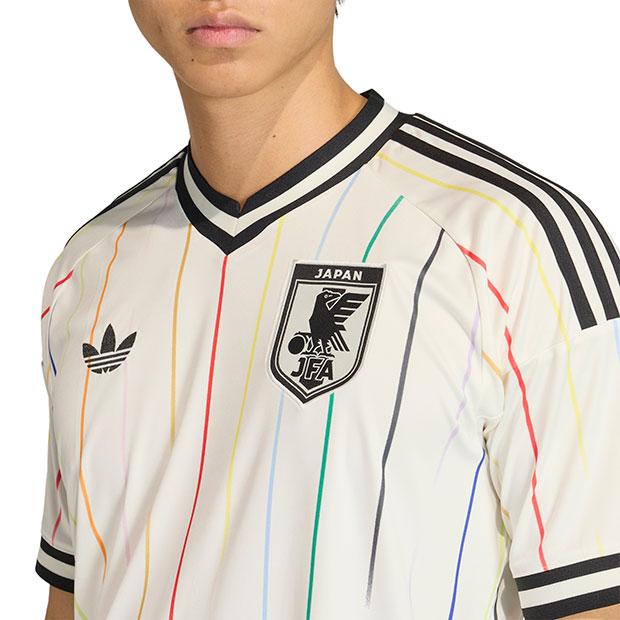
| March 20, 2026 | Disinformation accounts insist alternative "fan editions" will feature the viral art. | Footy Headlines confirms the release; official imagery confirms an off-white base with geometric structural trims. |
The official national team kit launch date aligned with the global retail cycle. This synchronization ensured authentic stock reached international flagship doors well ahead of pre-tournament friendlies and final squad announcements.
Engineering the Thread: Authentic vs Replica Specifications
Once genuine merchandise reaches distribution, supporters face a practical distinction that rarely translates into internet rumors: the technical gap between authentic match-issue gear and commercial replica editions. The match-grade shirt is built purely for elite athletes competing in high-humidity summer climates.
The authentic kit relies on Adidas HEAT.RDY textile engineering. This fabric uses open-mesh, body-mapped jacquard weaving that feels gossamer-thin, weighing roughly 120 grams. The team crest and iconic Three Stripes are precision heat-transferred using ultra-thin synthetic rubber films to shave weight and eliminate friction against skin during ninety minutes of sprinting. At retail, these competition-spec units carry a premium price tag near $150.
The commercial replica model, priced around $100, addresses daily wearability. Manufactured from structured AEROREADY polyester, this version weighs roughly 170 grams and offers looser, relaxed tailoring through the shoulders and torso. The JFA crest and performance logos on the replica are densely embroidered with polyester thread, boosting durability across dozens of domestic washing cycles. Spotting the difference between these builds protects buyers from deceptive third-party vendors who charge match-grade prices for budget garments.
The Evolution of Japan’s Alternate Colors Across Squads
Japan’s alternate palette holds a unique standing in international soccer. Unlike traditional powerhouses bound to national flags, the JFA has routinely experimented with secondary colors. White remains the historical anchor for away gear, but specific cycles have introduced striking diversions.
Consider the Nadeshiko Japan away uniform unveiled in March 2023. Dubbed "SUNRISE," that design broke ranks by blending gentle lilac-pink hues and pastel gradients inspired by morning skies over Mount Fuji. It earned widespread critical praise for forging an independent aesthetic identity for the women's national team. Conversely, the men’s alternate kits across 2014 and 2018 cycled through electric neon yellow and subtle light-grey origami folds.
The Japan soccer jersey colorway for 2026 returns to clarity. Grounded on an off-white foundation, the design integrates subtle geometric accents along the side panels and lower collar that reference the angular feathers of the Yatagarasu, the mythic three-legged crow sitting at the heart of the national crest. The result is calculated and understated. It honors cultural heritage while keeping visual noise minimal, ensuring high visibility during high-stakes group play.
Frequently Asked Questions (FAQ)
Q1: Why do online concept jerseys often look more creative than the official kits?
Independent digital designers face zero manufacturing constraints, regulatory limits, or cost ceilings. They create digital art designed to grab attention on social feeds. Official manufacturers must produce millions of units that survive rigorous athletic movement, adhere to strict FIFA visibility rules, and maintain consistent retail production standards.
Q2: How can I identify genuine Japan Football Association official merchandise?
Authentic garments feature serial-coded internal care labels, heat-sealed brand tags with verifiable production numbers, and holographic JFA licensing tags on the hangtag. Check the team badge: authentic shirts use heat-sealed silicone-poly badges with smooth edges, while replicas feature dense embroidery. Unlicensed bootlegs often feature sloppy stitching and generic care codes.
Q3: Will the Samurai Blue wear the official away jersey during every away fixture?
No. Kit selection is determined match-by-match by match directors to maximize contrast against opponents. If the host nation wears light colors, Japan wears its primary dark blue kit even when playing on foreign soil. The secondary kit is deployed only when the primary blue clashes with the opponent's home shirt.
Navigating the Global Kit Marketplace
The gap between digital concept hype and genuine federation gear highlights how modern kit culture works. Viral 3D renders can ignite fan excitement, but they operate entirely outside the regulatory frameworks that govern professional soccer. The genuine Japan away kit for 2026 reflects meticulous design work tailored for world-class performance under brutal summer conditions.
Supporters hunting for legitimate jerseys should avoid third-party drop-shipping websites that advertise viral concept designs as "special edition" merchandise. Those listings sell unlicensed, poorly printed garments that will never step onto a professional pitch. By tracking verified distributor SKU updates and relying on authorized JFA retail channels, fans can wear the genuine design that Japan's elite players will represent on the world stage.
