Fact-Checking 'U.N. Owen Was Her?': From Agatha Christie Lore to Viral Piano & Lyric Adaptations
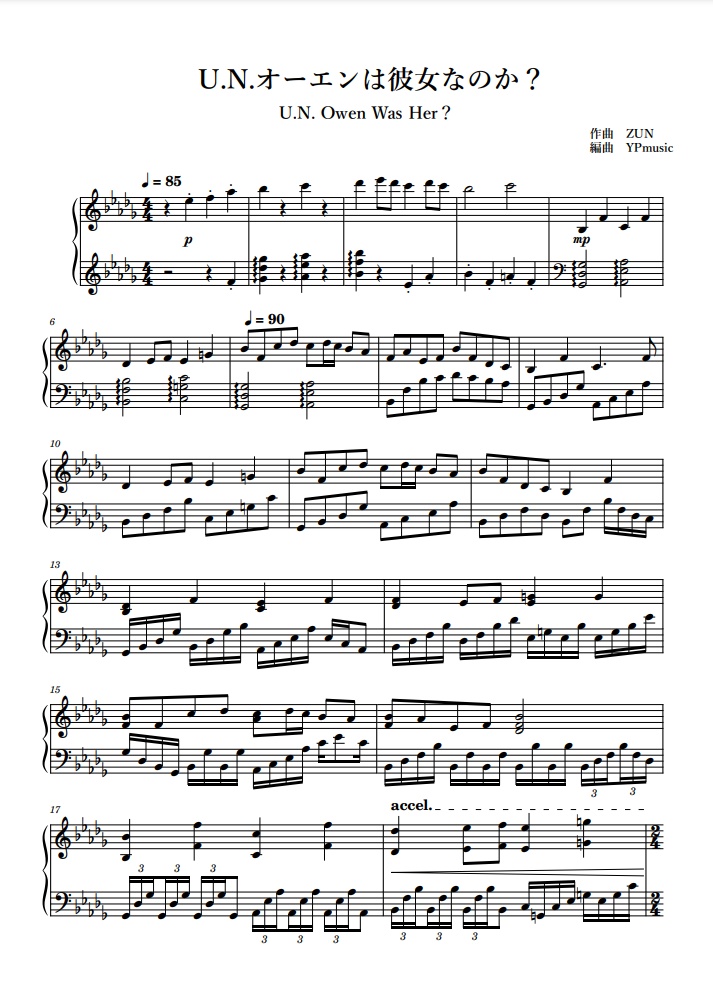
More than two decades after its 2002 debut on PC-98 successor hardware, a singular instrumental theme continues to dominate algorithmic feeds, piano practice rooms, and virtuoso recital halls across the globe. As documented in a recent viral showcase detailed by a YouTube Report covering high-level performances of "U.N.オーエンは彼女なのか?" (U.N. Owen Was Her?), musicians are still testing their physical endurance against its relentless tempo. What began as a synthesized MIDI loop for an elusive game boss has transformed into one of the most recognizable piano pieces in modern digital culture.
The composition sits at the crossroads of literary mystery, bullet-hell game design, and extreme keyboard technique. Yet widespread exposure through online remix culture has obscured its origins. Rumors often confuse its relationship to western literature, dispute its harmonic foundations, and misattribute its famous vocal spin-offs. Sorting fact from internet folklore requires examining how an eccentric indie developer created a piece that defies traditional keyboard scoring.
📌 Key Takeaways:
- Literary Cipher: The title directly references Agatha Christie's 1939 masterpiece And Then There Were None, where "U.N. Owen" functions as an anagrammatic phonetic pun for "Unknown."
- Acoustic Realities: Composed entirely on MIDI synthesizers without human physical constraints in mind, the piece forces acoustic pianists to manage polyrhythmic leaps and sustained 200-BPM arpeggios.
- The Derivative Boom: From the early virtuoso transcriptions by Marisyllis to modern Oricon-tracked vocal releases, doujin fan culture turned a 3-minute video game loop into a sprawling musical ecosystem.
Agatha Christie, Mystery Ciphers, and Flandre Scarlet’s True Identity
The curious phrasing of "U.N. Owen Was Her?" stems from classic golden-age detective fiction rather than gaming jargon. In Agatha Christie's landmark 1939 novel And Then There Were None, an unseen killer lures ten guests to an isolated island under invitations signed by "Ulick Norman Owen" and "Una Nancy Owen." The novel's characters eventually crack the phonetic wordplay: "U.N. Owen" sounds identical to "Unknown."
Independent developer Jun'ya Ota, universally known by his pen name ZUN, lifted this specific literary motif when crafting the climax of The Embodiment of Scarlet Devil in August 2002. The game stands as the foundational Windows installment of the long-running Touhou Project franchise. Players who defeat the main storyline unlock the punishing Extra Stage, descending into the sunless basement of the Scarlet Devil Mansion. There awaits Flandre Scarlet, a vampire shut away for nearly 500 years with the terrifying power to destroy anything simply by clenching her fist.
ZUN's grammatical puzzle in the title, phrased as a contemplative question, frames Flandre as the missing, unknowable presence. She represents the unseen architect of chaos, mirroring Christie’s murderous recluse. The track was composed explicitly to underline her mental instability, swinging erratically between playful innocence and apocalyptic violence.
Deconstructing ZUN’s Compositional Engine: Jazz Cadences Meets Boss-Fight Frenzy
ZUN did not compose the theme at a grand piano. He programmed it within MIDI sequencers, monitoring through a legendary Roland Sound Canvas SC-8850 sound module. This digital-first origin explains why the piece breaks several conventions of physical piano writing. MIDI instruments do not require breathing room, hand relocation, or physical finger substitution.
Musically, the composition leans into frantic syncopation, frantic chromaticism, and abrupt key modulations. Written in a brisk compound rhythm hovering between 190 and 205 BPM, the piece centers on a hypnotic minor melody accented by sharp, trill-heavy upper-register flourishes. Unlike typical cinematic scores that rely on sweeping sustained chords, ZUN deployed dense ostinatos, aggressive bass lines, and layered, brass-like synth leads.
The track relies on a relentless 4/4 meter that constantly displaces downbeats. For a game player evading curtains of lethal red projectiles, the off-beat accents create auditory disorientation. For a classical pianist, those exact shifts turn the piece into an obstacle course of rapid wrist rotation, octave shifts, and lightning-fast staccato control.
From Sheet Music to Black MIDI: The Evolution of Touhou Piano Adaptations
The transformation of "U.N. Owen Was Her?" from a background audio file into a celebrated piano benchmark followed a distinct digital trajectory. In the mid-2000s, arrangers in Japan's doujin communities began transcribing ZUN's digital output onto traditional stave notation. Arranger Marisyllis became a pivotal figure, publishing an ultra-demanding acoustic arrangement that demanded conservatory-level hand span and blistering endurance.
Once video platforms expanded globally, performance videos collided with visualization software, sparking a decade-long performance arms race.
| Arrangement Era | Dominant Medium | Technical Characteristics |
|---|---|---|
| Pioneer Transcriptions (2003, 2007) | PDF Sheet Music & MIDI forums | Two-handed acoustic reductions; emphasis on playable counterpoint; popularized by Marisyllis. |
| Synthesia & Viral Craze (2008, 2015) | Synthesia tutorials & Nico Nico Douga | Visual waterfall notation; collision with viral memes (e.g., Ronald McDonald "McRoll"); extreme left-hand jumping. |
| The Black MIDI Wave (2016, 2020) | Experimental software DAWs | Unplayable tracks containing millions of notes; sonic density pushes computing limits to render geometric visual art. |
| Acoustic Virtuosity (2021, 2026) | Concert halls & 4K video streams | Concert-grade virtuosic transcriptions; rigorous dynamics; human mastery over synthetic phrasing. |
The visual learning tool Synthesia lowered the barrier for self-taught pianists, replacing classical notation with descending visual blocks. Simultaneously, the Black MIDI movement adopted the composition as its favorite canvas. Blackers filled MIDI files with hundreds of thousands of notes, turning the sheet music entirely black and testing whether consumer audio engines could handle the sheer polyphony without crashing.

The Doujin Vocal Phenomenon and Lyrical Re-Inventions
ZUN’s instrumental piece gained a second life through amateur and commercial vocal arrangements. Because Touhou Project operates under a remarkably permissive derivative work guideline, independent artists are legally permitted to record, print, and sell their own interpretations at comic markets and online retailers.
Circles like COOL&CREATE launched the melody into subcultural stardom with tracks like "Help me, ERINNNNN!!" and subsequent Flandre tributes. But the darker, psychological vocal re-interpretations found the deepest traction. Mainstream media tracking confirms this longevity. As cataloged in lyric archives by ORICON NEWS in May 2025, lyricists continue to pen original Japanese texts for the melody:
"Like bubbles stirred inside my heart / 'Look only at me,' the words pierced the depths of my ears / Instead of afternoon tea, it is far too heavy / Affection born from meeting, that color shifted to dark indigo / To the forbidden fruit, I simply failed to notice / In a room with nowhere to go, standing on a road with no retreat..."
These lyrics capture the isolation of the Scarlet mansion basement. Rather than singing about video game mechanics, vocalists use Flandre’s centuries of confinement, distorted tea parties, and broken emotions to mirror psychological estrangement. The vocal tracks made the melody a staple at Japanese karaoke lounges, introducing ZUN's hooks to millions who had never dodged a single bullet in the original game.
The Mechanics of Playing Owen: Fingering Challenges and Sheet Music Realities
Sitting down at an 88-key piano with an authentic transcription of "U.N. Owen Was Her?" quickly reveals why classical performers treat it with respect. The primary hurdle is not raw finger velocity, but endurance and spatial awareness. The main theme's high-register arpeggios require rapid, even articulation across uneven black-and-white key contours.
Meanwhile, the left hand must execute rapid "stride" jumps, alternating between low bass octaves and mid-register harmony chords at speeds exceeding three hand-shifts per second. In standard orchestral or pop transcriptions, the arranger simplifies these patterns. In faithful virtuosic settings, such as those made famous by concert pianists tackling game scores, the player must preserve both the frantic rhythm and the sustained bass tones.
Pianists must manage distinct physical demands across the piece:
1. Metronomic Hand Decoupling: The right hand plays heavily syncopated, triplet-accented leads while the left hand anchors an unwavering sixteenth-note pulse. Any tension in the wrists will lock up the forearm muscles inside two minutes.
2. Dynamic Layering: Because the track originated as synthesizer audio with constant velocity, an acoustic rendition sounds harsh if every note is hammered at maximum force. Performers must whisper the accompaniment while allowing the chromatic lead lines to sing out.
Frequently Asked Questions (FAQ)
Q1: Is "U.N. Owen Was Her?" an official classical composition or public domain piece?
No. The piece is an original video game soundtrack composition written and copyrighted by Japanese indie creator ZUN (Jun'ya Ota) for The Embodiment of Scarlet Devil in 2002. While it uses literary references from Agatha Christie, the musical arrangement and underlying score remain modern copyrighted intellectual property, governed by ZUN's doujin guidelines.
Q2: Why is the song so closely linked to Ronald McDonald memes on early video platforms?
In 2008, a Japanese remix of the theme titled "Ran Ran Ru" synchronized the high-speed melody to Ronald McDonald commercials. Re-uploaded across western video sites under the title "McRoll," the audio spread to hundreds of millions of early internet users who enjoyed the chaotic speed long before learning about Touhou Project.
Q3: Can an intermediate pianist learn the authentic version of the track?
Simplified arrangements in standard keys (such as A minor) are accessible to intermediate players with solid rhythm skills. However, the original-tempo transcriptions popularized by Marisyllis and concert soloists demand advanced technical training, equivalent to mastering high-tempo studies by Chopin or Liszt.
Why Flandre Scarlet's Theme Endures Decades Later
The staying power of "U.N. Owen Was Her?" illustrates how digital communities can adopt, expand, and elevate a piece of independent game audio into a permanent musical fixture. ZUN designed the theme to heighten the anxiety of an unforgiving basement boss fight. In doing so, he produced a rhythmic signature so distinctive that it survived the migration from PC sound chips to acoustic concert grands, vocal pop albums, and viral tutorial feeds.
Whether performed by a classically trained virtuoso chasing flawless articulation or practiced by a beginner following lighted keyboard guides, the piece retains its chaotic charm. It remains a rare modern standard: built on the architecture of classic British mystery, fueled by Japanese doujin devotion, and sustained by the timeless human thrill of playing impossibly fast notes on eighty-eight keys.
