FIVB Men's Volleyball Rankings Shake-Up: Japan Climbs as Global Giants Battle

International volleyball entered a new competitive order this autumn as continental championships and multi-sport tournaments reshaped the global hierarchy. The Poland national volleyball team continues to anchor the summit of international play, but the spotlight has turned east toward the Japan men's national volleyball team. After surviving grueling knockout tests on home soil, Japan climbed to world number five, cementing its standing among the elite tier of men's volleyball.
Tracking movement across the FIVB World Ranking points table has become essential reading for fans and federations alike, especially with early seeding implications underway for the next Olympic cycle. As detailed in the latest Goal Report tracking international tournament returns, recent results from the Asian Championship in Fukuoka and the Asian Games in Aichi-Nagoya have rattled the top tier, forcing perennial European powerhouses to defend their ground.
📌 Key Takeaways:
- Summit Defense: Poland maintains the global lead above 400 points, followed closely by reigning continental medalists across Europe and the Americas.
- Ryujin Nippon's Surge: Japan reached the number five spot globally following high-pressure victories at the Asian Games and the Asian Volleyball Championship.
- Algorithmic High Stakes: The FIVB ranking algorithm formula punishes dropped sets against lower-ranked opponents, turning regional knockouts into high-risk balancing acts.
Poland's Stronghold and the Volatile Global Top Tier
Poland remains the benchmark in men's volleyball. Holding clear daylight over the chasing pack with well over 400 ranking points, their consistency across the Volleyball Nations League standings and European tournaments gives them breathing room. Behind them, margins are paper-thin. Traditional heavyweights including Italy, the United States, Brazil, and France constantly exchange spots within the top 10 men's volleyball nations based on isolated set scores.
Every World Championship points update now registers immediate shockwaves. The era when powerhouse squads could treat early-round matches or continental qualifiers as exhibitions is over. Because points are exchanged directly after each sanctioned match, an upset does not just eliminate a favorite, it subtracts a massive points bounty and hands it to the victor.
This dynamic keeps the world top six under continuous pressure. A single flat performance during regular pool play can erase months of hard-earned gains. While Poland's depth allows them to field rotated lineups without suffering rating penalties, rivals with narrower talent margins face severe ranking penalties whenever their starters take a breather.
How the FIVB Ranking Algorithm Dictates Matchday Stakes
The FIVB ranking algorithm formula calculates rating swings based on statistical expectation. Before the opening whistle, the system analyzes the ranking disparity between the two nations and assigns an expected match result. A sweep yields one multiplier, a four-set victory yields less, and a five-set marathon splits the differential even narrower.
When an elite team plays an opponent outside the top 30, the math is punishing. Winning 3, 0 yields only fractional points gains. Winning 3, 2 can actually result in a net penalty or negligible reward, while an outright defeat can slice 15 to 20 points off a nation's total balance in an afternoon. This volatility forces head coaches to treat every set as a standalone knockout frame.
That algorithmic pressure was evident throughout autumn 2026. Top programs must balance player recovery against rating security. Rest a starting setter, drop the opening frame, and the computer algorithm instantly tightens the vise.
Ryujin Nippon's High-Pressure Autumn Campaign
Japan's rise to world number five was forged through nerve-wracking tournament knockouts. In late September and early October, Ryujin Nippon faced contrasting tactical challenges that tested their squad depth and mental fortitude.
At the Asian Volleyball Championship in Kitakyushu, Japan produced a commanding display. Facing South Korea in the semifinals, they secured an emphatic 3, 0 sweep to reach the final against regional rival Iran. The tournament offered high stakes beyond prestige: the gold medal carried an automatic 2028 Los Angeles Olympics berth, eliminating years of qualifying anxiety for the victor.
Three weeks later at the 20th Asian Games in Aichi-Nagoya, the margin for error vanished completely. In the semifinals at Okazaki Chuo Sogo Park Gymnasium, Japan squared off against 34th-ranked China. Facing a team with nothing to lose, Japan was dragged into a five-set war before scraping through 3, 2 (23, 25, 25, 22, 25, 18, 19, 25, 15, 13) to reach their first Asian Games final since Guangzhou in 2010.
| Event & Location | Date | Matchup & Score | Ranking Context |
|---|---|---|---|
| Asian Championship (Kitakyushu) | Sep 12, 2026 | Japan 3, 0 South Korea | Decisive sweep defended Japan's ranking baseline ahead of the final. |
| Asian Games Knockout (Okazaki) | Oct 2, 2026 | Japan 3, 2 China | Surviving the 15, 13 tiebreak prevented a heavy rating deduction. |
| Global Baseline Comparison | 2023, 2026 | 335.45 pts (6th) to Top 5 | Steady climb overtakes traditional South American and European powers. |
The Tactical Foundation Behind Japan's Top-Five Breakthrough
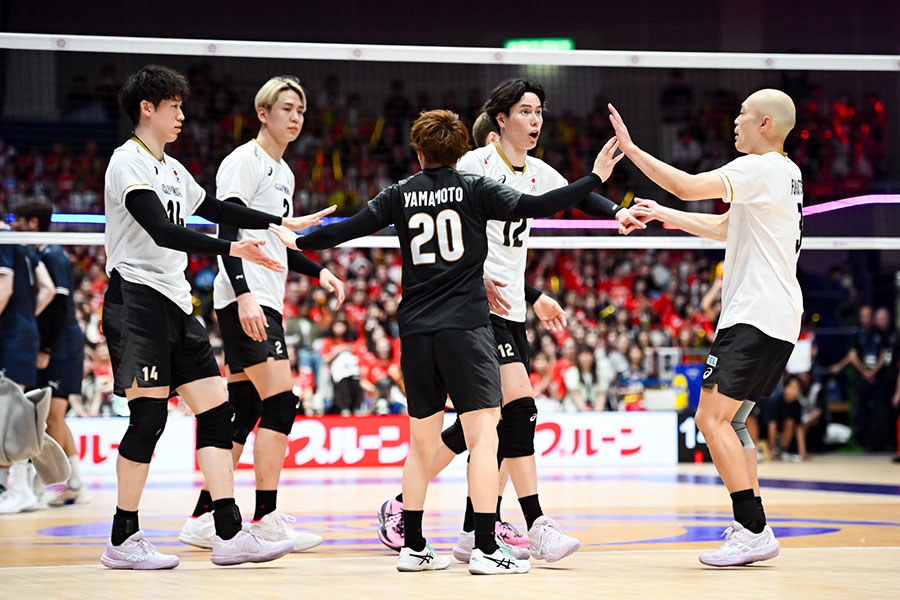
Japan's rise is no fluke of scheduling. It is the product of tactical adaptation. Where European squads rely on sheer height and heavy terminal hitting, Japan constructed an efficient transition defense that wears down power attackers over protracted rallies.
Floor defense and back-row coverage allow Japan to keep out-of-system plays alive. When rallies break down, their out-of-system setting creates clean hitting lanes from the pipe or opposite pin. That patience proved vital in Okazaki. When China's physical block caught fire in sets one and four, Japan avoided panicked errors and refocused on first-ball side-out distribution.
Serving precision complements their defensive discipline. Rather than relying solely on 125 km/h jump serves, Japanese servers vary trajectories with hybrid floaters that target reception seams. Neutralizing the opponent's first pass lets their compact middle blockers funnel attacks straight into the waiting libero.
Olympic Games Qualification and the Road to Los Angeles 2028
Holding a top-five ranking changes a team's strategic horizon. Olympic Games qualification routes favor the elite heavily under current guidelines. For nations locked inside the top tier, maintaining a high standing guarantees protection even if a continental qualifying tournament goes awry.
For Japan, locking down the 2028 Los Angeles Olympics berth early means head coach and staff can manage veteran minutes during future Volleyball Nations League windows. Instead of fielding an exhausted first team across every intercontinental leg, management can integrate younger prospects without fear of sliding off the Olympic bubble.
Federations below them in the standings face a grueling chase. Programs hovering between eighth and fourteenth must treat every VNL preliminary fixture as an emergency. One losing streak can derail Olympic dreams years before the opening ceremony arrives.
Frequently Asked Questions (FAQ)
Q1: How does the FIVB ranking algorithm formula calculate match points?
A1: The system uses an expected outcome model based on current point differentials between competing teams. A higher-ranked side earns fewer points for expected sweeps and loses substantial points if pushed to five sets or beaten by a lower-ranked opponent.
Q2: Why are regional matches so dangerous for top-ranked nations?
A2: When a top-five team plays an opponent outside the top 30, the rating expectation is a clean 3, 0 sweep. Dropping sets reduces the points won, and an upset loss inflicts massive deductions that take months of international play to recover.
Q3: How does the Ryujin Nippon FIVB ranking affect Olympic seeding?
A3: A top-five ranking ensures a priority seed in major tournament pool draws, preventing Japan from landing in group-stage "pools of death" alongside two other top-four powers during world championship and Olympic tournaments.
The Changing Balance of Men's Volleyball
The global men's volleyball circuit is no longer an exclusive duel between European giants and South American powerhouses. Japan's ascent to world number five proves that elite floor defense, service efficiency, and tactical discipline can overcome pure physical height advantage.
With Poland remaining the target at the top and the chasing pack separated by single-digit points, every set on the calendar carries postseason consequences. As preparations turn toward the next international window, Ryujin Nippon is no longer hunting the world elite, they are defending their place among them.
