From 'Angel's Egg' to Final Fantasy: The Hidden Techniques Behind Amano's Iconic Wings

Illustrators trying to capture the flight of mythical beings often stumble over the same hurdle: rigid, mechanical wings that look pasted onto a character's shoulder blades. When Yoshitaka Amano conjures celestial anatomy, the feathers do not merely support flight; they drape, billow, and dissolve like silk caught in water. As reported in a Polygon Report, Amano argued that automated generators fail to grasp the human spirit behind art precisely because hand-rendered expression thrives on irrational, emotional gestures that defy algorithmic predictability. Nowhere is that philosophy clearer than in his approach to angelic forms, where avian biological structure bends entirely to rhythmic calligraphy.
To draw angel wings with that haunting, otherworldly presence, artists must bridge the gap between hard anatomical mechanics and freeform lyrical gesture. By analyzing Amano's work across the seminal 1985 OVA Angel’s Egg (Tenshi no Tamago) and his character concept paintings for Final Fantasy, we can isolate the exact technical principles needed to render wings that feel both physically grounded and impossibly ethereal.
📌 Key Takeaways:
- Anatomical Foundation: Believable fantasy wings rely on modifying human arm bone equivalents, humerus, radius, ulna, and fused carpals, rather than sticking feathers onto flat fan shapes.
- Art Nouveau Influence: Amano subordinates rigid avian logic to whip-like "whiplash" contour lines, drawing inspiration from Gustav Klimt, Aubrey Beardsley, and traditional Japanese Nihonga.
- Tonal Dissolution: Contrast dense ink linework on primary flight feathers with wet-on-wet watercolor blooming to evoke weightlessness.
Skeletal Framework: Avian Anatomy Reimagined for Myth
Every convincing pair of angel wings begins with basic avian mechanics. A bird wing is a modified mammalian arm. The humerus forms the upper arm connecting to the scapula, the radius and ulna create the forearm, and the carpometacarpus forms a fused wrist and hand. When drafting the initial wing bone structure sketching, novice illustrators often make the mistake of drawing symmetrical, fully spread triangles. Real wings rest in an "accordion" Z-shape. The elbow drops downward, the wrist sits high, and the hand dips slightly toward the ground.
Amano's signature deviation occurs at the wrist joint. Where natural bird wings lock the manus forward to brace against aerodynamic pressure, Amano hyperextends the finger joints. He treats the primary flight feathers almost like long, elegant human fingers trailing through water. When sketching your initial gestural armature, establish the three-segment limb first using quick pencil passes. Pay close attention to the origin point: angel wings must anchor into the thoracic spine and latissimus dorsi, sweeping behind the shoulder blades rather than sprouting directly out of the trapezius. If the muscle attachments lack clear anatomical volume, the entire upper torso loses its balance.
Line Weight and Gesture: The Calligraphic Skeleton
Once the skeletal armature is locked, the rendering process shifts toward line weight and gesture drawing. Amano’s line does not act as an unyielding boundary. Instead, it moves like ink ribbon unspooling in wind, alternating between needle-thin scratches and sudden, pressurized ink pools.
To replicate this line quality, abandon rigid, uniform digital brush presets. Work with dip pens like the Japanese G-pen, fine sable hair watercolor brushes, or digital textured presets that respond aggressively to pen pressure and tilt. Start each feather stroke with high velocity from the quill base, ease off pressure along the shaft, and whip the tip outward with a flick of the wrist.
In standard manga and comic illustration, feathers are outlined as closed, hard-edged oval shields. Amano rejects closed forms. His contour lines often break midway, leaving the eye to bridge the gap across the white of the paper. This technique instantly removes physical bulk, transforming heavy keratin plumage into gossamer plumes.
Layering Feathers: Anatomy Across Three Aesthetic Approaches
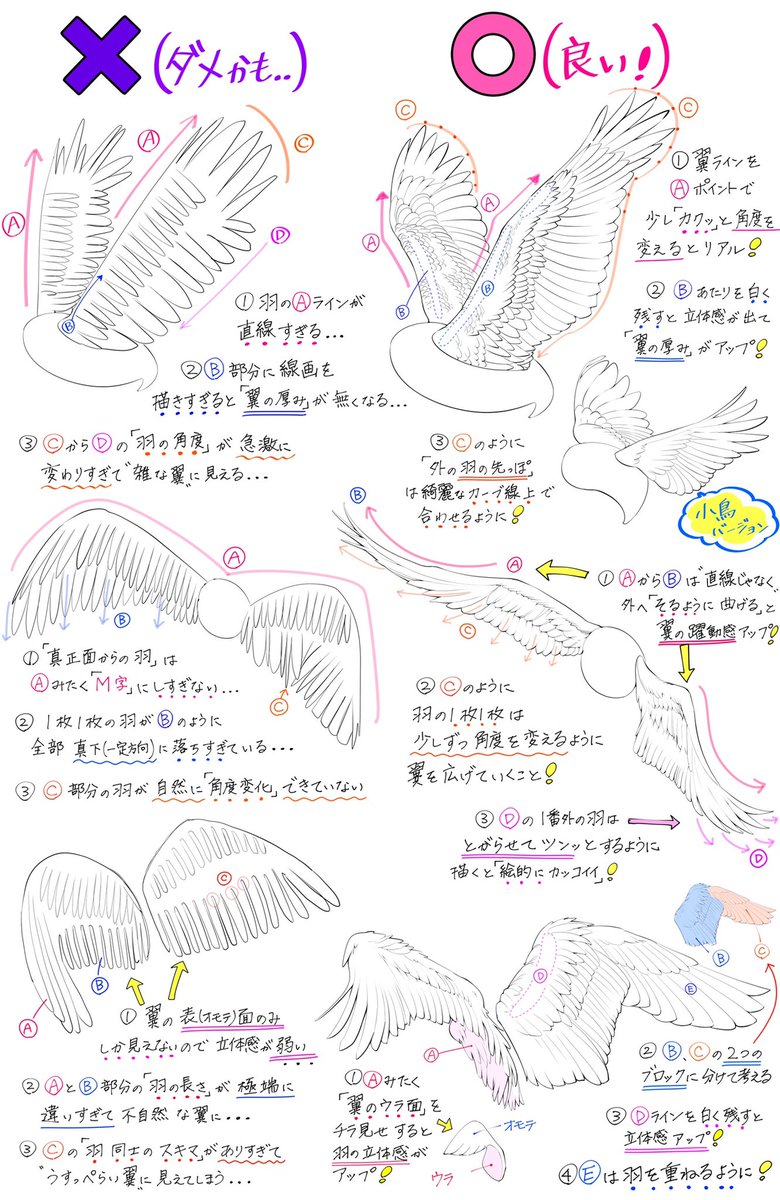
Arranging feathers requires systematic layering. Natural avian plumage organizes into distinct tiers: marginal coverts along the leading bone edge, lesser and median coverts forming the mid-cushion, greater coverts providing transition, and the long primary and secondary flight feathers generating lift.
Understanding how different illustration schools manipulate this order clarifies where Amano breaks tradition to achieve his dreamlike sensibility.
| Structural Element | Classical Ornithology | Standard Anime / Manga | Amano Ethereal Aesthetic |
|---|---|---|---|
| Covert Feathers | Dense, tightly packed scales that streamline airflow. | Simplified rounded scallops arranged in rigid rows. | Elongated, ribbon-like strands intermingling with loose hair. |
| Flight Feather Tips | Slotted, blunt emarginations designed to reduce drag. | Sharp, dagger-like geometric endpoints. | Whisper-thin, trailing filaments that taper into negative space. |
| Silhouette & Flow | Rigid aerodynamic airfoils dictated by physics. | Symmetrical, fan-shaped structural wings. | Asymmetrical, draping drapery mimicking Art Nouveau curves. |
| Line vs. Value | Full volumetric value modeling with heavy drop shadows. | Cell-shaded two-tone steps with clean black outlines. | Delicate hatch work layered over bleeding watercolor puddles. |
When executing feather layering techniques within an ethereal fantasy illustration, allow the primary flight feathers attached to the hand bones to fan outward across broad arc paths. Do not overlap them like identical shingles on a roof. Stagger the angles. Let two feathers cross, have one twist outward along its spine to show its underside, and allow the innermost feathers to trail back toward the torso like flowing sheer fabric.
Atmospheric Washes and the Angel's Egg Aesthetic
In Mamoru Oshii’s 1985 masterpiece Angel's Egg, for which Amano served as visual director and character designer, angelic imagery is defined by deep existential quiet. Wings do not burst from heroic bodies in glorious fanfares; they drift half-remembered through drowned cathedrals.
Achieving the Angel's Egg aesthetic requires balancing dense graphic mark-making with spontaneous watercolor washes. Amano frequently works with liquid inks, acrylic gouache, and watercolor on absorbent paper, allowing the medium to pool randomly.
To recreate this atmosphere manually or digitally:
- Lay down your structural line drawing using waterproof India ink or a textured digital pencil brush.
- Wet the interior area of the wings with clear water (or select a low-opacity wet-blend brush on a dedicated multiply layer).
- Drop deep indigo, burnt umber, and muted celadon pigment along the base bones, letting capillary action pull the pigment outward toward the primary tips.
- Stop the color before it hits the outer feather contours. Leaving the tips unpainted uses negative space to make the wings glow against dark environments.
- While the wash is still wet, drop tiny dabs of clean water or isopropyl alcohol into the puddles to bloom natural backruns and pigment rings, simulating mineral deposits and decay.
Executing Fluid Wing Dynamic Poses Digitally
Translating these traditional, paper-tested methods into a digital wing painting tutorial involves adjusting how you manage canvas layers and pen pressure curves. Most digital artists over-render their subjects, stacking highlights, occlusion shadows, and ambient reflections until the piece looks like polished plastic.
Begin with broad gesture sweeps on a canvas set to at least 4,000 pixels wide. Lock your brush opacity jitter to pen tilt rather than simply pen pressure. This setup allows you to switch between hair-thin feather quills and broad, smudgy shadows without constantly changing tool sizes.
When positioning wings in dynamic poses, avoid matching both sides symmetrically. If the character's torso twists toward the viewer, wrap the foreground wing around the chest like a tattered medieval cloak, while extending the background wing straight up into an elongated, vertical spire. The resulting silhouette breaks up predictable human proportions, immediately creating the haunting tension recognizable to fans of vintage Final Fantasy concept work.
Frequently Asked Questions (FAQ)
Q1: How do I make drawn wings look connected to the human back naturally?
A1: Avoid drawing wings directly out of the shoulder blade surface. Instead, anchor them between the lower edge of the trapezius and the latissimus dorsi muscles along the thoracic spine. Draw visible muscle strapping that wraps under the armpits and over the shoulders, establishing that the wings share the torso's skeletal load.
Q2: What is the biggest mistake artists make when illustrating feathers?
A2: Drawing every individual feather barb and contour with equal sharpness. This clutters the composition and flattens depth. Focus detailed linework only on the tips of the primary flight feathers and the leading edge of the wing bone. Leave the interior covert areas loosely suggested through broad, soft tonal washes.
Q3: Which traditional art supplies match Yoshitaka Amano's wing textures?
A3: Amano works primarily on heavy Japanese paper or illustration board using waterproof sumi ink, Maru or G-pen nibs, Kolinsky sable watercolor brushes, Dr. Ph. Martin's radiant concentrated water colors, and acrylic gouache. For digital workflows, dry ink brushes with tilt sensitivity and edge bleed mimic this combination best.
Cultivating the Weightless Line in Contemporary Fantasy
Drawing wings that linger in the viewer's memory requires unlearning the habit of over-polishing. Modern illustration trends lean heavily on 3D maquettes, ray-traced lighting models, and perfectly measured perspective grids. While those tools build mechanical accuracy, they frequently strip the poetry out of mythological subjects.
Yoshitaka Amano’s enduring influence across games, fine art, and animation proves that vulnerability, asymmetry, and intentional imperfection carry profound emotional resonance. When you pick up your pen, treat each feather not as a rigid biological scale, but as an extension of the character’s internal emotional state. Anchor the bones in anatomical truth, let the ink flow without micromanaging every edge, and allow negative space to do the heavy lifting of flight.
