From Clutter to Chic: How Japanese DIY Creators Ignited the 100-Yen Slat Trend
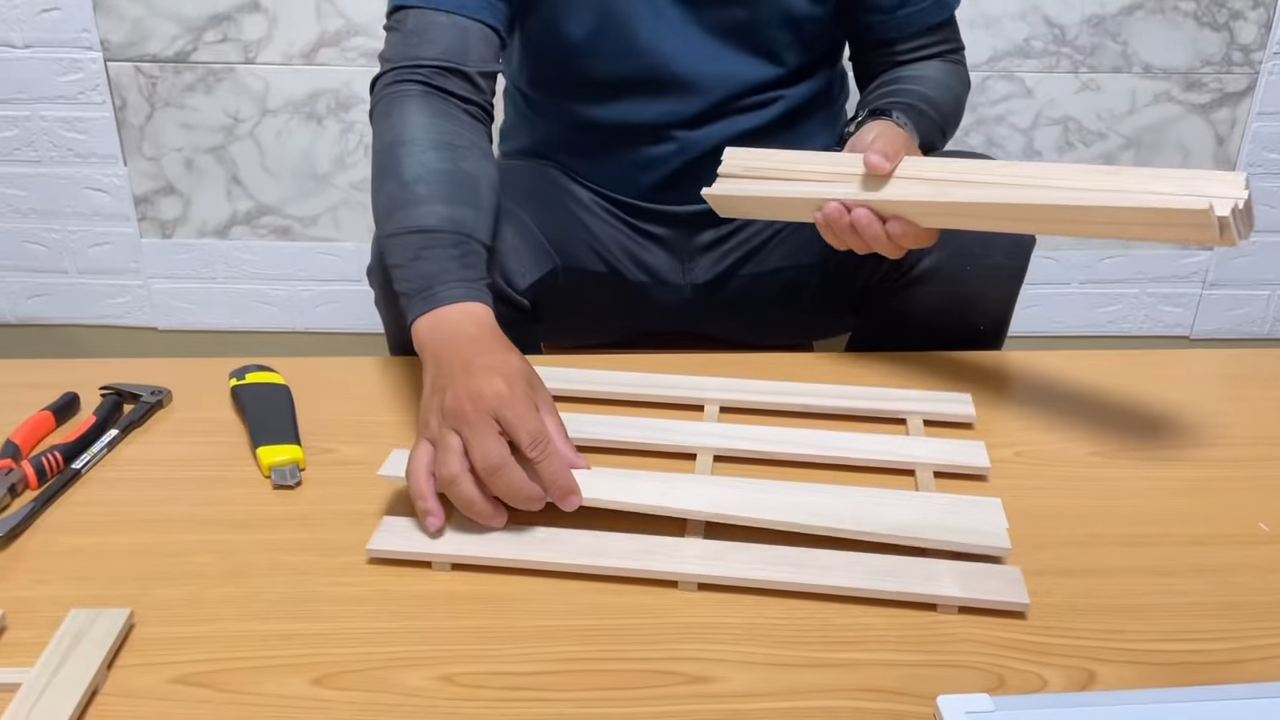
Walk into any suburban Daiso or Seria in Tokyo, and you will find lightweight wooden slats stacked neatly in the craft aisle, priced at just 110 yen (about $0.75) apiece. Known in Japan as sunoko, these humble slatted cedar and pine boards traditionally kept futons dry in humid closets. Today, they form the backbone of a major domestic design movement. As documented in a YouTube Report tracking flat-pack bed frame assemblies alongside viral interior projects, Japanese urbanites are bypassing expensive department-store furniture to engineer custom bedroom suites entirely from discount lumber.
What began as simple shoe-rack projects a decade ago has evolved into complex, budget-conscious residential renovations. Renters living in cramped 20-square-meter apartments face strict lease clauses barring wall modifications and heavy drilling. Discount wooden slats offered an instant workaround. By gluing, zip-tying, or disassembling these miniature timber grids, home crafters turned floor-level futon setups into elevated hotel-inspired sleep sanctuaries without spending more than pocket change.
📌 Key Takeaways:
- The Core Movement: Urban Japanese DIYers are transforming humble 100-yen cedar slats into custom under-bed storage organizers, accent headboards, and compact furniture.
- The Structural Reality: While these lightweight craft slats excel as accessories and organizers, they lack the weight-bearing integrity needed to form an entire adult bed platform on their own.
- The Cultural Shift: What started as basic craft projects has evolved into sophisticated Japanese apartment renovations, driven by social media creators and professional carpenters.
How Humidity and Small Apartments Birthed a DIY Phenomenon
Japan’s humid summers and rainy seasons present a perennial headache for apartment dwellers: floor mold. For centuries, households relied on full-sized cypress sunoko mats to elevate cotton futons off tatami floors, allowing trapped moisture to escape. As postwar construction shifted toward small concrete studio apartments, floor-bound living persisted, but square footage shrank drastically.
Around 2014, discount chains Daiso, Seria, and Can Do expanded their hardware sections to include miniature craft slats measuring roughly 40 by 25 centimeters. Early crafters bought them to make lightweight spice racks and entryway shoe tiers. But urban renters soon realized these prefabricated wooden units solved a structural problem in compact bedrooms. They provided rigid, pre-spaced wood planks at a fraction of the cost of raw lumber from commercial home centers. Rather than buying circular saws and measuring tape, an urban tenant could carry six slats home in a plastic shopping bag and assemble custom wood shelving using nothing more than wood glue or plastic zip ties.
From Clutter to Hotel Chic: The Viral Social Media Wave
The turning point came when micro-influencers moved beyond basic craft boxes and tackled full-scale room layouts. On January 15, 2026, MSN spotlighted popular renovation creator `@asunee_kurashi`, who documented her self-renovation of a 30-year-old home with structural flaws. Using Daiso wooden slat crafts paired with wire frames and woven baskets, she turned an unruly pile of children's toys and picture books into an under-bed storage organizer system reminiscent of an upscale boutique inn. The makeover drew thousands of shares across Japanese lifestyle boards, celebrated for giving cluttered living quarters an understated, hotel-style room renovation on a shoestring budget.
This evolution tracks a broader shift across Japanese DIY communities. Ten years ago, slat crafts looked noticeably handmade, often held together with visible screws and uneven coats of acrylic paint. Today, social media feeds showcase mature, Japandi-style aesthetics. Creators match stained timber tones, install hidden warm LED strip lights behind DIY headboards, and pair natural cedar grains with textured linen bedding to produce high-end visual results.
The Evolution of 100-Yen Slat Carpentry (2016, 2026)
The progression of discount timber projects reflects growing technical ambition within the Japanese crafting scene. What started as basic shelving has matured into full interior woodworking.
| Era | Dominant Build Types | Construction Methods | Average Project Cost |
|---|---|---|---|
| 2016, 2018 | Basic spice racks, desktop book ends, entry planter stands | Simple PVA wood glue, cable ties, pushpins | ¥300, ¥600 ($2, $4) |
| 2019, 2022 | Under-bed rolling drawers, bedside phone ledges, modular closet bins | Screws, adhesive casters, water-based wood stains | ¥800, ¥1,800 ($5, $12) |
| 2023, 2026 | Wall-mounted slat wood headboards, perimeter accent lighting, disassembled paneling | Disassembly, dowel joining, bracket anchoring, matte varnishes | ¥2,000, ¥4,500 ($13, $30) |
As documented by livedoor News across editorial series in 2016 and 2019, the core trick that unlocked new builds was "disassembled slat carpentry." Rather than leaving the slatted grid intact, users pried the top planks away from their crossbeams using rubber mallets and flathead screwdrivers. This turned a 110-yen unit into several finished, uniform pine battens ready for custom joinery.
Professional Craftsmen Enter the Space
The trend moved from casual lifestyle blogs to professional design channels in mid-2026. Veteran carpenter Karubi, host of the prominent YouTube channel Kotobuki Channel DIY, tackled 100-yen slats to demonstrate how trade joinery methods could elevate budget raw materials. Reported by ITmedia on July 7, 2026, Karubi used basic woodworking techniques, accurate squaring, reinforcing stress joints, and applying high-grade timber finishes, to show how dollar-store materials could produce furniture rivaling mid-tier boutique brands.
When professional builders demonstrated that a clean cut and proper staining could conceal low-cost origins, public interest spiked. Renters realized they did not need expensive power equipment to build a custom slatted headboard or an under-bed storage unit. The lightweight timber allowed tenants to craft bespoke organizers sized perfectly for non-standard room layouts, sliding cleanly into dead space beneath beds that commercial organizers could not fit.
The Structural Myth: Can You Build a True Bed Frame from Dollar Slats?
Online interest in "すのこ ベッド 100 均" often leads back to a persistent urban legend: building a structural platform bed frame using exclusively dollar-store materials. The short answer is an unequivocal no. A standard adult mattress requires a support structure capable of bearing 80 to 120 kilograms of dynamic weight. Dollar-store craft slats are made from paulownia (kiri) or soft Chinese pine, measured at just 7 to 9 millimeters in thickness. Subjected to human body weight, they will snap instantly.
Instead, crafters pair commercial foundation beds, such as flat-pack steel frames or heavy-duty cypress slatted bases from brands like Zinus or Nitori, with dollar-store customizations. They use 100-yen slats as low-cost aesthetic facades, rolling storage bins on mini caster wheels, or vertical headboard screens mounted behind the mattress. Using these craft boards for structural, load-bearing mattress support is a dangerous misconception that experienced creators actively warn against.
Best Uses Versus Structural Risks
Knowing where budget timber works, and where it fails, marks the difference between a successful bedroom project and a pile of broken pine.
- Under-bed slide-out pull drawers, wall-leaning slatted headboard panels, side tables holding under 5 kilograms, bedside smartphone trays, and closet divider racks.
- Main platform mattress decking, child crib railings, full-standing bookshelves, step stools, or load-bearing corner legs.
- Discard the factory staples immediately and replace them with short brass wood screws; apply a thin coat of wood-hardening sealant to keep the soft paulownia wood from denting.
Frequently Asked Questions (FAQ)
Q1: How many 100-yen slats does it take to make a DIY headboard?
A1: A standard semi-double bed width (approx. 120 cm) typically requires between **8 and 12 standard slats**, depending on desired height. Total materials, including rear support battens and wood stain, average roughly **¥1,500 to ¥2,200 ($10 to $15)**.
Q2: Will dollar-store wood warp or split over time?
A2: Yes, if untreated. The paulownia and soft pine used in 100-yen shops are porous and sensitive to ambient indoor humidity. Sanding the rough faces and brushing on a basic matte water-based clear coat or interior wax prevents seasonal warping and splintering.
Q3: How do you attach under-bed storage slats without heavy drilling?
A3: Most crafters use adhesive-backed caster wheels stuck directly to the slatted corner bases, reinforced with rapid-curing wood glue or zip ties. This keeps the assembly completely tool-free and easily removable for end-of-lease apartment cleaning.
Small Spaces and the Future of Pragmatic Living
The enduring popularity of 100-yen bedroom carpentry highlights how urban renters adapt when space and money are tight. In dense rental markets across Tokyo and Osaka, young tenants are priced out of custom carpentry and boxed in by rigid apartment rules. Rather than waiting for spacious suburban homes or shelling out for disposable flat-pack furniture, they have embraced simple wooden slats as modular building blocks.
This approach turns everyday limitations into smart, functional craft. By taking a disposable, century-old moisture-control product and repurposing it into space-saving bedroom organizers, budget-minded creators continue to prove that stylish, intentional interior design depends far more on ingenuity than a big bank account.
