Inside Bangkok Jewelry Trade Center: How Real Gem Traders Bypass Tourist Traps
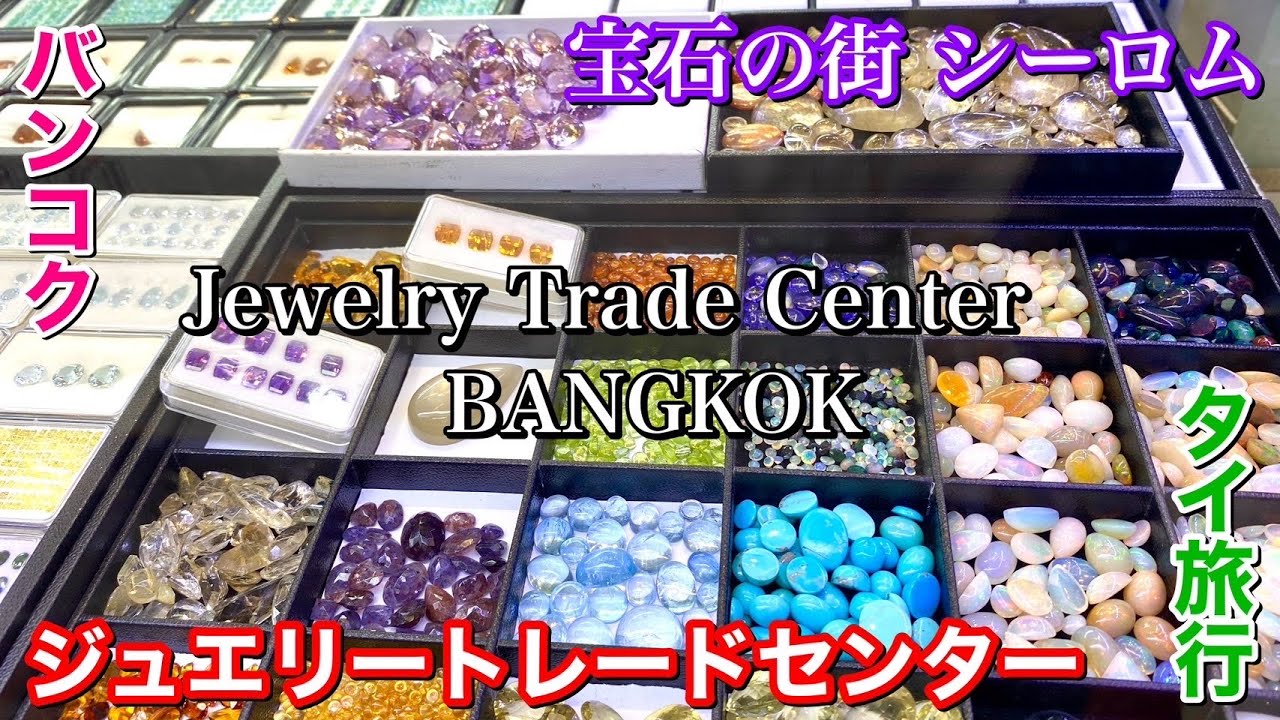
The humid pavement of Silom Road gives way abruptly to refrigerated air and the mechanical hum of high-speed elevators at 919 Silom. Inside the Bangkok Jewelry Trade Center (JTC), the atmosphere feels less like a luxury boutique and more like a high-velocity currency exchange. Men with nondescript messenger bags sit shoulder to shoulder across plain laminate counters, unfolding creased white paper packets known as plis. Under calibrated daylight lamps, pigeon-blood rubies, cornflower sapphires, and rough spinels flash against tweezers.
Thailand controls roughly 80% of the global supply of cut and polished colored stones, serving as the undisputed processing engine for the world's gem trade. At the center of this $8 billion annual B2B jewelry export industry sits the JTC, a 59-story complex housing thousands of Bangkok gemstone dealers, cutting operations, and independent testing facilities. Yet everyday tourists who enter the building rarely see the true wholesale engine. Most stay pinned to the ground-floor retail counters, vulnerable to the same inflated prices and treatment deceptions that define the surrounding street stalls.
📌 Key Takeaways:
- Trading Mechanics: The JTC operates as a multi-tier exchange where raw parcels move across lower-level trade floors while high-value corporate deals occur on secured upper levels.
- Treatment Disparities: Heat-treated stones dominate the open floor, while the premium unheated sapphire market and untreated Burmese rubies demand strict independent lab certification before settlement.
- Authentication Protocol: Professional buyers never finalize purchases without escrowing stones for verification at on-site facilities like the AIGS Gemological Laboratory or the state-run GIT.
The Silom Road Gem District and the JTC Architecture
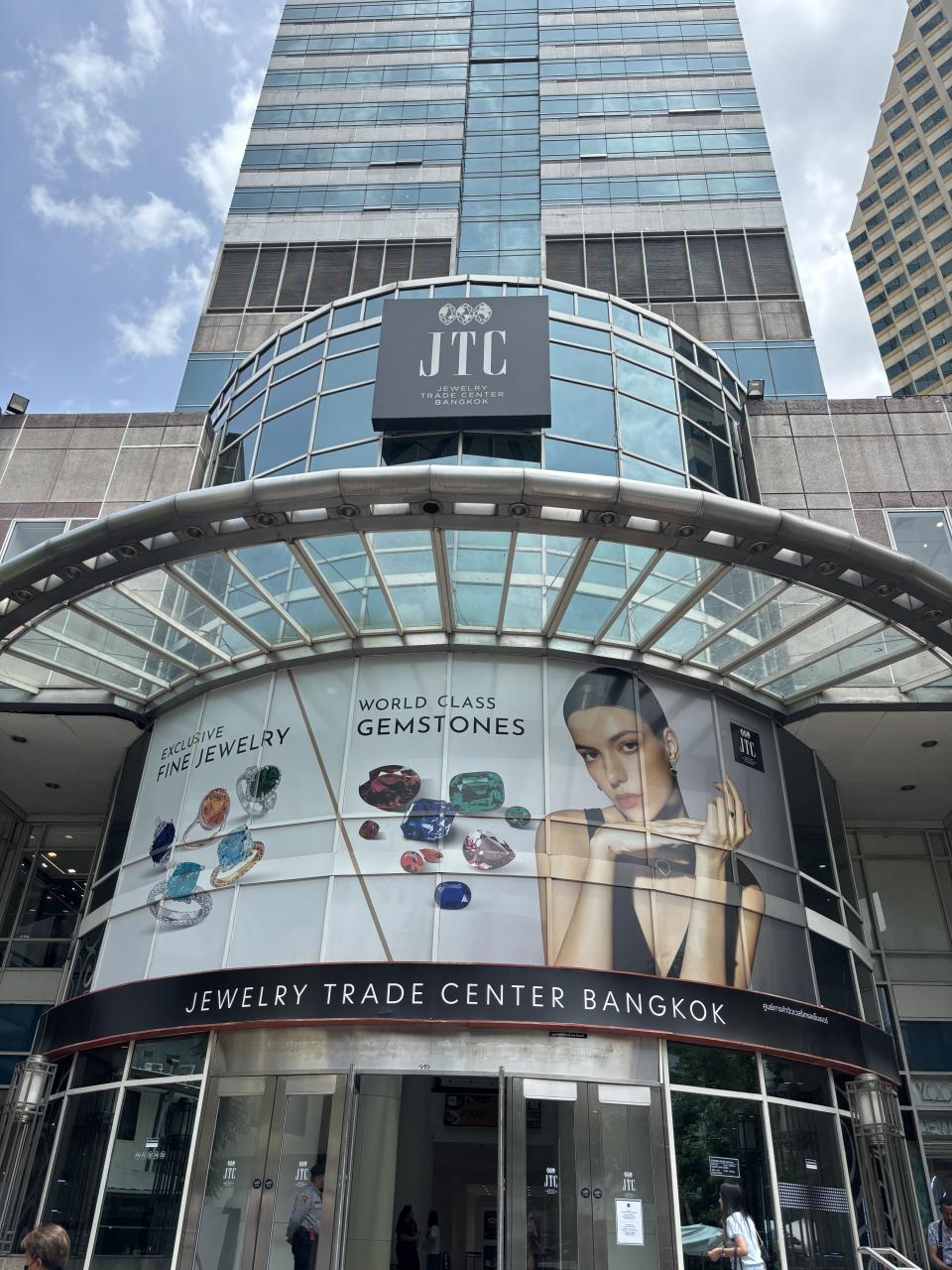
The colored stone economy of Southeast Asia converges along a narrow strip in Bang Rak. The Silom Road gem district, stretching between Charoen Krung and Mahesak Road, evolved over decades as gem merchants from Chanthaburi, Myanmar, Sri Lanka, and India established trading outposts in Bangkok. Opened in the mid-1990s, the Bangkok Jewelry Trade Center organized this chaotic street market into a centralized vertical hub.
The building operates on a distinct vertical hierarchy. The lower levels function as an open marketplace. Floors B1, 2, 3, and 4 hold hundreds of compact trading stalls, appraisal counters, and small-parcel booths. Here, independent runners carry goods between rough-stone cutters and wholesale colored gemstones dealers. Ascend past the retail and wholesale floors into the office tower, and the environment changes completely. Upper floors house private diamond bourses, multinational gemstone exporters, casting houses, and advanced analytical laboratories.
Understanding this geography is the first step in gemstone scam prevention. Street hustlers near temples and river piers frequently steer foreign travelers toward government-approved gem sales or side-street showrooms promising wholesale export discounts. These operations rely on high markups for heavily treated or synthetic material. Legitimate trade does not happen in curbside showrooms; it happens inside the regulated ecosystem of the JTC and its surrounding commercial towers.
Inside the Rough Stones Trading Floor: How Deals Actually Close
On the lower trading floors, transactions bypass conventional retail aesthetics. Buyers do not browse glass display cabinets. Instead, they rent or borrow desk space, equip themselves with a 10x achromatic triplet loupe, a daylight-balanced penlight, and a digital scale, and wait for runners to bring material.
The process follows a strict protocol developed over generations:
A dealer places a folded parcel paper on the desk. Inside lies a mixed lot of rough stones or calibrated cut gems. The buyer inspects the parcel under neutral light, checking for color saturation, cut proportion, windowing, and structural fractures. Silence is customary during inspection. Pointing out flaws to lower the price prematurely signals inexperience. Experienced buyers calculate a collective carat yield, formulate an offer, and state a single price for the entire lot.
Negotiations are brisk. If the dealer accepts the bid, the paper is initialed, sealed, and set aside. Crucially, cash does not change hands immediately for high-ticket items. Professional transactions rely on "memo" terms, conditional agreements where stones are inspected, sealed, and dispatched for loose stone appraisal and scientific testing before accounts settle.
Wholesale Colored Gemstones: 2026 Price Benchmarks and Treatment Standards
Pricing colored gemstones requires separating natural, untreated stones from their heavily modified counterparts. In recent years, supply restrictions out of Mogok combined with heightened global demand have pushed Burmese ruby pricing to historic highs, while Mozambique material has filled commercial jewelry pipelines.
Treatment dictates value. A ruby subjected to simple traditional heat treatment can command a respectable wholesale price, whereas the same stone infused with high-lead glass to mask fractures loses 95% of its commercial value and degrades over time when exposed to household chemicals or jeweler's torches.
| Gemstone & Origin | Treatment Status | Standard Verification Requirement | 2026 Wholesale Range (Per Carat, 1, 3ct) |
|---|---|---|---|
| Burmese Ruby (Mogok) | Unheated / Untreated | Full Origin Report (GIT / GIA / AIGS) | $4,500, $22,000+ |
| Burmese Ruby (Mong Hsu) | Standard Flux / Heat | Treatment & Residue Level Report | $800, $3,200 |
| Ceylon Sapphire (Sri Lanka) | Unheated | Spectroscopic Micro-analysis Report | $1,800, $6,500 |
| Madagascar / Thai Sapphire | Traditional Heat Only | Standard Identification Brief | $400, $1,500 |
| Commercial Corundum (Any Origin) | Lead-Glass Filled / Composite | Mandatory Glass-Filling Disclosure | $5, $40 |
The disparity between lead-glass treated corundum and an unheated specimen illustrates why unvetted transactions carry extreme risk. Without rigorous testing, an inexperienced buyer can easily pay unheated rates for a stone that is fundamentally industrial composite material.
Laboratory Validation: Leveraging AIGS and GIT Inside the District
Bangkok retains its dominance because testing infrastructure grew alongside the dealer community. The trade relies on rapid scientific verification to settle transactions within hours rather than weeks.
The Asian Institute of Gemological Sciences (AIGS Gemological Laboratory), established in 1978 as Southeast Asia's first educational gem facility, operates directly within the JTC complex. AIGS provides identification, treatment detection, and origin analysis. A few blocks away, the Gem and Jewelry Institute of Thailand (GIT), a public organization under the Ministry of Commerce, runs a state-of-the-art laboratory that sets national standards through its "Buy with Confidence" (BWC) initiative.
When negotiating significant parcels, professional buyers execute a conditional purchase agreement contingent on testing results:
- Stone Isolation: The buyer and seller agree on a price, place the stone in a security box or tamper-evident pouch, and sign across the seal.
- Lab Submission: The stone goes directly to the intake desk at AIGS or GIT for express testing (typically 24 to 48 hours for standard verification; same-day verbal services are often available for local dealers).
- Disclosure Check: The report checks for thermal enhancement, beryllium diffusion, fissure filling with oil or resin, and geographic origin indicators.
- Final Settlement: If the stone matches the seller's verbal representations, the buyer pays the agreed sum plus testing fees. If undisclosed treatments emerge, the transaction cancels without penalty to the buyer.
Dealers who refuse lab escrow within the building should be disqualified immediately. Legitimate merchants consider this standard operating procedure.
The Mechanics of Modern Gemstone Scams in Silom
Street-level fraud rarely targets gemological professionals; it targets opportunistic travelers seeking quick arbitrage. The schemes rely on psychological manipulation rather than forced sales.
The classic trap begins away from Silom. A friendly driver or passerby strikes up a conversation, mentions that today is a special holiday with waived export duties, and directs the victim to a specific export center. The stones presented are real mineral corundum, but they have undergone heavy artificial clarity enhancement. The invoice shows an inflated retail valuation, leaving the victim under the impression that they can double their money back home.
Inside the JTC, deceptive practices assume more subtle forms:
- Pale sapphires undergo high-temperature lattice diffusion with light elements, producing vivid padparadscha or yellow shades. Basic testing equipment misses this alteration without advanced UV-Vis-NIR or FTIR spectroscopy.
- Thin chemical films applied to the pavillion of cut stones temporarily mask poor body color or artificial inclusions.
- Labeling East African rubies as classic Burmese Mogok stones to inflate market value by 200% to 400%.
Overcoming these pitfalls requires personal discipline. Independent buyers must rely on calibrated testing equipment and insist on independent testing certificates rather than merchant-issued laminated cards.
Operational Guidelines for Private Sourcing in Bangkok
Entering the trade center as an independent operator requires preparation and a clear understanding of floor etiquette. Those arriving with retail expectations will struggle; those who approach the market systematically can access inventory unavailable anywhere else in the world.
First, clarify your purchase mandate before touching inventory. Determine target species, acceptable treatment parameters, size thresholds, and hard spending caps. Sellers quickly identify unfocused inquiries and present dead inventory that has circled the floor for months.
Second, carry essential inspection tools. A basic kit includes a 10x corrected triplet loupe, a strong 5500K daylight-balanced LED penlight, gem tweezers, a millimeter gauge, and a clean white sorting pad. Using dealer-supplied lighting can disguise yellow or brown undertones in colored stones.
Third, respect trading floor customs. Never interrupt an active deal at another desk. Do not touch stones while another buyer is handling them. Once an offer is accepted verbally, reneging damages your standing across the floor permanently, as news travels swiftly across Silom's dealer networks.
Frequently Asked Questions (FAQ)
Q1: Can an individual or tourist walk into the JTC trading floors without a commercial business license?
A1: Yes. The lower trading floors and retail levels of the Bangkok Jewelry Trade Center are accessible to the public without wholesale credentials. However, high-floor corporate offices and private trading suites operate strictly by professional appointment.
Q2: How much does a standard gem certification cost at on-site Bangkok laboratories?
A2: Basic stone identification briefs at AIGS or GIT generally range from $30 to $60, while comprehensive origin and treatment analysis reports for rubies, sapphires, or emeralds cost between $100 and $300, depending on carat weight and turnaround time.
Q3: Which payment methods are customary on the wholesale trading floor?
A3: Established dealers prefer direct domestic wire transfers (such as PromptPay for local accounts) or international SWIFT wire transfers for major parcels. Cash in Thai Baht remains widely used on the lower-level trading desks. Credit cards incur surcharges between 3% and 5% and are typically reserved for retail-level transactions.
Q4: Why are unheated Burmese rubies significantly more expensive than heated Mozambique stones of identical color?
A4: Historic prestige, geological rarity, and dwindling yields from Mogok drive the premium. Mogok rubies feature a natural fluorescence caused by high chromium and low iron content, creating an inner glow that heat-treated or iron-rich African stones rarely replicate under natural lighting.
Navigating Bangkok's Gem Market in 2026
The colored gemstone trade is undergoing rapid modernization. Advanced synthetic detection tools and blockchain-traced supply chains are shifting how rough and cut stones move from mine to consumer. Tighter regulatory scrutiny over Myanmar sourcing and heightened digital documentation standards for cross-border shipments mean informal, unverified deals are steadily fading.
Yet the raw physical marketplace at 919 Silom Road remains vital to the trade. No algorithm or digital photography replaces the tactile reality of examining a stone's luster under a 10x lens or weighing its crystal quality against market realities. Buyers who approach the Bangkok Jewelry Trade Center with technical discipline, proper verification procedures, and an understanding of floor etiquette will find an unmatched global hub for authentic colored gemstones.
