Japan's 'Bright Family Planning' Condom Dispensers Explained: Origins, Locations, and Lore

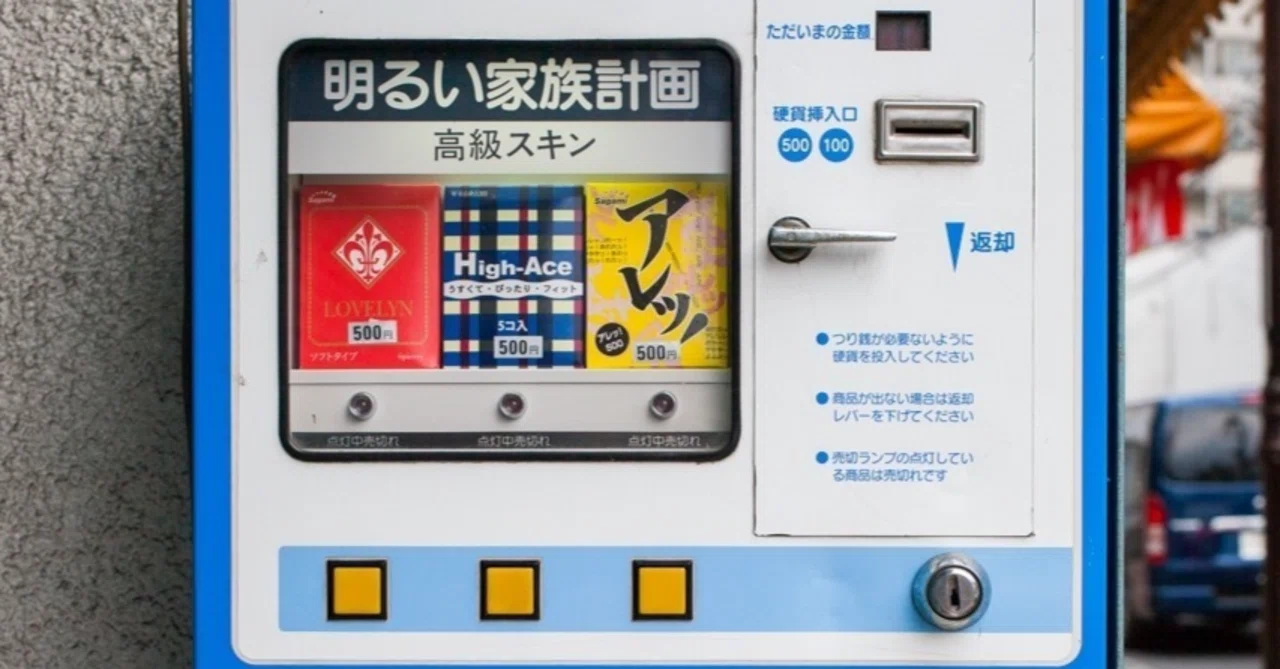
Tucked into the shadowed alcove of an aging suburban Tokyo pharmacy, a narrow cream-and-red metal box hums quietly against the evening chill. Hand-painted acrylic panels display the bold, mid-century slogan Akarui Kazoku Keikaku (明るい家族計画), translated literally as "Bright Family Planning." For decades, these automated dispensers stood as quiet sentinels across neighborhood shopping arcades (shotengai), offering barrier contraceptives without the social friction of an over-the-counter transaction. Today, as documented in an investigative dispatch from note Report, these vintage street fixtures are vanishing from urban centers, dismantled as independent pharmacies close their doors for good.
Yet several hundred remain active across the country, maintained through direct corporate subsidy rather than commercial viability. In an era dominated by ubiquitous convenience chains and rapid digital delivery, Japan's remaining condom vending machines occupy a unique space between retro design artifact and essential public health infrastructure.
📌 Key Takeaways:
- The Postwar Purpose: Dispensers bearing the "Bright Family Planning" slogan emerged during the Showa era to bypass the intense social shame associated with purchasing contraceptives over the counter.
- Deficit Operation: Major manufacturers like Okamoto openly acknowledge that maintaining these machines generates a financial loss, kept alive out of a corporate conviction tied to public health accessibility.
- Urban Disappearance: The decline of independent neighborhood pharmacies, combined with modern retail saturation, has turned the remaining operational units into critically endangered street culture relics.
The Postwar Origins of Akarui Kazoku Keikaku
The story of Japan's condom vending machines is inextricably bound to the nation's postwar demographic policies and medical politics. Following the passage of the 1948 Eugenic Protection Act, which legalized abortion under broad socioeconomic conditions, the government and health advocates sought humane ways to stabilize population growth while preventing unsafe terminations. Condoms became the frontline tool. While Western nations embraced the combined oral contraceptive pill throughout the 1960s and 1970s, Japan’s Ministry of Health and Welfare withheld approval of low-dose birth control pills until June 1999, a delay that lasted nearly four decades.
Because the pill remained restricted to therapeutic use for menstrual disorders, condoms carried the entire weight of national birth control. However, conservative social norms created a formidable barrier. Asking an elderly neighborhood chemist for a box of prophylactics carried immense shame, especially for young or unmarried adults.
To dissolve this friction, domestic manufacturers collaborated with local apothecary associations to install outdoor, coin-operated dispensers. The phrasing Akarui Kazoku Keikaku was carefully chosen. By framing contraception through the civic virtue of "family planning" and domestic prosperity, manufacturers provided cultural cover. A person feeding 100-yen coins into a dispenser under the cover of night was not indulging in illicit behavior; they were responsibly participating in a national campaign for a bright household future.
Why Manufacturers Keep Unprofitable Street Dispensers Alive
Every year on September 26, the global medical community marks World Contraception Day. In Japan, the date consistently sparks public discussions regarding how younger demographics access reproductive healthcare. In recent years, Japanese reporting has revealed a striking operational reality: virtually every outdoor condom dispenser on the street operates deep in the red.
Refilling and maintaining these mechanical units requires specialized technicians. Coin mechanisms jam, display bulbs burn out, and outdoor weather strips deteriorate under humid summer rains. When paired against meager daily sales figures, often just one or two boxes a week, the logistical costs far outweigh the revenue.
Manufacturers like Okamoto maintain them anyway. Corporate spokespeople have repeatedly emphasized that these machines function as emergency infrastructure. In regional prefectures, train station plazas, or sprawling residential suburbs where retail businesses close early, a mechanical street vendor provides round-the-clock protection. For teenagers, vulnerable populations, or individuals avoiding surveillance cameras inside commercial outlets, the unblinking metal cabinet on a dark corner remains a critical safety valve. Keeping them plugged in is an act of corporate public health duty, not an exercise in profit extraction.
The Mechanical Evolution and Shifting Economics of the Street Dispenser
The physical units themselves underwent distinct engineering transformations as Japanese manufacturing and materials science evolved across five decades.
| Era & Timeframe | Primary Street Role | Technology & Product Focus | Economic Status |
|---|---|---|---|
| Showa Expansion (1970, 1989) | Primary channel for anonymous consumer purchases; standard outside pharmacies | Mechanical coin drops; standard natural rubber latex; basic cardboard packaging | Highly profitable for family-run pharmacies and domestic brands |
| Material Innovation Era (1990, 2009) | Emergency nighttime resource competing against expanding 24-hour convenience stores | Introduction of polyurethane films; 0.03mm and 0.02mm thin-film marketing slogans | Break-even; sales volumes began migrating indoors |
| Preservation Era (2010, 2026) | Public health safety net and retro street culture artifact | Ultra-thin 0.01mm/0.02mm packaging; aging mechanical housings preserved with legacy parts | Operated at an active financial loss as corporate social responsibility |
During the late 1990s and early 2000s, vending machine panels changed alongside domestic manufacturing triumphs. As Japanese chemical engineers conquered the production of non-latex polyurethane, slogans boasting "Life Changes at 0.02mm" replaced older generic birth control messaging. The street boxes turned into miniature billboards showcasing engineering precision.
The Architecture of Street-Level Discretion
The placement of these machines was never accidental. In Showa era urban planning, pharmacies rarely placed condom dispensers directly next to the front door where clerks or passing neighbors could see who was lingering.
Instead, machines were mounted on the exterior blind wall, tucked into the narrow alleyway alongside the building or positioned beneath an extended storefront awning. The lighting was subtle, often just a single fluorescent tube illuminating the coin slot and product window. This deliberate micro-geography created a sanctuary of privacy. Buyers could approach after pharmacy closing hours, drop 500-yen coins into the slot, receive a generic cardboard package without loud digital chimes, and slip away into the residential shadows.
Unlike beverage dispensers, which flashed vibrant primary colors and loud audio advertisements, condom dispensers embraced visual restraint. The font on the Akarui Kazoku Keikaku panel used formal, institutional typography that mimicked civic health notices rather than consumer products, giving the buyer psychological relief.
The Factors Accelerating Their Disappearance
Despite corporate willingness to absorb financial losses, external forces are systematically extinguishing the machines.
The primary driver is the collapse of independent pharmacies across Japan. For half a century, individual licensed pharmacists lived above their storefronts, operating community drugstores for generations. As chain megastores like Matsumoto Kiyoshi and Welcia captured retail market share, and as aging pharmacists retired without successors, these neighborhood storefronts permanently lowered their iron shutters. When a shop closes, the building is frequently razed for residential redevelopment, severing the machine's electrical connection.
Second, the structural dominance of the convenience store (combini) dismantled the original privacy equation. With over 55,000 stores nationwide, including 7-Eleven, Lawson, and FamilyMart, condoms became available 24 hours a day under bright fluorescent lights. Self-checkout registers further stripped away human interaction, eliminating the awkward eye contact that once drove teenagers to rust-stained outdoor machines at midnight.
Finally, Japan's municipal landscape ordinances have tightened significantly. Many local councils now discourage or prohibit standalone outdoor contraceptive dispensers in school zones or designated beautification corridors, forcing building owners to retire obsolete cabinets rather than repair them.
Frequently Asked Questions (FAQ)
Q1: What does "Akarui Kazoku Keikaku" translate to in English?
A1: It translates directly to "Bright Family Planning." The phrase was coined during the postwar era as a wholesome, state-sanctioned euphemism to frame contraception as a responsible civic act rather than an embarrassing taboo.
Q2: Are the surviving machines still stocked with safe products?
A2: Yes. Active machines connected to power grids are regularly serviced and restocked with modern stock, such as Okamoto's polyurethane and latex lines. However, collectors and urban explorers caution that completely abandoned units outside derelict buildings should never be used, as exposure to seasonal heat and sunlight degrades latex integrity.
Q3: Why were condoms so dominant in Japan compared to the birth control pill?
A3: The Japanese government did not approve low-dose oral contraceptives for birth control until 1999, citing concerns over public hygiene, side effects, and STIs. This left condoms as the only legally accessible, mass-market contraceptive option for decades, entrenching them into everyday retail systems.
Q4: Where can you still find these machines in Tokyo today?
A4: Surviving operational units are typically found in older working-class neighborhoods (shitamachi), including parts of Arakawa, Kita, and Katsushika wards, as well as peripheral suburban rail stops where mom-and-pop pharmacies still manage to operate.
What Lies Ahead for Japan's Streettop Relics
The gradual disappearance of the Akarui Kazoku Keikaku dispenser represents more than the retirement of an outdated sales mechanism; it marks the closing of a chapter in Japanese street sociology. In response, a loose coalition of urban ethnographers, retro enthusiasts, and health historians has begun cataloging the surviving units. Online crowdsourced maps log operational status, mechanical model variations, and physical coordinates before neighborhood redevelopments wipe them off the map.
These metal cabinets quietly rewired how a conservative society handled personal health, granting autonomy to millions of citizens when institutional channels offered little discretion. Even as the power cords are pulled one by one, the legacy of the "Bright Family Planning" machine remains etched into Japan's modern urban fabric, a reminder of an era when public health had to be delivered discreetly, one cold coin at a time.
