Miss Paris Beauty College Tuition Shock: The Real Price Tag Behind Elite Esthetician Training
Prospective students walking through the polished glass corridors of Miss Paris Beauty College in Tokyo’s Ikebukuro district or Osaka’s Umeda center are met with an atmosphere resembling a five-star hotel rather than a standard vocational trade academy. Uniformed instructors enforce strict salon posture, practical training suites mirror private treatment rooms at Dandy House, and promotional brochures highlight prestige credentials like the Swiss-based CIDESCO certification. Yet behind the polished marketing campaigns lies a heavy financial calculation that every prospective applicant must confront before signing an enrollment agreement.
Tuition stickers across Japanese vocational institutions rarely reflect the actual money leaving a student's bank account. At Miss Paris, mandatory cosmetic product kits, standardized clinical attire, laboratory supply replenishment fees, and international credential test registries steadily drive up the baseline invoice. Navigating the real price tag requires looking past the basic course handbook to examine every line item across the full two-year curriculum.
📌 Key Takeaways:
- Baseline vs. Real Cost: Official tuition for primary programs hovers between ¥2.2 million and ¥2.6 million over two years, but mandatory tool kits, consumables, and licensing assessments push the total cash outlay past ¥3.1 million to ¥3.4 million.
- The Kit Expense Factor: Mandatory personal tools, clinical cosmetics, and official spa uniforms require an upfront materials payment between ¥350,000 and ¥520,000 during the first semester alone.
- Career Payoff Realities: The school consistently posts a verified beauty therapist job placement rate near 100% through the Miss Paris Group career network, yet new graduates face starting salon wages of ¥220,000 to ¥255,000 per month, meaning full recoupment requires disciplined long-term career planning.
The Sticker Price Versus Real Cash Outlays in Tokyo and Osaka
Vocational schools in Japan operate under educational guidelines set by prefectural governors, but private vocational colleges enjoy broad autonomy over their fee schedules. The published base tuition at Miss Paris Beauty College lists standard lecture fees, ordinary facility upkeep, and an initial entrance fee of ¥100,000 to ¥150,000. That initial figure creates an artificially modest impression for families planning their educational budgets.
Meeting standard admission qualification requirements, such as completing 12 years of formal schooling or holding an equivalent Japanese high school graduation credential, is only the first hurdle. Once acceptance letters arrive, the true payment schedule reveals a front-loaded invoice structure. First-year fees require upfront settlement before classroom entry, combining the admission charge with full-year facility operational assessments and practical training equipment maintenance fees. For international applicants needing student visa sponsorship, admissions officers scrutinize financial solvency statements to guarantee bank balances exceed ¥2.5 million to ¥3.0 million, ensuring the student can carry both living costs and education bills without unauthorized labor.
Line-by-Line Breakdown of the Two-Year Esthetician Track
The flagship Esthetic Course and the comprehensive Total Beauty Course train students in body contouring, facial therapy, aromatherapy, and international salon management. Understanding where each yen goes prevents financial surprises midway through semester two.
The foundational tuition charge covers classroom lectures, standard salon simulations, and school-wide overhead, totaling roughly ¥700,000 to ¥800,000 annually. Added to this is the facilities and clinical maintenance fee of roughly ¥250,000 to ¥300,000 per year, which funds the upkeep of hydrotherapy tubs, electrical muscle stimulation (EMS) apparatus, and ultrasonic facial machines identical to those used in commercial luxury spas. Practical training costs add another ¥150,000 to ¥200,000 per year to cover clinical lotions, massage oils, disinfection compounds, and single-use disposables consumed during hands-on student-on-student practice sessions.
Specialized uniform sets cost an extra ¥45,000 to ¥60,000, requiring students to maintain strict corporate dress codes comprising tailored dresses, posture-support footwear, name badges, and manicured hair accessories. When these departmental fees accumulate across the four-semester timeline, the baseline two-year expenditure climbs to ¥2,400,000 before personal kit purchases or examination fees enter the balance sheet.
Expense Comparison Across Flagship Programs
Fee structures differ across educational tracks based on required equipment, consumable materials, and external board oversight. The following comparison outlines the real two-year costs across the core programs offered at the Tokyo and Osaka campuses:
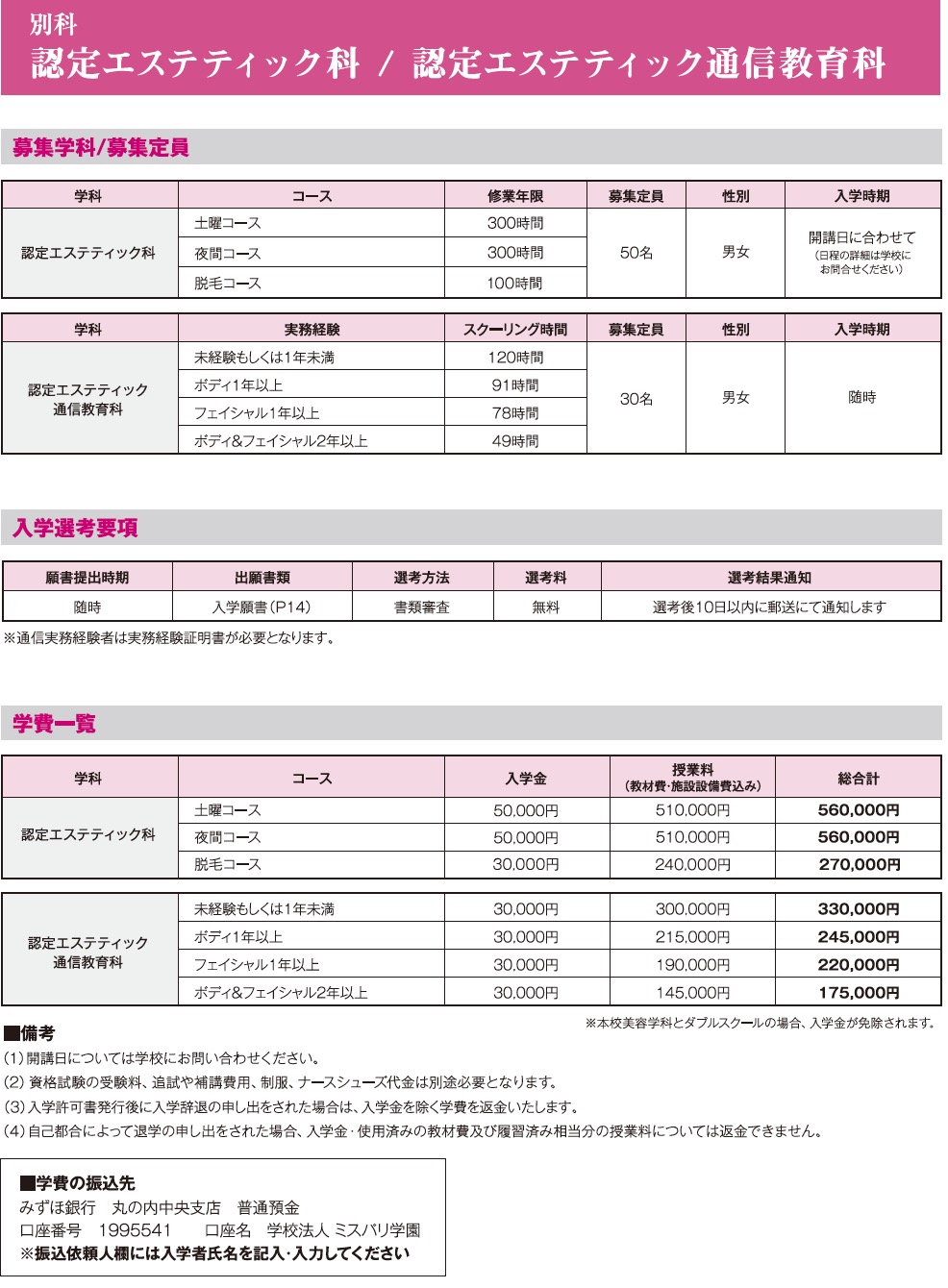
| Program Department | Published Base Tuition (2 Yrs) | Tool Kit & Consumables Fees | Total Cost of Attendance (2 Yrs) |
|---|---|---|---|
| Esthetic Course (CIDESCO & Spa Focus) | ¥2,300,000, ¥2,450,000 | ¥400,000, ¥500,000 | ¥2,950,000, ¥3,250,000 |
| Cosmetology Course (Hair & National License) | ¥2,150,000, ¥2,300,000 | ¥480,000, ¥560,000 | ¥2,850,000, ¥3,100,000 |
| Total Beauty Course (Nails, Makeup, Esthetics) | ¥2,350,000, ¥2,500,000 | ¥450,000, ¥550,000 | ¥3,050,000, ¥3,350,000 |

Hidden Tool Kits, Uniforms, and International Examination Surcharges
The gap between base tuition and total cash requirements stems from required personal items. Unlike university lectures where textbooks can be acquired secondhand, Miss Paris mandates direct purchase of brand-new, inspection-cleared practical sets. Students in the cosmetology license examination prep track must buy professional-grade Japanese shears, sectioning clips, hairpieces, styling irons, sanitizing boxes, and testing mannequins conforming to Ministry of Health, Labour and Welfare testing standards. These toolkits run upwards of ¥450,000.
For esthetic tracks, personal equipment bags include proprietary skincare kits formulated by Miss Paris cosmetics laboratories, individual brush collections, extraction gear, and body-wrap linens. Running out of creams or treatment peels during classroom sessions requires immediate repurchase from the internal school depot.
Testing charges introduce a secondary layer of unplanned out-of-pocket costs. Miss Paris emphasizes world-class qualifications, most notably the Swiss CIDESCO International Diplome alongside Japan Esthetic Association (AJESTHE) credentials. The CIDESCO certification examination fees, encompassing registration fees, case study administration fees, practical assessment materials, and processing costs, can add between ¥60,000 and ¥120,000 per sitting. If a student fails to clear a practical section on their initial trial, re-examination testing charges fall entirely upon the student.
Funding Pathways: JASSO Aid, Payment Plans, and Corporate Pledges
Few domestic students pay the multi-million yen balance purely out of household checking reserves. The most accessible safety net is the Japan Student Services Organization scholarships framework. Qualifying Japanese citizens and eligible long-term foreign residents can draw upon Type 1 interest-free loans or Type 2 low-interest loans. Students from lower-income brackets can also secure government tuition waivers through Japan’s higher education tuition reduction system, shaving hundreds of thousands of yen off primary institutional costs.
For families managing cash reserves across tight quarters, the administration offers tuition installment payment plans. Rather than demanding massive lump sums before each academic year, approved students can divide annual tuition into monthly or quarterly remittances, softening the impact on domestic budgets.
A separate alternative exists through the school's unique corporate umbilical cord. Miss Paris Group operates hundreds of premium aesthetics salons across Japan and overseas. High-performing students who clear early interviews can access proprietary corporate scholarship advances or signing loan programs. Under these arrangements, the company finances an agreed portion of the student's final-year studies in exchange for a binding multi-year employment commitment post-graduation. Leaving the firm ahead of the designated service period triggers an immediate repayment clause, locking the newly minted technician to company salon floors through their early career.
Evaluating the Return on Investment in Japan's Luxury Wellness Sector
Assessing the spa therapy and wellness diploma ROI comes down to immediate placement efficiency versus entry-level wage ceilings. Graduating from Miss Paris Beauty College carries distinct hiring weight. Top-tier luxury spas, high-end hotel chains, and the Miss Paris Group salon network recruit heavily from the campus, yielding a verified job placement rate consistently touching 98% to 100%.
Entry-level economic realities, however, contrast sharply with the luxury image promoted during orientation. Newly certified estheticians entering Japanese urban salons typically command initial gross wages between ¥220,000 and ¥255,000 per month before taxes and social insurance deductions. Long shifts, weekend service rotas, and physically taxing manual techniques define the initial 24 to 36 months of employment. Commissions on corporate retail skincare sales provide supplementary income, but base wages remain constrained across the industry.
The financial payoff accelerates for therapists who actively capitalize on CIDESCO credentials. Holding an internationally recognized certification enables skilled practitioners to transition out of standard commercial salon floors into medical dermatology clinics, global resort spas, or independent boutique businesses where hourly billings rise sharply. For those who stay the course, the structured training and strict corporate etiquette instilled at Miss Paris yield career durability. Those expecting high entry wages to instantly offset a ¥3.2 million tuition debt, however, find that recouping their initial outlay requires at least three to four years of rigorous salon work.
Frequently Asked Questions (FAQ)
Q1: What is the exact total cost of attending Miss Paris Beauty College for two years?
A1: While official baseline tuition ranges from ¥2.2 million to ¥2.5 million, the real two-year cost of attendance, including practical toolkits, required clinical uniforms, consumable product refills, and mandatory certification examination fees, ranges between ¥2.85 million and ¥3.35 million depending on the chosen specialty.
Q2: Can international students access installment plans and JASSO scholarships?
A2: Installment payment plans can be arranged through the school's finance office with proper guarantor documentation. JASSO scholarships, however, are primarily restricted to Japanese nationals, special permanent residents, and non-Japanese students with permanent or spouse-based residency visas. General international student visa holders must rely on private international study grants, private school discounts, or self-funded bank balances.
Q3: Are tool kits and uniforms mandatory, or can students source their own equipment?
A3: Every student must purchase the standardized kits provided by the college. The toolkits are configured to match classroom instruction sequences, specific sanitization codes, and testing requirements for both the Japanese national cosmetology boards and international bodies like CIDESCO.
Q4: How does the Miss Paris Group corporate scholarship system work?
A4: Selected students receive tuition funding directly from Miss Paris Group's corporate arm in return for signing an employment contract to work at company-operated salons, such as Dandy House or Esthetic Miss Paris, for a designated period (typically two to three years) following graduation. Terminating the employment contract early requires repaying the remaining tuition balance.
Making the Final Call on the Miss Paris Premium
Enrolling at Miss Paris Beauty College represents a deliberate trade-off: paying top-tier tuition in exchange for elite physical facilities, rigorous corporate grooming, and an unmatched institutional bridge into Japan's luxury beauty industry. The school does not compete on price. Local public vocational academies and smaller independent beauty colleges charge substantially lower fees, often saving students between ¥800,000 and ¥1.2 million across an identical two-year educational span.
Applicants aiming for modest community salons or casual styling shops will struggle to justify the premium price tag. For those who intend to build their careers in luxury spa management, five-star hotel wellness suites, medical esthetic clinics, or the Miss Paris salon network itself, the investment delivers tangible brand prestige and clear operational competence. The essential requirement is stepping into the admissions office with eyes open to the complete invoice, anticipating every kit expense, certification charge, and consumable replenishment fee before making the first payment.
