Mos Burger Ordering Myths Debunked: Mobile Order Hacks, Timing Rules, and Customization Facts

Mos Burger Ordering Myths Debunked: Mobile Hacks, Timing Rules, and Customization Facts
Walking into a Mos Burger in Tokyo or Osaka without understanding its kitchen rhythms usually leads to confusion or an unexpectedly long wait. Unlike Western fast-food giants built around batch-cooked heat chutes, Mos Burger prepares every item strictly after receiving the ticket. As detailed in recent analysis from a Yahoo!ニュース Report on chain menu rollouts and order dynamics, diners frequently misinterpret how digital tools, kitchen prep schedules, and counter requests intersect across the chain's network of over 1,300 locations.
Social media rumors claim you can double any sauce for free, score secret off-menu items, or bypass breakfast limits at the register. Most of these viral claims fall apart under scrutiny. Navigating the register requires separating corporate policy from urban legend, especially as the chain accelerates high-end digital reservations, app payments, and revamped morning service across Japan.
📌 Key Takeaways:
- Morning Deadlines: The Morning Mos menu strictly concludes at 10:30 AM, governed by point-of-sale registers that lock out breakfast inventory automatically across all franchised stores.
- Customization Policies: Kitchens honor requests for extra meat sauce or onion adjustments within reasonable bounds at zero charge, but meat patties and custom bun swaps require fixed menu upgrades.
- Digital Reservation Advantages: Advance web ordering bypasses physical waiting areas and eliminates the classic number-stand delay, while earning up to 2% back on registered digital cards.
How the "Made-After-Order" Kitchen Culture Created Today's Order Bottlenecks
Mos Food Services was established in 1972 on a simple operational premise: assemble every burger strictly to order. That commitment gave birth to the brand's iconic meat sauce and fresh vegetable crunch, but it also cemented a dining reality that tourists and casual visitors rarely expect. Walk up to an in-store counter, pay cash, take a numbered plastic stand, and sit down. Your meal will arrive between 7 and 15 minutes later, delivered by hand directly to your seat.
During peak lunch hours between 12:00 PM and 1:30 PM, those production lines stretch thin. Because cooks grill patties, steam buns, and ladle scalding-hot bolognese individually, three customer groups ahead of you can trigger a 20-minute bottleneck. The brand did not design its physical layout for lightning-fast drive-thru throughput. Understanding that structural trade-off explains why recent operational adjustments center on digital pre-orders and precise kitchen timing.
The Truth About the 10:30 AM Morning Mos Cutoff and Sauce Adjustments
A persistent rumor on travel forums suggests counter staff can quietly slip you a breakfast sandwich at 10:35 AM if inventory remains. That is false. Mos Food Services rolled out a sweeping overhaul of its morning lineup, introducing items like the Morning Vegetable Burger with Aurora Sauce and toasted breakfast hot dogs alongside morning drink pairings. Kitchen displays and internal POS registers lock the Morning Mos menu at exactly 10:30 AM. Staff cannot ring up morning items past that mark because register software blocks the product codes.
Customization rules, on the other hand, offer surprising flexibility if you know how to phrase them. Japanese social media calls these adjustments urawaza (tricks), though company handbooks define them as standard customer hospitality:
- Extra Sauce Request (ソース多め - Source Oome): You can request extra signature meat sauce on the classic Mos Burger or teriyaki sauce on chicken and beef patties. Staff ladle an extra portion at zero additional charge.
- Onion Adjustments (玉ねぎ多め / 抜き - Tamanegi Oome / Nuki): Finely chopped raw onions inside the signature Mos Burger can be increased or removed entirely.
- Vegetable Swaps and Removals: Mustard, mayonnaise, and pickles can be omitted cleanly. Patrons with specific sensitivities can request allergy and ingredient customization directly at the register, where clerks provide laminated allergen charts displaying the top eight mandatory reporting ingredients.
- Extra Wrapping: If you order a messy, sauce-heavy burger, asking for an extra wrapper paper (baigaishi) ensures you can capture the residual sauce without it bursting open onto your tray.
There are firm boundaries to this flexibility. You cannot request "extra beef" or swap regular buns for steamed rice discs for free. Modifying structural ingredients requires ordering distinct menu SKUs like the Mos Rice Burger or double-patty variations directly.
Comparing Mos Burger Ordering Channels: Register, App, and Advance Web Reserve
Choosing the right transaction path saves money, eliminates language barriers, and avoids waiting near the counter. Different sales channels handle custom requests, tax points, and pickup workflows distinctively.
| Ordering Channel | Customization Support | Payment & Reward Perks | Wait Time Profile |
|---|---|---|---|
| Physical Register (Counter) | Full support (verbal requests for sauce, vegetables, mustard). | Cash, transit cards (Suica/Pasmo), credit, Mos Card, Rakuten/d-Points. | 8, 18 minutes (table delivery via plastic number stand). |
| Official Mobile App Order | Partial (set toggles for no-onion or no-mustard; extra sauce not always selectable). | Integrated Mos Card grants 1%, 2% reward points, credit cards, PayPay. | 0, 3 minutes (dedicated ticket pickup system counter). |
| Online Advance Reservation (EC) | Fixed builds exclusively (designed for seasonal high-end releases). | Pre-paid credit cards; includes cold-chain delivery options. | Scheduled delivery or fixed-date pickup windows. |
The standard tax rules apply: in Japan, dining inside the store incurs a 10% consumption tax, whereas takeout orders incur the reduced 8% tax rate. Self-order touchscreens and counter staff will ask "Tennai de omeshiagari desu ka?" (Will you dine in?) to apply the correct taxation band. Attempting to order takeout at 8% and sitting down at an open table violates local tax rules and creates friction with floor staff.
Specialty Drops and High-End Booking: The Rise of Luxury Rice Burgers
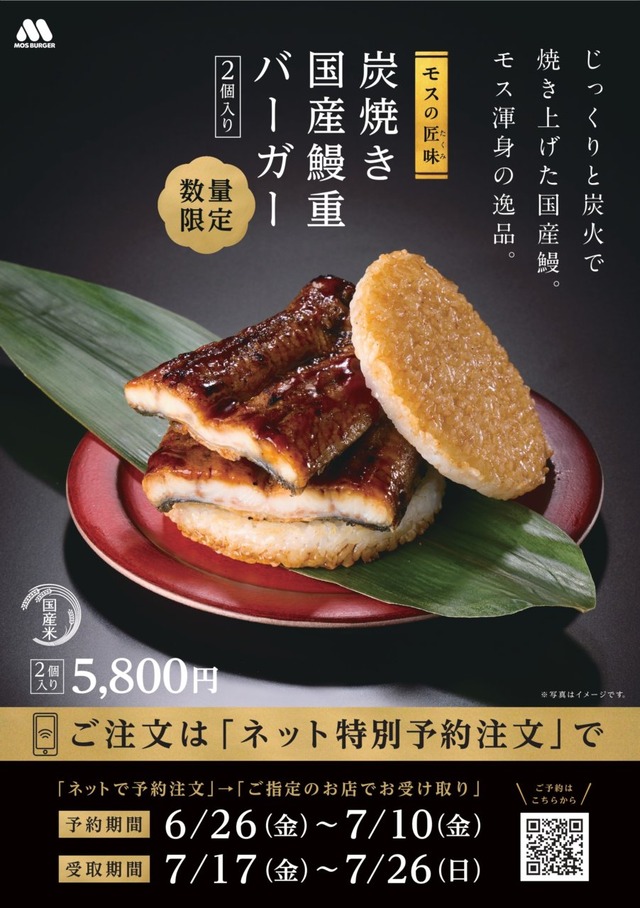
While the regular menu hinges on everyday favorites like the Yakiniku Rice Burger and Spicy Mos Cheeseburger, the brand has pushed into premium online advance reservations. Consider the release of the "Mos no Takumi" Charcoal Grilled Domestic Unaju Burger. Priced at 5,800 yen for a two-burger package, the brand opened reservations via its official online shop ahead of the traditional summer midsummer Day of the Ox (Doyo no Ushi no Hi).
The item utilizes an entire domestic Japanese eel filleted over grilled rice patties, shipped under deep-freeze conditions or picked up through specialized channels. This shift proves that Mos Burger treats its rice platform not merely as a novelty substitute for wheat bread, but as a culinary canvas. If you want high-tier seasonal limited edition burgers or collaborative releases, physical walk-ins often find shelves cleared out within hours. Setting up an online profile through the Japanese site remains the only dependable way to secure these specialty releases.
Mastering Counter Language, Digital Wallets, and In-Store Pickup
English menu availability varies dramatically. Major transport hubs in Shinjuku, Shibuya, or Kansai Airport feature full bilingual laminated menus at the counter. In residential neighborhoods, you will encounter monolingual Japanese overhead displays. You can simply ask for "Eigo menyu ga arimasu ka?" to get an English folder with allergen matrices and item descriptions.
If you prefer using the Mos Burger mobile app, remember that the payment engine prioritizes the digital Mos Card. Loading funds onto your virtual Mos Card using a credit card on designated "Mos Card Action Days" (typically the 25th to the 29th of every month) yields a 4% balance bonus, in addition to standard loyalty redemptions. If you do not have a Japanese phone number to register the app, transit IC cards like Suica or Pasmo tapped against the counter terminal provide the fastest checkout experience.
When collecting your food in a busy downtown shop, listen for the bell or watch the visual ticket pickup screen. Digital app orders bypass the table-delivery wait entirely: walk straight up to the pickup shelf (Uketori-guchi), match the numerical digits from your smartphone receipt, and take your thermal paper-wrapped parcel.
Frequently Asked Questions (FAQ)
Q1: Can I ask for a burger wrapped in lettuce instead of bread at the register?
A1: Yes. Mos Burger offers a standardized menu option called the "Natsumi" series (モスの菜摘). The kitchen replaces wheat buns with crisp iceberg lettuce leaves wrapped around patties like teriyaki chicken, pork cutlet, or beef. You can order it straight from the counter or the mobile app.
Q2: Why did my French fry order take 12 minutes to arrive when the dining room was half empty?
A2: Mos Burger fries all potatoes and onion rings in batches only after order tickets register. If several delivery platform couriers (Uber Eats or Demae-can) or mobile app advance pickups were queued ahead of your receipt, the kitchen prepares those orders chronologically regardless of how many people are sitting in the dining room.
Q3: How do I eat a sauce-heavy burger without making an absolute mess?
A3: Keep the burger inside the square paper wrapper pouch without pulling it out. Fold the edges slightly back as you eat down toward the center. Once the burger is finished, Japanese diners often use their French fries to dip into the pool of warm meat sauce remaining at the bottom corner of the wrapper.
Navigating Mos Burger with Confidence
Dining at Mos Burger requires adjusting your expectations away from conventional fast-food assembly lines. You are patronizing a hybrid between a casual restaurant and an express kitchen. Arrive before 10:30 AM if you want breakfast items, keep sauce adjustments polite and concise at the register, and lean on the mobile ordering channel during bustling lunch rushes. Respecting these operational boundaries turns an otherwise confusing counter interaction into one of the most reliable quick-service meals in Japan.
