New Under-Eye Tightening Protocols Launched Across Premier Osaka Clinics

Aesthetic clinics across Osaka's primary medical hubs in Umeda and Shinsaibashi are overhauling how they treat infraorbital aging. Driven by shifting patient demographics and technical refinements, practitioners are steering away from aggressive fat removal and toward preservation-focused structural correction. A recent PR TIMES Report highlighted that home-care instructional resources for women over 50 targeting lower face and under-eye sagging distributed more than 1,000 copies, underscoring intense consumer focus on periorbital aging. Yet while topical regimens address surface-level skin elasticity, they cannot alter the anatomical shift of descending fat pads.
To address this physiological gap, Osaka aesthetic plastic surgery centers are rolling out combined protocols that match non-surgical skin tightening with micro-incisional operations. The result is a more nuanced, individualized approach to dark circles and eye bag correction that prioritizes long-term facial architecture over temporary fixes.
📌 Key Takeaways:
- Anatomical Realignment: Transconjunctival lower blepharoplasty and orbital fat repositioning have replaced simple fat excision as the regional gold standard to prevent post-operative hollows.
- Non-Invasive Options: Patients with mild skin laxity increasingly choose radiofrequency under-eye treatment and targeted ultrasound to defer surgical intervention.
- Financial and Clinical Realities: Corrective procedures in Osaka range from ¥150,000 for non-cutting modalities to upwards of ¥650,000 for advanced surgical methods, with downtime spanning 2 to 14 days.
Behind Osaka's Rising Demand for Periorbital Procedures
The periorbital zone is historically the first region of the face to betray chronological age. In Western Japan, Osaka functions as the central clearinghouse for cosmetic surgery innovations, drawing patients from Hyogo, Kyoto, and across the Kansai basin. Clinics in Kita-ku and Chuo-ku report a distinct shift in client requests: patients rarely ask for a generic "refreshed" look anymore. Instead, they present specific anatomical complaints, specifically the protruding triangular fat pads beneath the eyes and the shadow-casting tear trough groove below them.
Three distinct structural issues drive this concern. First, the orbital septum, the connective membrane holding back intraorbital fat, thins with age, permitting the central and medial fat pads to push forward. Second, the cheek fat pads descend, widening the distance between the lower eyelid and the midface. Third, dermal collagen depletes, leaving paper-thin skin that accentuates underlying venous structures. Treating these three interrelated factors simultaneously requires far more than generic fillers or superficial peels.
Non-Cutting Interventions Versus Deep Structural Surgery
Clinics along Osaka's Midosuji boulevard divide under-eye interventions into two core camps: thermal tightening modalities and surgical interventions. For patients in their late twenties to late thirties presenting with early-stage skin laxity rather than pronounced fat herniation, non-surgical skin tightening offers a viable holding pattern. Practitioners deploy focused radiofrequency under-eye treatment devices equipped with micro-insulated needles, such as Agnes, or external monopolar RF platforms like Thermage Eye. These systems deliver targeted thermal injury to the reticular dermis, inducing neocollagenesis without breaking the surface skin.
Non-invasive energy devices, however, reach an absolute anatomical wall when pseudoherniated orbital fat is prominent. Radiofrequency cannot dissolve substantial fat pads without risking tissue fibrosis or dermal burns. When significant fat protrusion casts visible shadows, transconjunctival lower blepharoplasty becomes the primary recommendation. Performed via a tiny incision on the internal mucous membrane of the eyelid (the conjunctiva), this method leaves zero visible external scars while granting surgeons direct access to the medial, central, and lateral fat compartments.
Procedural Spectrum: Methods, Costs, and Downtime Compared
Understanding the balance between recovery commitment, surgical invasiveness, and total financial investment is essential for patients researching under-eye bag removal Osaka options. The following comparison outlines the primary procedures currently deployed across major Umeda and Shinsaibashi cosmetic practices.
| Treatment Modality | Anatomical Mechanism | Average Recovery Time | Typical Cost Range (JPY) |
|---|---|---|---|
| Radiofrequency / HIFU Tightening | Dermal heating to stimulate collagen contraction and mild septal tightening | 0, 2 days (minor redness) | ¥80,000, ¥180,000 per session |
| Transconjunctival Fat Removal | Direct excision of protruding orbital fat pads through an internal conjunctival cut | 5, 7 days (bruising, mild edema) | ¥200,000, ¥380,000 |
| Fat Repositioning (Internal Hamra) | Shifting and anchoring herniated fat into the tear trough depression below the orbital rim | 7, 10 days (moderate swelling) | ¥350,000, ¥550,000 |
| Extended Hamra / Skin Excision | External subciliary cut to reposition fat, tighten the orbicularis muscle, and trim redundant skin | 10, 14 days (visible stitches removed day 7) | ¥450,000, ¥700,000 |
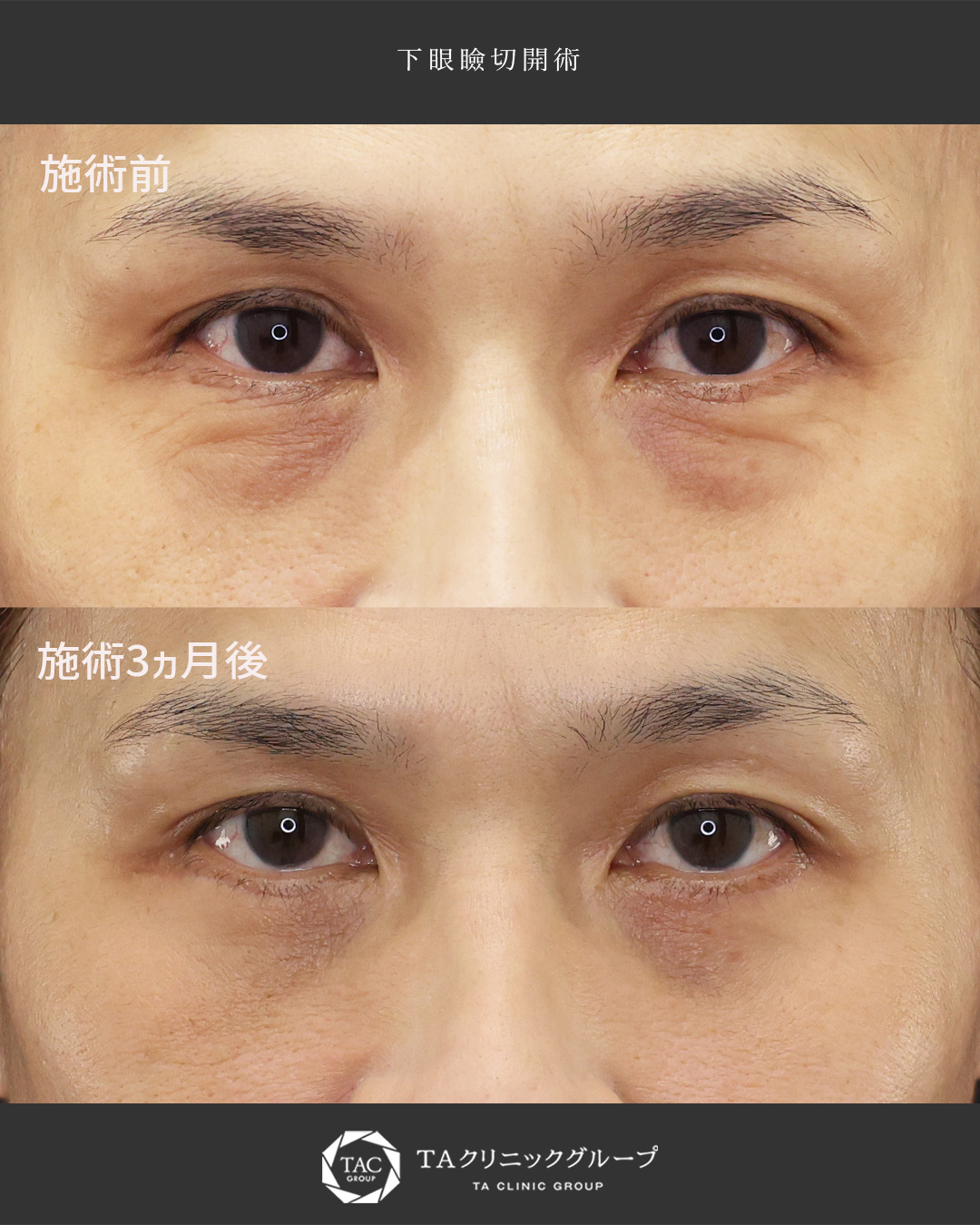
The Surgical Shift Toward Orbital Fat Repositioning and the Hamra Method
For decades, standard lower blepharoplasty relied on straightforward excision: surgeons cut into the eyelid and simply trimmed away bulging fat. While this flattened the eye bag immediately, it frequently created severe secondary complications years down the road. Patients developed an unnaturally sunken, skeletonized appearance around the lower orbital rim, exacerbating dark circles rather than resolving them.
Today, leading board-certified plastic surgeons in Osaka favor orbital fat repositioning, widely known as the Hamra method. Instead of discarding the protruding fat, the surgeon releases the tear trough ligament and mobilizes the fat downward over the infraorbital bone. This maneuver fills the hollow valley beneath the eye using the patient's own living vascularized tissue, eliminating the step-off deformity between eyelid and cheek.
Tear trough rejuvenation achieved through this approach avoids the risks of synthetic dermal fillers, such as vascular occlusion or the bluish Tyndall scattering that occurs when hyaluronic acid sits too close to the surface. It also bypasses the variable resorption rates of autologous fat grafting taken from the thighs or abdomen.
Navigating Clinical Consultations Across Umeda and Shinsaibashi
Prospective patients scheduling Umeda cosmetic clinic consultations face a crowded marketplace ranging from small boutique surgical ateliers to high-volume commercial chains. Distinguishing between sales pitches and sound surgical judgment requires assessing how the clinic diagnoses the underlying dark circle.
Dark circles are not uniform. Blue circles reflect vascular visibility through thin skin; brown circles stem from epidermal hyperpigmentation; black or shadow circles result from three-dimensional fat protrusions casting light shadows. Reputable clinics use cross-polarized dermoscopy and high-resolution 3D facial scanning to demonstrate whether a patient's primary deficit is pigmentary, structural, or volumetric. If a clinic recommends simple fat extraction without evaluating the depth of the tear trough groove, patients risk ending up with hollowed under-eyes that darken the shadows instead of softening them.
Clinical Risks and Anatomical Red Flags to Assess
While lower blepharoplasty recovery time is generally manageable, most swelling resolves within 7 to 10 days, under-eye surgery carries distinct risks that demand strict candidate selection. External skin incisions carry the risk of ectropion, a condition where the lower eyelid pulls downward and turns outward, exposing the sclera and cornea. This happens when surgeons resect excessive skin or fail to anchor the lateral canthal tendon to the periosteum.
Patients with negative vector anatomy, where the cornea projects further forward than the lower eyelid margin and malar cheek prominence, face an elevated risk of eyelid malposition. In these anatomical profiles, transconjunctival approaches without external skin cuts are substantially safer. Reviewing clear before-and-after cases of patients with matching bone structures remains a baseline safeguard during pre-operative planning.
Frequently Asked Questions (FAQ)
Q1: What is the true lower blepharoplasty recovery time before returning to work?
For internal transconjunctival procedures, internal swelling peaks at 48 hours and visibly recedes by day 5 to 7; most patients return to office work within a week wearing light makeup or tinted glasses. External skin-excision procedures require 7 to 10 days before stitch removal, with faint residual bruising lasting up to two weeks.
Q2: How much does comprehensive under-eye sagging treatment cost in Osaka?
Non-cutting radiofrequency or ultrasound treatments run between ¥80,000 and ¥180,000 per session. Standard transconjunctival fat extraction typically costs ¥200,000 to ¥380,000, whereas complex structural repositioning via the Hamra method Osaka specialists perform ranges from ¥350,000 to ¥650,000 depending on anesthesia and facility fees.
Q3: Can non-surgical radiofrequency completely resolve protruding eye bags?
No. Energy-based devices tighten the overlying skin and mildly contract connective tissues, which can soften the appearance of minor laxity. They cannot physically shrink or reposition hereditary, herniated fat pads; moderate-to-severe herniation requires surgical mobilization.
Strategic Takeaways for Patients in 2026
The evolution of periorbital medicine in Osaka reflects a broader transformation across international aesthetic plastic surgery: the abandonment of destructive tissue removal in favor of anatomical preservation. Patients exploring options in Western Japan must prioritize surgical diagnostic precision over aggressive marketing claims. Clarifying whether your condition stems from septal laxity, tissue descent, or cutaneous pigmentation is the necessary starting point before booking either a laser suite or an operating theater.
