Secrets of Takada Honcho: How Century-Old Shops Are Reinventing Japan's Traditional Shopping Arcade
Heavy snow country does not forgive poor planning. In Joetsu City, Niigata Prefecture, the winter air carries the bitter chill of the Sea of Japan, dumping meters of snow along the avenues of castle town Takada. Yet along the Takada Honcho Shopping Arcade, foot traffic moves uninterrupted beneath timber awnings that have sheltered merchants for more than four centuries. While thousands of traditional Japanese retail arcades across regional prefectures have shuttered into silent "shutter streets," Takada Honcho is mounting a counteroffensive grounded in deep history, civic design, and grassroots visual arts.
The district is not leaning on nostalgia alone. As highlighted by an MSN Report covering the Winter Picture Signboard Festival on February 7, 2026, Takada Honcho has turned its status as a registered Hyakunen Shotengai (Centenary Shopping District) into an active civic laboratory. By fusing centuries-old confectionery craftsmanship and hyper-local gastronomy with community art commissions, this northern retail strip offers an alternative manual for small-town survival.
📌 Key Takeaways:
- Living History: Takada Honcho retains dozens of shops operating continuously for more than 100 to 200 years, anchored by architectural protections and legacy food production.
- The E-Kanban Strategy: Custom illustrated shop signboards, created through collaborations between legacy merchants and local students, have expanded across 38 storefronts as a functional tourism draw.
- Civic Resilience: Rather than relying on public subsidies or massive corporate developments, the street's machizukuri revival links historic pedestrian shelters, inclusive social art initiatives, and food festivals.
The Architectural Defense of Joetsu's Gangi Network
Takada's urban layout was designed around crisis. Founded in 1614 when Matsudaira Tadateru established Takada Castle, the town had to solve an existential problem: how to maintain commerce when snow accumulates three meters high. The answer was the gangi, privately owned wooden eaves extended out over public rights-of-way to form continuous covered walkways.
At its peak, Takada possessed more than 16 kilometers of uninterrupted gangi passages, the longest network anywhere in Japan. Walking through Honcho today feels distinct from traversing modern plastic-domed shopping centers. The cedar beams overhead, varying in height from one shopfront to the next, show the individual property lines of tradespeople who signed collective maintenance pacts during the Edo period. That structural interdependence set the precedent for how the street operates today.
When mass motorization gutted regional downtowns in the late twentieth century, suburban bypass malls pulled retail foot traffic away from Joetsu's historic core. Arcades without weather protection folded quickly. Takada Honcho held on because the gangi remained an essential winter pedestrian corridor connecting neighborhoods to schools, clinics, and municipal hubs. The street retained human presence when other districts went hollow.
Two Centuries of Mochi and Coastal Suruten
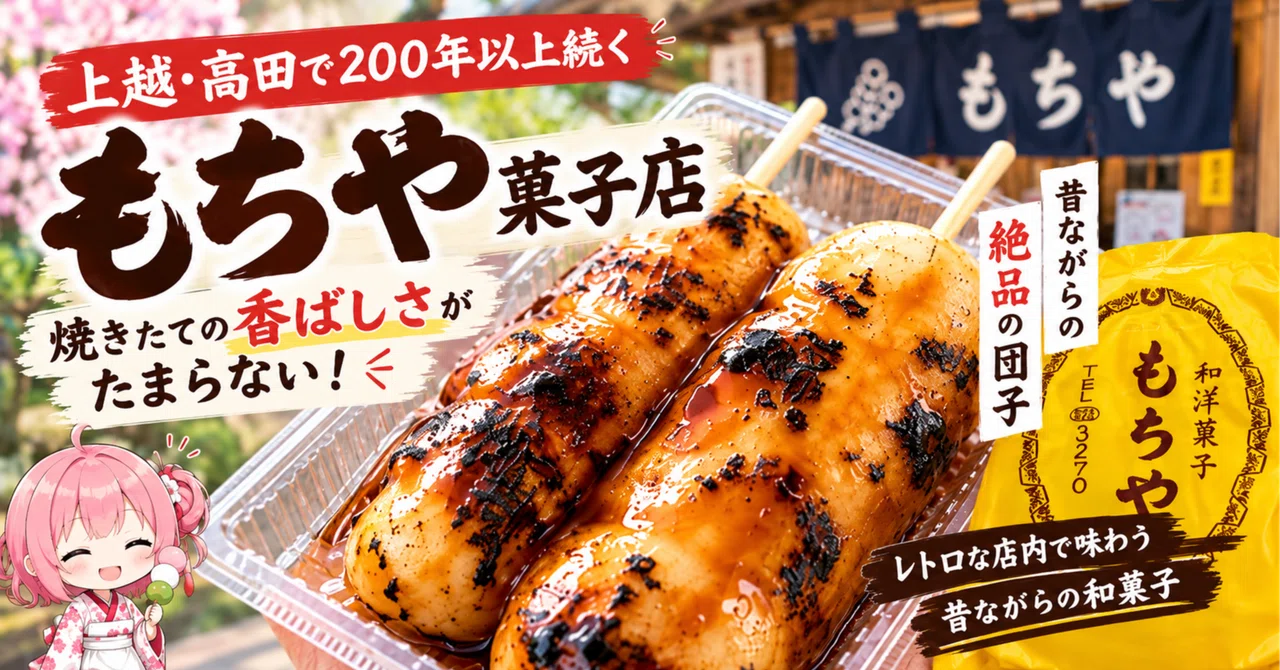
Commerce here rests on deeply rooted culinary habits. Consider Mochiya Kashi-ten (もちや菓子店), an Edo-era confectionery shop that has operated on this strip for more than 200 years. During the feudal era, it served as the castle town's sole authorized rice-cake specialist. Step through the threshold today, and the scent of charred soy sauce hits immediately. The shop still grates, shapes, and grills its skewered dango over open heat only after an order is placed. The paper bag warms your palms through the winter frost before you take the first bite.
A few blocks down, coastal commerce takes center stage in the form of suruten. This local staple, salt-cured squid, sun-dried briefly to concentrate umami, coated in batter and flash-fried into crisp tempura, dates back generations as preserved protein for the inland castle population. During regional events, including the Winter Picture Signboard Festival, food stalls and local diners serve piping hot suruten alongside bowls of soba and local rice.
These foods are not nostalgic novelties imported for tourists. They are routine provisions for the families living in the surrounding Honcho 3-, 4-, and 5-chome blocks. That local loyalty provides baseline revenue, shielding long-running vendors from sudden swings in broader travel markets.
The E-Kanban Movement: Visual Storytelling on the Eaves
To turn passive pedestrian foot traffic into deliberate cultural exploration, merchant leaders launched the e-kanban (painted signboard) project. Rather than installing uniform corporate logos or generic digital banners, shops commissioned large-format, hand-painted wooden signboards that tell the specific founding narrative of each business.
The program originally restricted participation to businesses that had traded for at least one century. Walking the corridor, visitors could identify a heritage apothecary, a century-old miso brewer, or an Meiji-era tea purveyor by looking up at vibrant illustrations showing Edo peddlers, Taisho-era storefronts, and hand-cranked machinery. In late November 2025, the project reached a major milestone when organizers unveiled new boards, bringing the official total to 38 decorated shops.
Crucially, the criteria shifted. The newest panels include enterprises striving toward their first hundred years of continuous operation, integrating younger trades into the heritage roster. The production process itself operates as a civic glue. Middle school art classes and graduate design students from regional universities partnered directly with shop proprietors to research archival records, draft concepts, and paint the wooden boards. The signs do not merely advertise goods; they document working family histories.

Factual Record: Evolution of Takada Honcho's Commercial Core
The resilience of Takada Honcho stems from continuous administrative adaptation rather than stubborn preservation. The table below traces how the district evolved from a feudal supply line into a modern model of cooperative commerce.
| Era | Structural Strategy | Economic & Cultural Anchor |
|---|---|---|
| Edo Period (1614, 1868) | Construction of private timber gangi walkways under castle decree | Guild monopolies; sole-supplier confectionery houses (e.g., Mochiya) |
| Showa Expansion (1950, 1985) | Modernization of covered arcades; introduction of concrete storefronts | Regional commercial dominance serving inland Kubiki plain farm towns |
| Crisis & Realignment (1990, 2010) | Formation of the Hyakunen Shotengai network to defend against suburban malls | Cataloging legacy family shops with continuous century-long operation |
| Modern Machizukuri (2020, 2026) | Deployment of 38 e-kanban; youth art collaborations; accessible walkways | Culinary festivals (suruten), sake labeling programs, cultural walking tourism |
Inclusive Art and the Niigata Sake Project
Takada Honcho does not rely exclusively on antique trades. The district serves as an experimental venue for grassroots social enterprise. In October 2025, the shopping street hosted the public exhibition for "Bokura no ShuShuShu" (ぼくらのShuShuShu), an initiative pairing independent Niigata sake breweries with artists with intellectual and psychiatric disabilities.
Original paintings and photographs created by these local artists were converted into striking, high-design labels wrapped around premium junmai bottles produced across Joetsu's rich rice belt. Instead of confining the artwork to sterile civic centers, organizers placed the installations directly inside Honcho storefronts. Shoppers picking up dry goods or household items found themselves standing in front of expressive, contemporary abstract canvases.
The strategy solved two challenges at once. It generated sustainable licensing income for local social welfare programs while giving regional sake producers an artistic retail presence that caught the eye of younger buyers. This approach treats the commercial arcade as a common platform for neighborhood welfare rather than just a place to buy goods.
Why Takada Thrives While Competing Shotengai Fade
Urban revitalization in regional Japan often stumbles on top-down construction projects: costly civic plazas, parking garages nobody uses, and empty community hubs. Takada Honcho avoided those pitfalls by adhering to three hard rules.
First, property ownership has remained overwhelmingly local. Many storefronts house the third, fourth, or fifth generation of the founding family living above the shop floor. Because the operators own their real estate outright, they are not subject to crushing lease payments during slower tourist months. This allows specialty food purveyors and small stationers to weather macroeconomic pressures that topple leveraged retail chains.
Second, the merchant association avoids isolating itself from the youth population. By inviting junior high and graduate students into the creation of the e-kanban, shopkeepers built personal links with the rising generation. A teenager who spent weeks interviewing a dry-goods master to paint a signboard views that street as a personal civic asset, not a dated strip for elderly neighbors.
Third, culinary authenticity is kept accessible. Specialties like suruten and freshly roasted mochi sell for a few hundred yen. The district remains a functional destination for everyday locals rather than an overpriced historical theme park. Tourism serves as an auxiliary stream of revenue, not the sole foundation.
Frequently Asked Questions (FAQ)
Q1: What is the best season to explore Takada Honcho Shopping Arcade?
A1: Early February is ideal for experiencing the Winter Picture Signboard Festival and sampling fresh suruten tempura while seeing the historical gangi covered walkways function in deep snow. Spring is equally compelling, as the street sits minutes from Takada Castle Site Park, home to one of Japan's top three nighttime cherry blossom festivals in April.
Q2: How do travelers access the Takada Honcho shopping street?
A2: Take the Hokuriku Shinkansen to Joetsu-Myoko Station. From there, transfer to the local Echigo Tokimeki Railway Myoko Haneuma Line for a six-minute ride to Takada Station. The Honcho shopping district begins less than a five-minute walk east of the station exit.
Q3: How many shops currently feature the hand-painted e-kanban signs?
A3: As of early 2026, 38 commercial storefronts display certified e-kanban signboards. The project has expanded beyond shops over 100 years old to include newer neighborhood retailers working toward their centennial mark.
The Road Ahead for Joetsu's Living Corridor
The lessons emerging from Takada Honcho go far beyond regional Niigata. Across Japan, aging demographics and rural flight have forced hundreds of shopping streets into managed decline. Takada proves that longevity is not preserved under museum glass; it is maintained by everyday use.
By treating its four-hundred-year-old snow walkways as functional daily infrastructure, trusting neighborhood students with its public imagery, and refusing to compromise on traditional food production, Takada Honcho preserves its past by putting it to work. As fresh signboards join the eaves and hot oil sizzles along the winter walkway, this castle town district continues to write its own future, one storefront at a time.
