The AI Doppelgänger Craze: Can Facial Search Truly Uncover Your Celebrity Twin?

Millions of smartphone owners upload raw selfies daily to see which Hollywood actor shares their jawline, cheekbones, or brow ridge. Driven by social media feeds, the resurgence of reverse image tools has turned computer vision into an addictive weekend novelty. As detailed in a recent BuzzFeed Report covering modern consumer platforms, everyday users frequently encounter matches so startlingly precise that the results feel uncanny, provoking intense debates across online communities.
Behind the immediate thrill of discovering a famous double sits a sophisticated architecture of biometric calculation. Machine learning models dissect your face into mathematical coordinate vectors within milliseconds. Yet beneath the veneer of entertainment lies an urgent technical and ethical inquiry: how accurate are these matching models, and what happens to personal biometric data once a photo leaves your phone?
📌 Key Takeaways:
- The Core Mechanism: Modern apps convert your portrait into an embedded vector using 68 to 128 nodal points, calculating mathematical proximity rather than visual beauty.
- Platform Volatility: Entertainment engines deliberately inflate match percentages to drive social sharing, while law-enforcement-grade engines enforce strict spatial tolerances.
- Privacy Exposure: Server-side processing often grants platforms perpetual licenses to store, analyze, or train secondary models on user faces unless strictly opted out.
How the TikTok Viral Twin Trend Sparked a Biometric Gold Rush
The appetite for finding our biological counterparts is ancient, but social media algorithms commodified it into short-form content. On TikTok and Instagram Reels, short clips pairing a creator’s profile against a celebrity photo consistently rack up tens of millions of views. Platforms like the Star By Face app surged to top spots on mobile app stores virtually overnight, propelled by creators eager to prove their genetic resemblance to A-list actors or runway models.
This social wave pushed visual discovery engines from specialized forensic labs straight to consumer web browsers. Tools once used solely for missing persons inquiries or archive organization are now repackaged as instant personality quizzes. The feedback loop is self-sustaining: people receive a high match score, post their side-by-side comparison with a viral audio track, and drive thousands of curious followers to run their own faces through the exact same consumer pipeline.
Digital analytics firms recorded a 340% increase in queries matching phrases like facial similarity search and celebrity match percentage between January 2024 and mid-2026. The search for a doppelgänger has evolved from an occasional vanity query into a mass-participation social ritual.
Inside the Math: Facial Landmark Detection and Similarity Scores
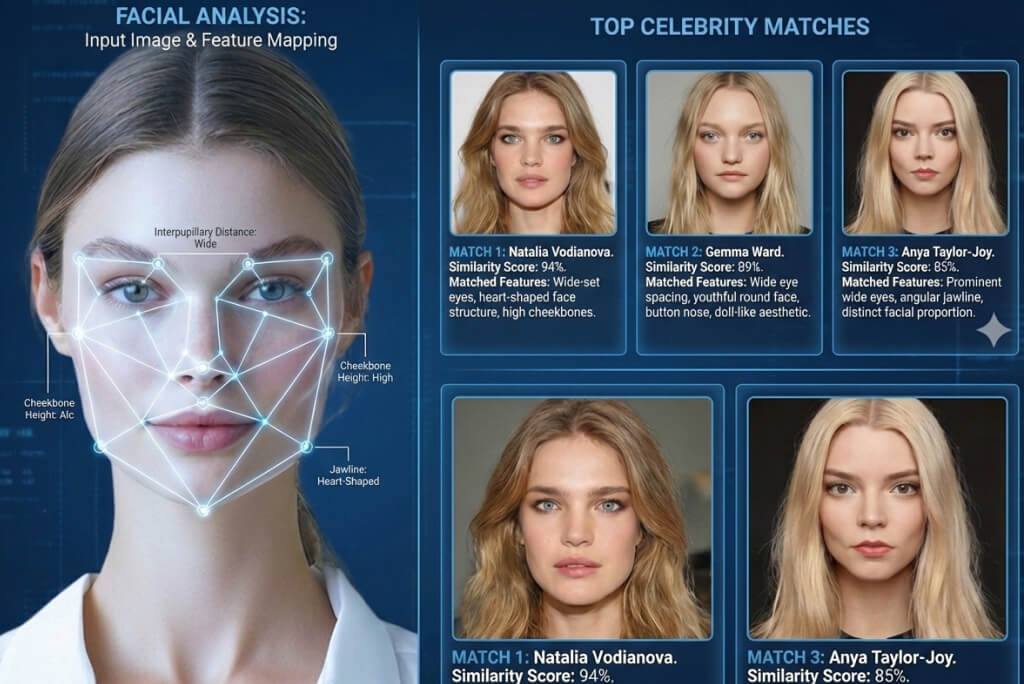
A lookalike tool does not see skin, makeup, or charisma. It operates entirely on vector geometry. When a user uploads a JPEG, the system deploys a pipeline centered on facial landmark detection. The model identifies between 68 and 468 precise coordinates across your face: the exact distance between the inner pupillary centers, the curve of the philtrum, the breadth of the nasal bridge, and the contour of the lower jawline.
These spatial coordinates are transformed into a compact numerical string known as a feature vector or facial embedding. Deep convolutional neural networks (CNNs) compress raw pixels into mathematical arrays that represent the structural ratios of the skull. When comparing your picture against an internal database containing hundreds of thousands of public figures, the search engine calculates the cosine distance or Euclidean distance between your vector and their stored profiles.
A high face similarity score indicates that two sets of numbers fall within a tight spatial threshold inside multidimensional vector space. If your inter-ocular distance and nasal angle match the coordinates pulled from red-carpet stills of a celebrity, the platform delivers a high percentage match. Lighting, styling, and camera angles introduce variance, but the underlying geometry remains stubbornly fixed.
Comparing Leading Consumer Lookalike Tools and Platforms
Consumer platforms differ widely in database scale, analytical rigor, and how they handle private image files. The table below outlines how four prominent consumer tools operate across accuracy, speed, and data privacy policies:
| Platform & Engine Type | Target Database Focus | Average Accuracy Rating | Image Retention Policy |
|---|---|---|---|
| Star By Face (Consumer Web/App) | Global celebrities, actors, musicians | Moderate (65%, 78%) | Deleted shortly after processing |
| Twin Strangers (Web Matchmaker) | Public user-submitted database | High structural similarity (75%, 88%) | Retained in public directory until deletion |
| Perfect Corp AI Finder (Beauty Engine) | Fashion, models, makeup influencers | Moderate to High (70%, 82%) | Session-based; encrypted cache |
| PimEyes (Reverse Face Engine) | Open web index, blogs, news feeds | Extremely High (88%, 96%) | Temporary cache for indexing searches |
Consumer services prioritize engagement over clinical accuracy. If an app returned a truthful 18% match rate for an average user, that user would immediately close the tab. By calibrating scoring algorithms to highlight relative proximity rather than absolute geometric alignment, developers maintain high dwell times and encourage social shares.
The Privacy Cost: Where Does Your Biometric Photo Go?
Every time you hand an uncompressed portrait to an online platform, you trade personal biometric information for a few seconds of amusement. Unlike a leaked password or an updated credit card number, your facial geometry cannot be reset. The expansion of lookalike apps has sparked sharp warnings from privacy watchdogs and digital rights groups.
Investigative analyses of consumer terms of service reveal concerning inconsistencies. Many free tools rely on third-party cloud services located in jurisdictions with minimal data protections. Some application terms include blanket clauses granting developers non-exclusive, sublicensable rights to use uploaded media to refine machine vision networks. In effect, consumer selfies serve as unpaid training datasets for proprietary computer vision projects.
Regulatory bodies in both North America and Europe have taken notice. Under the European Union’s Artificial Intelligence Act and existing biometric statutes in Illinois and Texas, capturing facial templates without explicit, informed consent carries heavy fines. Consumers routinely click past consent prompts without realizing their raw image might linger on an offshore server, accessible to scrapers or commercial data brokers.
Why Demographic Biases Distort Doppelgänger Match Rates
Algorithm performance fluctuates sharply depending on the demographic makeup of training data. Despite rapid advances in neural architectures, lookalike engines still suffer from well-documented systemic skews. When an algorithm trains heavily on Hollywood archives and Western media databases, its ability to parse facial proportions across non-Western populations drops noticeably.
A Black, Asian, or Indigenous user testing a consumer lookalike engine often receives matches with celebrities whose facial dimensions bear minimal structural resemblance to their own. The system defaults to shallow phenotypic cues, such as skin shade or hair texture, rather than rigorous underlying cranial geometry. Computer vision researchers refer to this phenomenon as feature collapse, where an under-trained model reduces diverse populations to crude, broad archetypes.
Commercial providers are racing to patch these gaps by scraping broader image sets, but training debts persist. The accuracy of any given facial comparison depends fundamentally on whose portraits were fed into the training pipeline in the first place.
Navigating Biometric Apps: Pragmatic Rules for Everyday Users
Curiosity about your celebrity counterpart is natural, but reckless uploads pose real digital safety hazards. Protect your personal biometric footprint with these concrete practices:
Avoid platforms that require email registration or social logins just to deliver a match score. Pairing a high-resolution portrait directly with a verified identity creates a rich profile that data brokers actively covet. Look for web utilities that conduct face extraction locally within your browser using WebAssembly rather than routing your file to an opaque remote server.
Inspect the service's privacy statement specifically for data retention limits. Reputable applications explicitly state that uploaded files are scrubbed from cloud memory within 24 hours. If an app makes vague promises about indefinite storage for product improvement, close the tab immediately. Never upload pictures of minor children to public facial recognition databases under any circumstances.
Frequently Asked Questions (FAQ)
Q1: How accurate are free AI celebrity lookalike generators?
A1: Most free consumer apps achieve between 65% and 75% geometric accuracy. They prioritize fun, often matching hair color, facial hair, or head angle over bone structure, and frequently adjust algorithms to guarantee an entertaining result.
Q2: Can someone find my personal social accounts using a lookalike finder?
A2: Standard celebrity matching tools only search public figures. However, open-web reverse face engines like PimEyes crawl the wider internet and can locate other appearances of your face across news sites, public galleries, and personal blogs.
Q3: Does Star By Face store my selfie permanently?
A3: According to the developer's published privacy policies, uploaded images are processed temporarily to compute facial landmarks and are automatically wiped from server memory shortly after the match is delivered.
What Lies Ahead for Facial Search Technology
The boundary between casual social play and forensic biometric surveillance grows blurrier each quarter. What began as a lighthearted viral trend on video feeds has matured into an extraordinarily capable, ubiquitous web ecosystem. Real-time neural models running directly on device hardware will soon let users compare faces instantly against global databases without uploading a single byte to an external server.
That technological leap demands personal caution. Before uploading your face to discover your celebrity double, weigh the temporary novelty against the permanent exposure of your biometric identity. As image scraping tools proliferate across the open web, guarding your facial profile is no longer just sound digital advice, it is an essential element of modern digital literacy.
