The Complete Large-Group Campfire Manual: Icebreakers, Safety, and MC Scripts

Leading a campfire program for twenty people is an informal chat. Leading one for two hundred is live theater staged over active embers. When youth camps, corporate retreats, and scouting jamborees assemble massive crowds in outdoor fire circles, the margin between hypnotic community bonding and chaotic disinterest narrows fast. Unfocused leaders lose control within ten minutes, leaving kids fidgeting in the dark and adults retreating to their phones.
Recent market shifts underscore this organizational challenge. While minimalist solo camping dominates online aesthetics, data tells an entirely different operational story. According to a joint industry survey released via a PR TIMES Report by Japanese Trend Research and recreational vehicle specialist A-saito!, 80.4% of respondents with camping experience regularly participate in multi-person outings. When group sizes expand into double or triple digits, casual hosting habits collapse. Organizing large-group campfire recreation demands architectural crowd management, stage discipline, and strict physical safety protocols.
📌 Key Takeaways:
- Operational Layout: Circular seating for crowds exceeding 50 people requires a concentric horseshoe formation to ensure clear sightlines and immediate egress lanes.
- Rhythm & Pacing: Successful campfire scripts follow a strict bell-curve dynamic: starting with low-stakes ritual, escalating to high-decibel physical play, and tapering to reflective acoustic wind-downs.
- Zero-Prep Execution: High-impact group icebreakers rely entirely on vocal cadence, directional gestures, and call-and-response dynamics, removing physical props that trigger nighttime logistical bottlenecks.
Engineering Crowd Control in the Fire Circle
Sound dissipates rapidly outdoors. Light from wood fires does not illuminate faces beyond fifteen feet. These environmental realities dictate how you arrange a mass gathering before striking a single match.
Never arrange large groups in a single, massive perimeter. A circle holding one hundred people ends up over sixty feet wide. Participants on opposite sides cannot see each other's expressions, and the Master of Ceremonies (MC) is forced to turn their back on half the audience at any given moment. Instead, construct a tiered horseshoe layout with three concentric rings.
Position younger or shorter participants in the front row, seated directly on ground mats or logs. Place folding chairs in the second tier, and leave the outer ring for standing participants and counselors. Always orient the open mouth of the horseshoe downwind. This simple structural choice ensures that drifting smoke and rising sparks bypass the audience entirely while providing staff with an unobstructed utility lane for timber handling and emergency response.
Zero-Prep Icebreakers for Instant Mass Engagement
When dealing with huge groups, passing out props or dividing people into micro-teams burns daylight and shatters focus. The best campfire icebreakers rely exclusively on somatic movement, vocal volume, and visual mimicry.
Start with Thunderstorm Synthesis. The MC stands center-stage without speaking, simply rubbing their palms together. Counselors on the circle's periphery mirror the action, encouraging adjacent campers to join. The sound resembles a light breeze. The MC transitions to snapping fingers, then thigh-slapping, then rhythmic foot-stomping. Within sixty seconds, two hundred people produce the visceral acoustic surge of a torrential downpour before the MC reverses the sequence back to absolute silence. It resets baseline attention without shouting.
Follow immediately with directional elimination games like North, South, Fire, Sparks. The MC calls out commands that require campers to lean, duck, or point in unison. Those who break synchronization freeze in place as "statues," serving as obstacles for remaining players. These low-prep outdoor games build fast psychological cohesion because participation carries zero technical barrier to entry.
Structuring the Evening: A Camp Counselor Stage Blueprint
A memorable fire circle never maintains a flat emotional tone. It operates on an intentional theatrical curve that moves from solemn anticipation to explosive physical comedy, before dropping into collective calm as the coals burn down.
| Phase & Duration | Energy Level | Program Objective | Staff Roles |
|---|---|---|---|
| Phase 1: Gathering & Ignition (10, 15 min) | Low / Formal | Seating control, fire lighting ceremony, rules briefing | Ushers guide perimeter; Fire Warden tends tinder |
| Phase 2: Group Warming (15, 20 min) | Medium / Rising | Call-and-response chants, unison seated movement | Section leaders amplify MC cues |
| Phase 3: Peak Hysteria (20, 30 min) | High / Peak | Skits, standing team battles, competitive singing | Safety spotters monitor crowd perimeter boundaries |
| Phase 4: Cooldown & Reflection (15, 20 min) | Low / Introspective | Acoustic storytelling, camp anthems, daily debrief | Fire Warden lets flame drop to bed of coals |
| Phase 5: Safe Dispersal (5, 10 min) | Controlled / Silent | Staggered cabin exit, final water dousing | Flashlight escorts on dark pathway intersections |
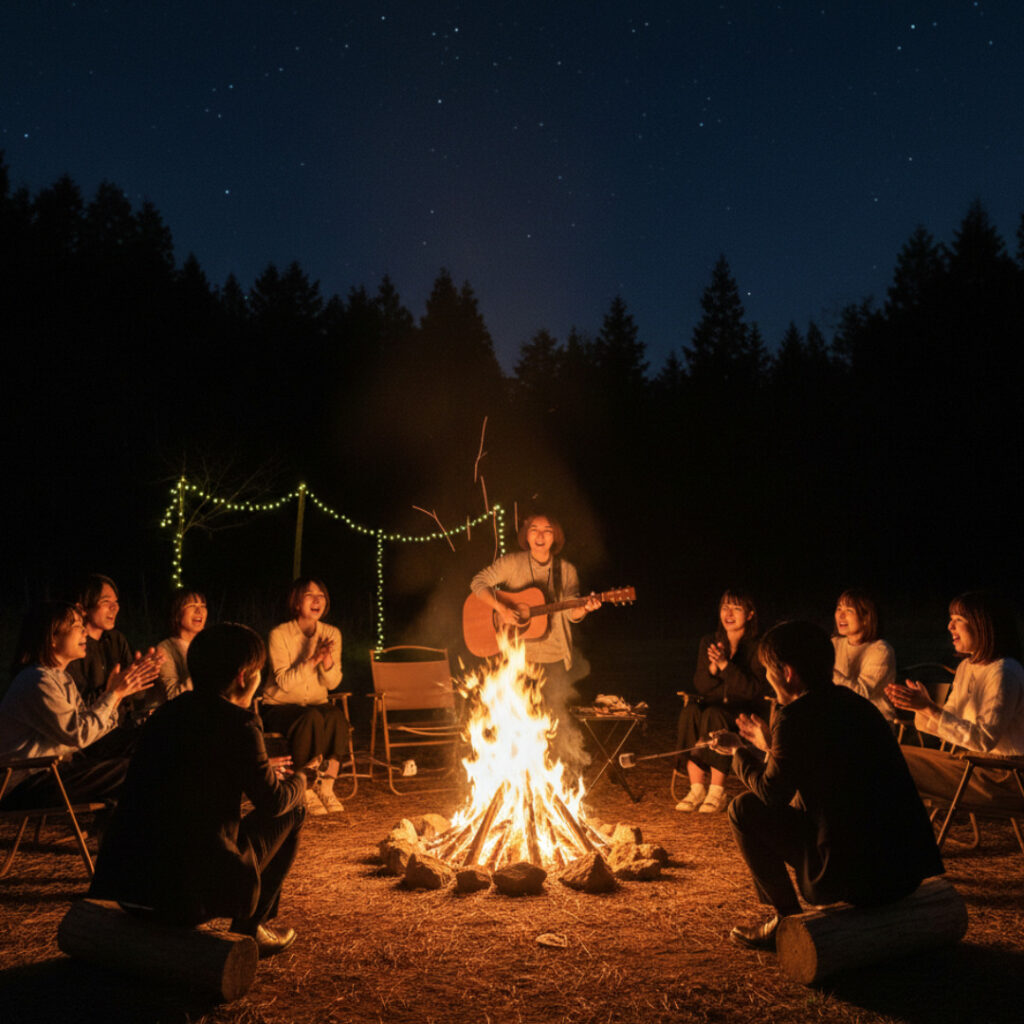
The Campfire MC Script: Running Calls, Responses, and Skits
An effective campfire host never competes with group chatter. Shouting shreds your vocal cords within fifteen minutes. Master conversational pacing by commanding the airwaves through structured calls and physical cues.
Opening Script: The Lighting Invocation
(The MC stands five feet back from the unlit structure. Spotters hold unlit torches.)
MC: "The timber is stacked, the circle is closed, but the night is cold. How do we answer the dark?"
Audience (coached beforehand): "With the spark!"
MC: "From the spark comes what?"
Audience: "The flame!"
MC: "Fire tenders, bring the light."
(Torchbearers touch the pre-soaked inner kindling. As the fire takes hold, the MC immediately transitions into a rhythmic cadence to lock down attention.)
Mid-Show Call-and-Response: The Energy Escalator
Use short, punchy rhythm calls to break up downtime between skits. This prevents individual sections from drifting into side conversations while props or volunteer performers reposition.
MC: "Boom-chicka-boom!"
Audience: "Boom-chicka-boom!"
MC: "I said a boom-chicka-rocka-chicka-rocka-chicka-boom!"
Audience: "I said a boom-chicka-rocka-chicka-rocka-chicka-boom!"
MC: "Now say it like an opera singer!" / "Now say it like an eighty-year-old grandfather!"
Every participatory skit must feature an unmistakable visual climax. When presenting classic counselor theater like the "Enlarging Machine" or "The Invisible Bench," ensure actors amplify physical comedy through oversized pantomime. Subtle facial expressions vanish in firelight; broad gestures and exaggerated body mechanics resonate across seventy feet of open air.
Rigorous Campfire Safety Protocols for Packed Outdoor Circles
Managing an open fire alongside a crowd of energized participants introduces serious logistical liability. Chaos occurs when organizations treat safety as a passive reminder rather than an active perimeter architecture.
Establish a physical "Spit Zone." This buffer zone must measure at least 10 feet from the active fire ring in every direction, marked by natural logs, chalk lines, or solar-lit perimeter markers. Only the designated Fire Warden may cross this line. No camper enters the zone to adjust logs, roast marshmallows, or toss trash during the recreational program.
Operational safeguards require three non-negotiables on site before crowd arrival:
First, place two 5-gallon metal buckets filled with water and a long-handled shovel directly behind the upwind staging area. Keep a multi-purpose ABC dry chemical extinguisher visible and inspected.
Second, monitor ambient wind velocity. If sustained surface winds exceed 15 miles per hour or erratic gusts blow embers into the crowd perimeter, abandon the bonfire immediately. Transition without hesitation to an emergency alternative: electric lantern rings, glow sticks, or an indoor lodge auditorium.
Third, implement a strict clothing check. Synthetic fleeces and cheap nylon shells melt instantaneously when hit by floating embers. Require campers sitting in the inner horseshoe rings to wear natural fiber outer layers like cotton hoodies or denim jackets.
Nighttime Group Games That Scale Past Fifty Participants
Standard youth party games break down when applied to vast numbers. Games requiring individual turns cause eighty percent of the circle to sit idle. Scalable night games demand simultaneous, full-group participation.
The Mega-Current
Divide the horseshoe into two opposing halves: Left Flank versus Right Flank. Campers link elbows along their bench rows. The MC stands at the open apex holding two flashlights. When the MC flashes the left beam, the left team sends a wave of seated body-sways and vocal hums from the outside edge all the way to the center fire tender. The team whose "electrical current" reaches the center fastest without breaking arms wins the round. It generates intense inter-group rivalry without requiring a single person to step into the dark.
Giants, Wizards, and Elves: Mass Edition
An expanded version of Rock-Paper-Scissors. Split the horseshoe into East and West factions. Each side huddles for thirty seconds to select a group persona. Giants stomp and roar; Wizards raise their hands and cast spells; Elves drop low and point their ears. Both sides advance three paces toward the safety line and display their character simultaneously. Giants crush Elves, Elves outsmart Wizards, and Wizards zap Giants. The losing side must turn and sprint back to their log benches before tagged by the victors. The game delivers high-octane cardiovascular exertion while keeping everyone localized within the lit clearing.
Frequently Asked Questions (FAQ)
Q1: How do you project your voice across a loud, 100-person fire circle without an electric sound system?
A1: Position yourself with your back to the wind so the breeze naturally carries your vocal projection across the clearing. Speak from the diaphragm, dropping your pitch down an octave rather than shouting, as lower vocal frequencies penetrate crackling timber far better than high-pitched yells. Station counselors at the rear corners to mirror your physical gestures and echo key chants.
Q2: What is the cleanest way to extinguish a massive group campfire at the end of the night?
A2: Follow the "Douse, Stir, Feel" protocol. Stop adding large logs forty-five minutes before the session wraps. When dispersing campers, pour water across the coals using a wide spray rather than dumping a single heavy bucket, which creates scalding steam and kicks up hot ash. Stir the coals with an iron rake, douse again, and hold the back of your bare hand two inches above the wet ash. If you detect residual heat, repeat the cycle.
Q3: How should an MC handle an unscripted disruption, such as a camper getting frightened by the dark or acting out?
A3: Never stop the program to discipline an individual from the center of the ring. That surrenders group momentum. Use peripheral counselors as designated handlers. Maintain the show's pacing while a counselor quietly steps in from the back row to escort the unsettled individual away from the circle toward lit support facilities.
Mastering the Arc from Ignition to Embers
A well-run campfire recreation session leaves an indelible mark on collective memory. That magic does not happen by accident. It is the calculated product of clean perimeter spacing, vocal discipline, and emotional pacing.
When you stand before a crowd surrounded by wilderness, understand your true role. You are not just organizing games; you are managing attention and maintaining safety in an unpredictable environment. Honor the natural lifecycle of the flame. Ignite curiosity early, burn through excess energy with full-body games at the apex, and deliver your audience safely into quiet reflection as the logs turn to gray ash.
