The Hidden Fortune in Your Closet: How One Vintage Gap Tag Skyrockets Resale Value

Walk into any neighborhood thrift store in 2026, and you will see resale pickers rifle right past the designer rack to comb through faded sweatshirts and denim jackets. What used to be dismissed as mass-market suburban mall wear has turned into one of the most profitable sectors of the vintage clothing market. Archival Japanese collectors, street-style curators, and high-volume Depop sellers are actively scouting vintage Gap pieces, paying anywhere from $80 to upwards of $400 for garments that originally cost $24 on a clearance rack three decades ago.
The secret lies entirely inside the collar. As retail historians and fashion archivists have long documented, a phenomenon recently analyzed in the ファッションスナップ・ドットコム Report tracing how label evolutions dictate collector valuations in American heritage clothing, small shifts in font geometry, textile weave, and country-of-origin tags reveal whether a garment is cheap modern excess or a lucrative historical artifact. For Gap, a brand founded in San Francisco in 1969 as a record-and-denim shop, its five-decade manufacturing trail leaves definitive physical markers that any sharp eye can authenticate.
📌 Key Takeaways:
- The Value Trigger: Pre-2000s Gap garments, specifically 1980s pocket-tag denim and 1990s heavyweight fleece, command substantial resale premiums due to superior textile weights and boxy, tailored drape.
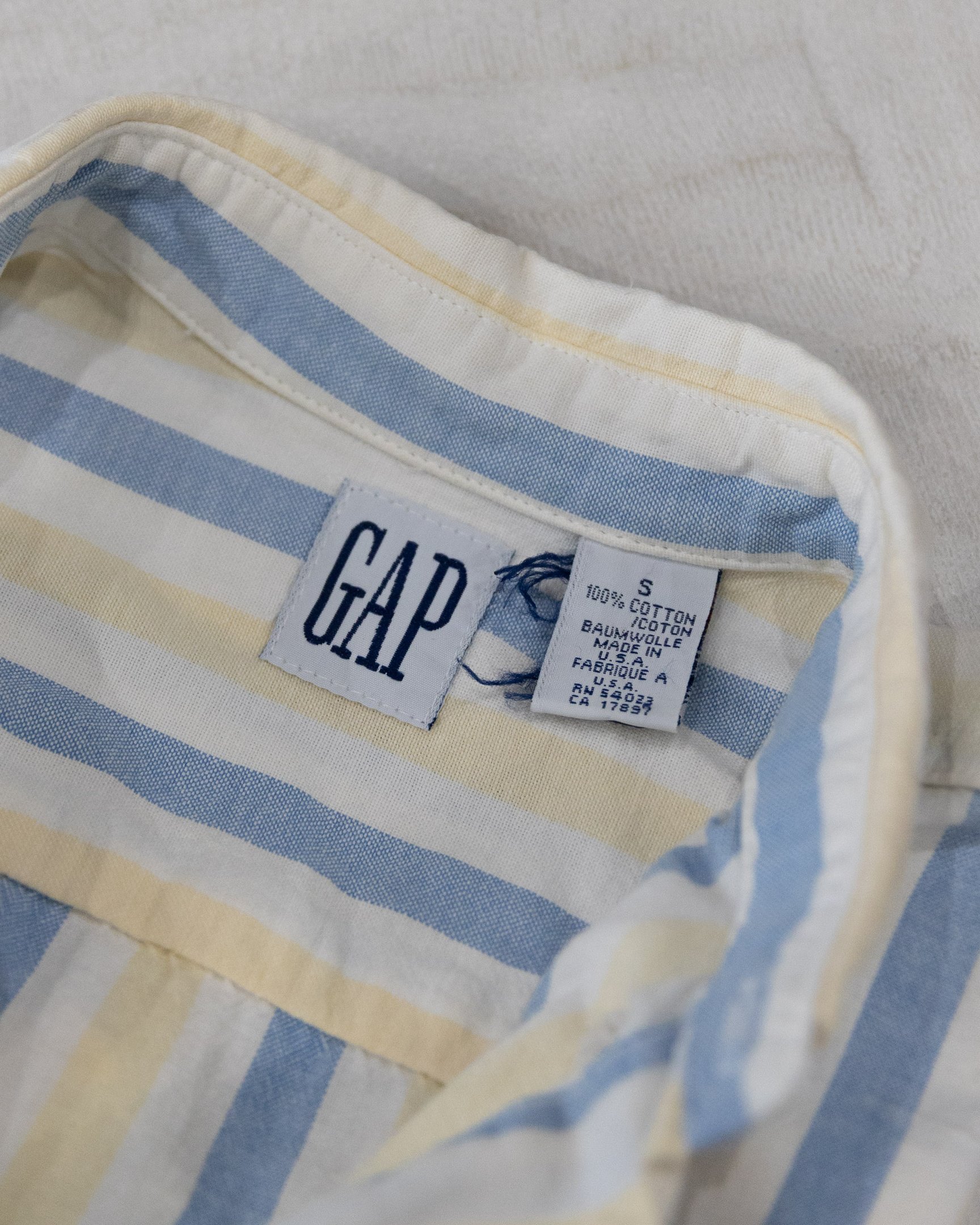
- The Essential Identifiers: Authentic grails feature registered identification number RN 54023, single-stitch hem construction, "Made in USA" origins, and internal fabric care tags stamped with two-digit seasonal codes.
- Market Realities: The ubiquitous printed blue square logo labels from 2001 onward represent modern mass-production with minimal collector demand, while early script labels and 1990s navy woven tags represent genuine profit opportunities.
The Thrift Arbitrage Driving Vintage Gap Prices Past Luxury Staples
A strange inversion has taken hold across secondhand marketplaces. Mid-range 1990s sportswear and normcore basics regularly outpace second-tier luxury brands in sell-through rate. On platforms like Grailed, eBay, and Mercari, search queries for archival 1990s Gap have surged by more than 45% year-over-year. Buyers are not chasing nostalgia alone; they are chasing patterns, cotton weight, and stitch integrity that vanished from consumer retail decades ago.
Early Gap releases featured 12-to-14-ounce ring-spun denim, heavyweight loopback French terry, and durable double-needle felled seams. When corporate production migrated offshore during the late 1990s and early 2000s, lighter synthetic blends and automated chain stitching replaced domestic garment-dyed cotton. Today, vintage enthusiasts use tag variations to separate these overbuilt heritage garments from the disposable iterations that followed.
The difference in resale value between eras is stark. A standard 2012 Gap crewneck sweatshirt struggles to clear $12 at auction. Find a 1988 version featuring a pocket label and single-stitch cuffs, however, and bids frequently cross $160 within hours. Knowing how to date vintage Gap tags transforms an ordinary thrift run into high-yield sourcing.
The Label Anatomy: Decoding RN 54023 and Stitch Markers
Every vintage authentication starts with three foundational elements: the registered identification number, the construction technique, and the label weave.
The first detail to verify on any potential find is the registered identification number issued by the U.S. Federal Trade Commission. Gap’s universal identifier is RN 54023. If a garment lacks this specific RN number, it was either manufactured for an overseas licensee or produced under a separate sub-brand like Banana Republic (which uses RN 54023 under the parent company umbrella, but with distinct internal identifiers).
The physical neck label itself tells a mechanical story:
- Embroidered and Woven Cloth Labels: Garments made between 1974 and 1995 feature thick, woven cotton or dense damask tags stitched directly into the collar seam. These labels age alongside the garment, showing fraying around the border folds rather than cracking.
- Slick Poly-Satin Labels: Mid-to-late-2000s pieces introduced glossy, synthetic care labels that feel slick to the touch, often printed with thermal ink that washes out over repeated cycles.
- Single-Stitch Construction: On short-sleeve t-shirts and polo collars produced before 1994, check the hem and sleeve cuffs. A single run of horizontal thread indicates early vintage manufacturing. Modern manufacturing adopted double-stitch serged hems in the mid-1990s for high-speed assembly.
If you spot a woven tag marked "Made in USA" paired with single-stitch construction and RN 54023, you have secured a piece from Gap’s golden era of American manufacturing.
The Gap Tag Timeline: From San Francisco Counterculture to Mall Hegemony
Dating vintage clothing requires tracking corporate branding shifts across key design eras. Gap altered its neck tag typography and construction roughly every five to seven years.
| Production Era | Tag Characteristics & Typography | Origin Country | Resale Range (2026) |
|---|---|---|---|
| 1969, 1974 | Lowercase "the gap" typography; circular target logos; often co-branded with Levi Strauss tags. | USA | $250, $600 |
| 1974, 1983 | "Pioneer Tag": Block lettering with rainbow striped accents; thick canvas fabric neck tags. | USA | $150, $400 |
| 1984, 1993 | White woven rectangle tag; forest green or burgundy serif font; "Pocket" style external branding on denim. | USA / Hong Kong | $80, $250 |
| 1994, 2000 | Deep navy blue rectangular tag; white or silver serif "GAP" block letters; size tab tucked below main label. | USA / N. Mariana Islands / Korea | $45, $180 |
| 2001, 2010 | Navy blue square "Blue Box" logo printed on white or light blue tag; introduction of modern care tags. | China / Vietnam / India | $15, $40 |
| 2011, Present | Screen-printed tagless neck stamps; thin horizontal heat-transfers; minimal material weight. | Global / Multi-region | $8, $20 |
The tag transition of 1994 remains the most critical pivot in the brand's history. When Gap shifted away from the white woven 1980s tags to the dark blue rectangular label, it streamlined global marketing under creative director Millard "Mickey" Drexler. Pieces sporting the crisp, dark navy tag from 1994 through 1998 hit the sweet spot of 1990s oversized aesthetics without sacrificing construction durability.
Deciphering Internal Care Tag Date Codes
When a neck tag has been torn out by a previous owner or faded beyond recognition, look inside the garment along the lower left hip seam. The internal wash and care tags contain an exact manufacturing timestamp if you know how to read the alphanumeric sequencing.
From the late 1980s through the early 2000s, Gap used an internal alphanumeric code stamped near the bottom of the care label:
- Look for letters indicating the fashion season: SP (Spring), SU (Summer), FA (Fall), and HO (Holiday).
- Followed immediately by two digits representing the year. For instance, FA96 translates to Fall 1996. SP91 denotes Spring 1991.
- Month/Year Format: In certain late-1990s garments, particularly outerwear, the code appears as a standard numerical date format such as 08/98 (August 1998) or 11/95 (November 1995).
Locating one of these stamped care codes removes all ambiguity. A faded fleece with an obliterated neck tag instantly regains its market value once you prove via an internal HO94 care stamp that it was manufactured during the peak of the brand's mid-90s production run.
Collector Grails: Arctic Light Fleece, Pioneer Denim, and Barn Coats
Not every 1990s Gap item warrants an aggressive bidding war. Astute pickers watch for three specific product lines that command premium prices among collectors in Tokyo, London, and New York.
The Gap Arctic Light Fleece
Introduced in the winter of 1992, the Arctic Light Fleece line directly rivaled Patagonia’s Synchilla snapshots. Built with an exceptionally dense, anti-pilling polyester pile, these pull-over quarter-zips featured high-contrast nylon chest pockets, rugged YKK zip-pulls, and bold color blocking in hunter green, deep purple, and ochre. Pristine specimens bearing the navy rectangular neck tag regularly clear $140 to $220 on Japanese vintage forums.
1980s "Pocket Tag" Selvedge Denim
Before Gap produced lightweight stretch blends, their 1980s denim lines were manufactured using heavyweight domestic cone denim. Identifiable by a small woven white or red label stitched directly onto the exterior edge of the coin pocket or the right rear pocket, these jeans cut a straight, rigid silhouette. Paired with an interior "Made in USA" care tag, these jeans fetch $180 to $300 among purist denim collectors.
1990s Heavy Leather Barn Jackets
During Mickey Drexler’s tenure, Gap produced chore jackets and barn coats made from thick, uncorrected cowhide. These garments weighed between four and six pounds, featuring corduroy collar accents and quilted plaid wool liners. Because comparable modern workwear jackets often retail above $600, 1990s Gap leather jackets in good condition command $200 to $380 on secondary resale markets.
Frequently Asked Questions (FAQ)
Does every garment marked with RN 54023 qualify as vintage?
No. Gap continues to use RN 54023 on its garments today. You must cross-reference the RN number with the neck label style, country of origin, and internal date stamp to confirm age. Modern garments will have heat-stamped tagless necks or multi-language polyester wash ribbons.
What is the quickest way to spot a 1980s Gap piece at a glance?
Check the typography and country of origin. If the tag is a white woven cloth rectangle with serif lettering that says "Made in USA," it dates almost exclusively between 1984 and 1993. If the hem features single-stitch threading, you have an authentic 1980s garment.
Why are early 2000s blue square tags valued so much lower?
The transition to the blue square logo in 2001 marked Gap’s total pivot toward high-volume globalized supply chains. Garments from this era feature lighter fabrics, synthetic fiber blends, and lower resale appeal compared to the rugged, domestic cotton construction of the 1980s and 1990s.
Where do I look for the seasonal date stamp on Gap jackets?
Inspect the interior left-hand pocket or the lower lining seam near the waist. Winter outerwear often hides a small, narrow white care label behind the primary wash instructions, stamped with alphanumeric identifiers like FA97 or HO98.
Navigating the Archival Vintage Boom in 2026
The ongoing surge in vintage Gap valuation proves that brand prestige in the secondary market is no longer dictated by luxury house pedigrees. Collectors now value physical craftsmanship, verifiable textile provenance, and period-accurate cuts over high-fashion logos.
The next time you browse a crowded thrift rack or clean out a storage bin, pass over the obvious luxury knockoffs and flip the collars on faded sweatshirts and heavy chore coats. Spot a woven cloth label, read the RN 54023 registry, check the inner seam for a two-digit year code, and you may find that an overlooked mall basic is worth hundreds of dollars to the right collector.
