The Surprising History Behind Dynamic Ryukyu: The Modern Stadium Hit Built for Traditional Sanshin

Walk past the roar of Koshien Stadium during Japan's national high school baseball tournament, and you will hear a thunderous chant rising from the brass bands and bleachers. Stand along the parade routes of Okinawa’s August festivals, and that exact melody pounds through youth eisa drum troupes. To unfamiliar ears, "Dynamic Ryukyu" carries the heavy cadence of an ancient Ryukyuan Kingdom chant passed down through five hundred years of oral history.
Yet the track did not emerge from pre-modern folklore. Rock musician Akira Ikuma composed it in 2008 alongside lyricist Shingo Hirata, originally designing the song as a stage anthem for contemporary Okinawan performing arts. Its journey into the national consciousness accelerated dramatically over the following decade, culminating when Tokuma Japan dropped its long-awaited official music video nearly a decade after its stage debut, as documented in the YouTube (TOKUMAJAPAN) Report. Today, amateur musicians and classical players alike hunt down kunkunshi notation, the traditional kanji-based sanshin sheet music, to translate this modern pop phenomenon back into ancestral wooden instruments.
📌 Key Takeaways:
- Modern Origins: Akira Ikuma composed "Dynamic Ryukyu" in 2008 as a modern theatrical piece, not a pre-modern folk ballad.
- Structural Ingenuity: The song relies strictly on the Okinawan musical scale and standard honchoushi tuning, fooling listeners into hearing ancient heritage.
- Notation Crossover: Sanshin players have embraced kunkunshi sheet music adaptations, cementing the track as an essential piece of contemporary Ryukyuan folk fusion.
The Accidental Anthem That Deceived Folk Purists
The song’s path from local performing arts stages to national ubiquity defied every standard music-industry marketing playbook. Akira Ikuma, formerly the frontman of the 1990s rock outfit Kurusu, relocated to Okinawa to merge mainland pop sensibilities with subtropical island roots. When he paired up with producer Shingo Hirata to score theatrical youth dance shows, they aimed for visceral, blood-pumping energy rather than dusty ethnomusicology.
The public response took an unexpected turn. High school cheer squads discovered the track’s infectious four-on-the-floor taiko cadence. In 2017 and 2018, schools like Sendai Ikuei High School turned the song into a brass-heavy rallying cry during the summer Koshien baseball championships. Viral smartphone clips on TikTok and Twitter racked up tens of millions of views. Teenagers who had never set foot in the Ryukyu archipelago started singing Hirata’s Okinawan dialect lyrics from memory.
By the time major labels recognized the shift, the song had slipped completely out of its original pop-single category. It became an open-source civic anthem. Folk teachers across Naha found their private studios flooded with students demanding to learn the track on traditional three-string instruments, prompting a scramble to transcribe a synthesized 2008 pop production into centuries-old fretboard notation.
Deconstructing the Ryukyuan Pentatonic Architecture
The secret behind the song's deceptive antiquity lies in Ikuma’s disciplined adherence to indigenous melodic theory. Most pop composers working with regional music make the mistake of tacking ethnic instruments onto standard Western major scales. Ikuma took the opposite route. He structured the song's primary melodic hooks squarely within the Ryukyuan pentatonic scale (Do, Mi, Fa, Sol, Ti), completely omitting the Western scale's second and sixth intervals (Re and La).
That absence creates immediate, distinct emotional resonance. In the Okinawan musical scale, the half-step interval between the third and fourth steps, paired with the half-step between the seventh step and the octave, evokes the humid, hypnotic cadence of coastal ritual music.
Ikuma layered this austere scale over driving modern rhythm tracks. Underneath the driving dance pulse runs an authentic shime-daiko and odaiko rhythmic pattern, typical of traditional Eisa drum dance ceremonies. By anchoring synthetic percussion to authentic festival grooves, the composition bypassed modern pop filters and resonated directly with traditional memory.
Translating Pop Energy into Historic Kunkunshi Notation
To play the track on an authentic Okinawan sanshin, musicians must bypass standard Western stave notation and guitar tabs entirely. Instead, they read kunkunshi (工工四), an indigenous tab system established in the 18th century by Ryukyuan court musician Yakabi Choki.
Kunkunshi arranges Chinese characters inside a vertical grid, where each character instructs the musician where to press on the snakeskin-covered neck:
- The piece relies on honchoushi (本調子), the primary tuning where the male string (uujiru), middle string (nakajiru), and female string (miijiru) are tuned to C-F-C.
- The fundamental low tonic rests on 合 (ai), the open low string, while the fourth interval rings on 中 (chuu), the open middle string.
- Melodic Character Progression: Key vocal phrases demand quick transitions between 四 (shi), 上 (jou), and the high-register characters like 五 (go) and 七 (shichi).
The vertical script functions as both a pitch indicator and a rhythmic timeline, read strictly from top to bottom, right to left. Adapting Ikuma’s fast tempo to this formal system required folk teachers to develop fresh sanshin beginner tabs that simplify the ornamentation while preserving the percussive attack of the left-hand hammer-ons.
| Era & Milestones | Primary Instrumentation | Performance Domain |
|---|---|---|
| 2008, 2010 (Creation) | Digital synthesizers, drum machines, lead vocals, solo sanshin | Contemporary Okinawan theater, youth dance troupes |
| 2016, 2018 (Stadium Spread) | High school brass bands, stadium megaphones, bass drums | National High School Baseball Championship (Koshien) |
| 2019, 2026 (Global Folk Integration) | Traditional sanshin (honchoushi), paranku drums, odaiko | Worldwide diaspora festivals, classical folk recitals |
From Koshien Bleachers to Global Diaspora Stages
The spread of "Dynamic Ryukyu" did not stop at Japanese domestic stadium fences. As younger diaspora communities searched for high-tempo performance pieces to engage new audiences, Ikuma's hybrid composition crossed international borders.
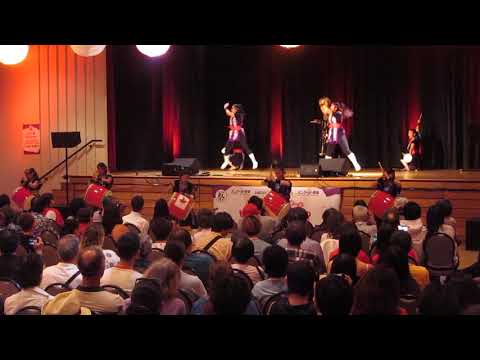
In Canada, the Vancouver Okinawa Taiko troupe incorporated the track into their signature festival routines. Their documented live showcases at both the Powell Street Festival in August 2019 and the Nikkei Matsuri in September 2019 proved that the song’s physical energy translates instantly across cultures. The group paired synchronized paranku (hand-held drum) choreography with soaring recorded vocals, proving that the composition functions just as powerfully on international streets as it does in Okinawan community halls.
This international adoption solved a growing crisis in traditional arts preservation. Many younger players find classical court music, such as Kagiya de Fu, intimidating and structurally rigid. "Dynamic Ryukyu" serves as a bridge. It offers beginner and intermediate players a fast-paced, contemporary piece of Ryukyuan folk fusion that still forces them to master authentic fingerings on the snake-skin instrument.
Mastering the Fretboard: Fingering and Rhythm Execution
For sanshin players tackling the song using kunkunshi notation, technical execution comes down to right-hand snap and left-hand discipline. The piece runs at a lively 125 to 132 beats per minute, which is unusually swift for classical sanshin repertoire.
First, lock the instrument into honchoushi tuning with an electronic tuner (C3, F3, C4). Classical Okinawan fingerings demand that the index finger (hito-sashi-yubi) covers the first position, while the ring finger (kusuri-yubi) handles the third position. Western guitarists often make the error of using their middle finger for the second position, disrupting the hand angle required for rapid down-strokes with the water-buffalo horn plectrum (bachi).
Second, coordinate the down-stroke with the primary beat of the taiko drum accompaniment. The sanshin is not purely a harmonic backing tool; in Okinawan ensembles, it acts as a rhythmic timekeeper alongside the percussion. Striking the string cleanly while sounding open drones keeps the melody cutting through dense brass arrangements or festival crowds.
Frequently Asked Questions (FAQ)
Q1: Is Dynamic Ryukyu a traditional folk song from the Ryukyu Kingdom era?
A1: No. The song was written and composed in 2008 by Akira Ikuma, with lyrics by Shingo Hirata. It feels centuries old because it relies strictly on the traditional Okinawan pentatonic scale and authentic Eisa rhythmic patterns.
Q2: What tuning is required to play Dynamic Ryukyu on the sanshin?
A2: It is played in standard honchoushi (本調子) tuning. On a digital tuner, the strings are pitched to C for the low string, F for the middle string, and C for the high string.
Q3: Why is kunkunshi notation used instead of Western sheet music or guitar tabs?
A3: Kunkunshi is the historical vertical notation designed specifically for the sanshin fretboard. It uses Chinese kanji characters to represent precise finger placements along the unfretted neck, capturing the subtle microtonal inflections unique to Ryukyuan instruments.
Q4: Why did the song become famous at Japanese high school baseball tournaments?
A4: Around 2017, Tohoku-area schools like Sendai Ikuei High School arranged the driving rhythm for their brass bands and cheer squads. The energetic chants went viral on social video platforms, turning a regional Okinawan dance track into a national sports anthem.
The Living Future of Ryukyuan Folk Fusion
The story of "Dynamic Ryukyu" reframes how traditional music survives in the twenty-first century. Rather than freezing folk heritage inside museum glass, Akira Ikuma illustrated that traditional scalar rules can supercharge modern stadium pop.
For the thousands of musicians deciphering kanji grids on kunkunshi sheets today, the song is far more than a catchy cheer tune. It proves that centuries-old scales and snake-skin instruments remain vibrant, elastic, and fully capable of shaking concrete stadiums worldwide.
