Three Years After the Beppu Crash: A Chronology of the Yoichi Hatta Manhunt

September 8, 2026, marks exactly three years since Japan’s National Police Agency placed Yoichi Hatta on its top-tier Important Most Wanted list. More than four years after a speeding black sedan plowed into two college students stopped at a red light in Beppu, Oita Prefecture, the 29-year-old suspect remains completely untraceable. The incident, which killed a 19-year-old university student and injured another, triggered one of the most intense, high-profile manhunts in modern Japanese history.
Yet as the investigation crossed its three-year most wanted milestone this autumn, public leads dried up. As detailed in a recent livedoor ニュース Report, police departments across Japan have recorded a steep decline in incoming tip-line calls, prompting an agonizing plea from the victim’s family: "Please do not let this case become a thing of the past." The lingering mystery of how a young man with no known criminal syndicate ties vanished into thin air exposes critical blind spots in Japan's domestic fugitive tracking apparatus.
📌 Key Takeaways:
- The Incident: On June 29, 2022, Yoichi Hatta rammed two motorbikes at nearly 100 km/h in Beppu with zero braking distance following a minor verbal altercation, killing a 19-year-old student.
- The Unprecedented Roster: In September 2023, the NPA took the historic step of placing Hatta on the national Most Wanted list under hit-and-run charges, the first time a traffic crime suspect received that designation.
- The Evasion Tactics: Hatta abandoned his vehicle, wallet, and footwear near Beppu Bay, successfully avoiding digital banking, mobile network pings, and facial recognition surveillance for four straight years.
- The Current Crisis: Investigative leads dropped substantially by September 2026, despite a combined 8 million yen bounty and active public campaigns demanding murder charges.
The Fatal Intersection at Noguchihara: Reconstructing the June 2022 Crash
The tragedy began on the evening of June 29, 2022, outside a commercial facility in the resort city of Beppu. Witnesses reported an initial verbal disagreement between Hatta and two college students. The students subsequently left the scene on their motorbikes, stopping side-by-side at a red light at the Noguchihara intersection.
Hatta followed them in his black sedan. Traffic camera analysis and vehicle telemetry revealed he accelerated aggressively toward the intersection, striking the stationary bikes from behind at an estimated speed between 96 km/h and 100 km/h. There was no evidence of braking before the collision. The impact threw both riders violently across the pavement; 19-year-old student Taizo Kamiyama suffered catastrophic injuries and died shortly after reaching the hospital. The second rider survived with severe injuries.
Hatta did not stop to render aid. He drove the wrecked vehicle several hundred yards until it stalled, abandoned it, and fled on foot toward the coast. Within hours, police recovered his sandals, t-shirt, and discarded personal effects near Beppu Bay. Then, the trail went cold.
An Unprecedented Designation on the National Most Wanted Roster
Fugitive traffic offenders in Japan rarely land on the NPA's most wanted posters. Historically, that roster was reserved for organized crime figures, brutal home invaders, or cult members linked to homicide. Under Japanese criminal law, hit-and-run cases typically proceed under charges of negligent driving resulting in death (Road Traffic Act violations).
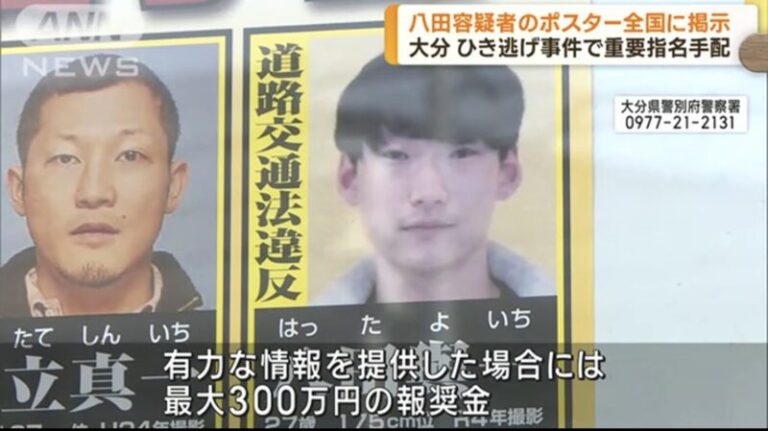
By September 2023, public outrage and the sheer malice of the vehicular assault pushed Japanese law enforcement into uncharted territory. The National Police Agency designated Hatta as an "Important Most Wanted Suspect" (Juyo Shimei Tehai), an extraordinary move that blanketed police boxes (koban), transit hubs, and public bathhouses across all 47 prefectures with his face.
A joint bounty program raised the stakes. The NPA offered an official statutory reward of up to 3 million yen, while a private association funded by the bereaved family and supporters contributed an additional 5 million yen, bringing the total incentive for actionable information to 8 million yen. Yet, despite thousands of initial tips and national media scrutiny, Hatta evaded capture month after month.
Timeline of the Beppu Manhunt and Tracking Milestones
The operational trajectory shows a pattern of early public frenzy giving way to institutional friction and stalled leads:
| Date / Timeframe | Investigative Milestone | Operational Impact |
|---|---|---|
| June 29, 2022 | Fatal collision at Noguchihara; Hatta flees on foot | Clothing and phone found near coastline; initial 48-hour containment failed |
| September 8, 2023 | NPA classifies Hatta as "Important Designated Wanted" | First pure traffic violation suspect given national priority status; poster campaign spreads nationwide |
| 2024, 2025 | Total bounty reaches 8 million yen; 6,000+ tips investigated | Sightings reported in Tokyo, Osaka, and Kyushu rural zones; all confirmed false or inconclusive |
| September 8, 2026 | Three-year anniversary of top-tier designation | Tip volumes hit record low; Oita Prefectural Police launch renewed public appeal |
Why Hasn’t He Been Caught? Analyzing the Evading Mechanics
Investigators and forensic criminologists point to several intersecting dynamics that explain how Hatta slipped through the security net. Japan maintains extensive closed-circuit television (CCTV) coverage in central urban cores, but vast regional gaps persist across transit routes, dockyards, and rural prefectures.
Immediately after the collision, Hatta severed all digital ties. He left his smartphone, bank cards, and identification documents behind. In modern fugitive tracking, electronic footprints, such as ATM withdrawals, prepaid transit IC card taps, and cellular triangulation, solve the vast majority of manhunts within two weeks. By operating entirely off the financial grid, Hatta eliminated the most common investigative tripwires.
His escape also exposed the structural challenges of Japan's cash-based informal economy. Construction sites, seasonal agricultural outfits, isolated fishing communities, and day-labor hubs in metropolitan areas frequently provide room-and-board accommodations without requiring rigorous identification checks or My Number verification. Tatsuya Ichihashi, who murdered British teacher Lindsay Hawker in 2007, successfully hid for two years and seven months using precisely this blueprint, moving between coastal shipyards and construction shacks while performing crude self-administered facial alterations.
Forensic analysts do not rule out physical alterations. Hatta possessed distinct facial features on his 2022 wanted notices, but changes in weight, hair, dental profile, or cosmetic surgery could easily defeat casual recognition by street patrols.
Diminishing Tip Lines and the Bereaved Family's Fight for Murder Charges
As the manhunt stretched into its fourth total year, the primary battle shifted from the streets to public memory. Human attention spans are short. Public awareness campaigns that once dominated national morning talk shows have largely receded, leading directly to the decline in tip submissions reported by the Oita Prefectural Police.
The victim's family has spent the past several years fighting a dual front: keeping Hatta's face visible on social networks while petitioning prosecutors to reclassify the charges. The current warrant specifies dangerous driving resulting in death under the Road Traffic Act. The family and their legal team argue that ramming a stationary motorcycle at nearly 100 km/h without touching the brake pedal constitutes willful intent, murder under Article 199 of Japan's Penal Code.
Upgrading the formal charge to murder or dangerous driving homicide carries practical investigative weight. It expands prosecutorial resources, removes procedural ambiguities, and communicates the severity of the crime to potential third parties who might be aiding or harboring Hatta without realizing the full legal consequences.
Frequently Asked Questions (FAQ)
Q1: Why was Yoichi Hatta put on the Most Wanted list if it was a traffic incident?
The National Police Agency recognized the collision was not a standard traffic accident. Telemetry showed deliberate acceleration into stationary riders at 96, 100 km/h after a road-rage altercation. The cruelty of the incident, combined with his immediate flight, led authorities to issue an unprecedented national priority designation for a vehicular fatality suspect in September 2023.
Q2: How much is the reward for information leading to his arrest?
The bounty currently totals 8 million yen. This includes up to 3 million yen from the National Police Agency's official investigative reward fund, plus 5 million yen supplied by a private support fund established by the victim's family and community backers.
Q3: Could Yoichi Hatta have fled overseas?
While immigration authorities placed alerts at all Japanese international airports and sea terminals, informal maritime transit remains an open possibility. Beppu is a coastal port city with dense regional ferry and cargo routes. Investigators continue to treat domestic evasion within rural or day-labor settings as the most probable scenario, but cross-border checks remain active via Interpol notices.
The Road Ahead for the Beppu Investigation
The anniversary of Yoichi Hatta's three-year designation on Japan’s most wanted list highlights the fragile balance between institutional surveillance and public vigilance. When a suspect abandons their digital identity completely, law enforcement agencies are forced to rely on traditional community reporting. When those tip lines grow quiet, the manhunt stalls.
For Oita investigators, the path forward requires deploying newer forensic matching tools against historical CCTV logs, monitoring informal labor registries, and systematically renewing public outreach. For the family of Taizo Kamiyama, the objective remains clear: ensuring that the face on the posters does not fade into the background before justice is served.
