Toy Story Dogs Visual Guide: Scud, Buster, and Slinky Compared
When audiences debate the technical triumphs of Pixar, dialogue usually gravitates toward human skin rendering or realistic lighting. Yet the studio's true developmental benchmarks often walked on four paws. As theater crowds celebrate new franchise milestones in 2026 and toy collectors scramble for villain-centric releases, including a sought-after Bandai Spirits lottery collection detailed in an Infoseekニュース Report, the canine characters of the Toy Story universe deserve a rigorous second look. They are not background set dressing. Each dog marks a decisive leap in computer animation capabilities while anchoring distinct narrative tensions.
From the terrifying mechanical aggression of Sid Phillips' backyard terror to the faithful squeak of a slinky wire, the dogs in Andy's neighborhood shaped how computer-generated characters interacted with weight, fur, and emotional fidelity. Breaking down Scud, Buster, and Slinky Dog reveals how Pixar solved some of digital animation's steepest challenges across three decades.
📌 Key Takeaways:
- Distinct Breed Frameworks: Pixar drew direct inspiration from real-world breeds, modeling Scud after an English Bull Terrier, Buster after an energetic miniature dachshund, and Slinky Dog after Helen Malsed's classic 1952 pull toy.
- Rendering Breakthroughs: Scud's smooth, furless design was born out of 1995 hardware limitations, whereas Buster required the studio to write custom code for hair dynamics and soft-body squash-and-stretch physics by 1999.
- Voice Legacy: Slinky Dog remains an animation marvel anchored by character actor Jim Varney, whose signature rasp was preserved after his passing by close friend Blake Clark starting in 2010.
Scud the Bull Terrier: The Horror Monster of Sid Phillips' Backyard
Pixar animators faced an immediate barrier in 1994: computer hardware could not render animal fur convincingly. The workstations of the era lacked the computing bandwidth to calculate individual hair follicles reacting to wind, velocity, and light bounce. Director John Lasseter and his team solved this problem through smart art direction by making the antagonist's dog a breed that required almost no fur at all.
Enter Scud. Modeled as a white English Bull Terrier with an eye patch and a studded collar, Scud functioned visually and narratively as an unthinking wrecking ball. Bull Terriers possess an egg-shaped skull, small sunken eyes, and a muscular, short-coated physique. Animators coated his digital geometry with a high-specular sheen. The result made him look lean, oily, and intimidating under the flickering fluorescent bulbs of Sid's chaotic bedroom.
Scud represented pure environmental threat. He was not evil in a human sense; he was an apex predator trapped inside a suburban home, trained to destroy plastic playthings. His animations emphasized jerky, hyperactive aggression. He bounded across floorboards with sharp, rigid hoof-like footfalls, cornering Woody and Buzz Lightyear under automobiles and behind shipping crates. The animators gave him slobbering jowls and unblinking stares, setting the tone for the entire final escape sequence of the 1995 film.
Buster the Dachshund: Pixar's First Organic Fur Breakthrough
The final joke of the original 1995 film teased Andy Davis receiving a puppy for Christmas. That off-screen bark became Buster, the energetic miniature dachshund introduced fully in 1999's Toy Story 2. Between the production of the two films, Pixar developed proprietary fur-shading tools for Monsters, Inc., allowing the studio to test organic coats on four-legged quadrupeds.
Buster's physical build completely inverted Scud's sharp geometry. Instead of taut muscle and hyper-aggressive lunges, Buster was defined by low-slung belly clearance, floppy ears, velvety coat shaders, and loose skin folds. Animators spent weeks studying real dachshund locomotion to capture how the breed's long spine sways while trotting across hardwood floors.
The iconic Buster search scene in Toy Story 2 remains a masterclass in staging animal behavior alongside miniature characters. When Andy's mother announces that Buster needs to go outside, the dachshund barrel-rolls through the bedroom door. Woody whistles, taps his thigh, and reveals that Andy's pet is actually in league with the toys. Buster ignores Andy's formal commands like "sit" but willingly plays dead when Woody commands, "Reach for the sky!"
By the time Toy Story 3 arrived in 2010, Buster's visual design delivered one of the franchise's most poignant environmental storytelling beats. No longer a bounding puppy, Buster appeared visibly aged. His muzzle was dusted with gray, his midsection sagged with arthritis, and his breathing rattled with audible wheezes. When Woody calls upon him to mount a rescue mission, the older Buster simply flops onto his side and falls asleep. In a single visual gag, Pixar communicated the painful passage of ten real-world years inside Andy's house.
Slinky Dog: Translating Mechanical Toys into Soulful Companions
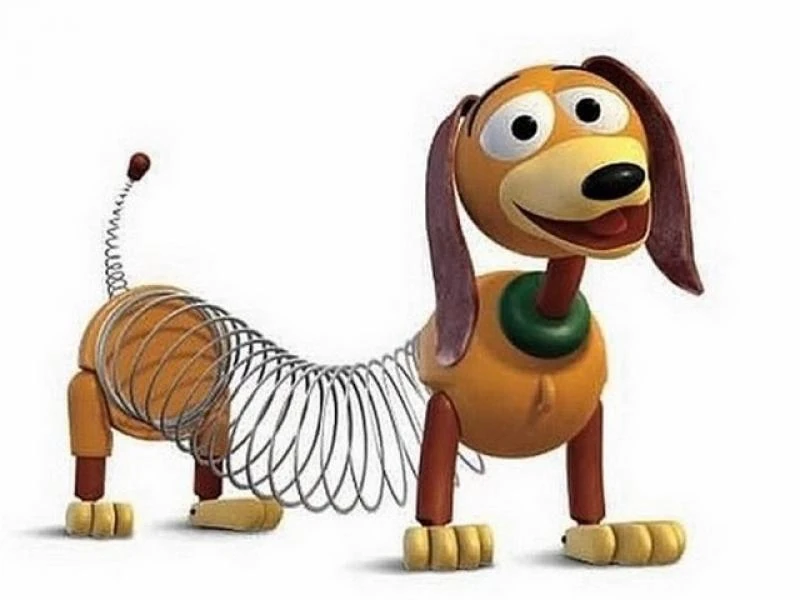
While Scud and Buster represent biological animals living inside the human realm, Slinky Dog occupies the unique space of being an artificial canine who displays more genuine animal loyalty than either of them. Based on the real-world Slinky Dog pull toy invented in 1952 by Helen Malsed and manufactured by James Industries, the character required Pixar to design complex spring dynamics inside a digital environment.
Rendering a coiled steel spring that could stretch, droop, tangle, and recoil without clipping through its own geometry required dedicated technical problem-solving in 1995. The animators created a dynamic rigging rig that calculated spring resistance based on the distance between Slinky's wooden front chassis and his plastic hindquarters. His wagging tail, a simple upright spring with a plastic ball on the tip, served as an emotional barometer throughout the franchise.
The character's soulful warmth came from legendary actor Jim Varney. Best known for his live-action Ernest P. Worrell character, Varney infused Slinky with a slow, dry Southern drawl that positioned him as Woody's most reliable lieutenant. Varney voiced the character through the first two films before his death in February 2000. To maintain continuity for 2010's Toy Story 3 and 2019's Toy Story 4, Pixar turned to character actor Blake Clark, Varney's close personal friend. Clark replicated the specific rhythmic gravel of Varney's delivery so accurately that casual viewers rarely realized the role had changed hands.
Visual and Technical Breakdown: Pixar's Three Iconic Dogs Compared
Each canine in the series fulfilled a radically different narrative role, which dictated every choice in their character rigging, surface textures, and behavioral physics.
| Character & Breed | Rendering Technology & Coat | Narrative Function | Defining Scene |
|---|---|---|---|
| ScudEnglish Bull Terrier | Smooth, non-procedural skin shading; high-gloss specular map without hair geometry (1995). | Suburban apex predator; physical obstacle enforcing Sid's reign of terror. | Chasing Woody and Buzz down the hallway during the moving truck escape. |
| BusterMiniature Dachshund | Procedural soft-coat shading with squash-and-stretch skin weight (1999); aging passes with gray hair nodes (2010). | Comedic ally and domestic pet; marker of chronological time inside the Davis household. | Responding to Woody's "Reach for the sky!" command while ignoring Andy. |
| Slinky DogJames Industries Pull Toy | Procedural metal spring coils, plastic/wood painted joints, mechanical articulation rigs (1995, 2019). | Moral compass, utility tool, and steadfast lieutenant to the toy collective. | Anchoring the rescue chain from the back of the moving van in the original climax. |
Al's Toy Barn Canine References and Background Sight Gags
Beyond the primary trio, Pixar peppered the franchise with background canine details that reflected the studio's evolving mastery of animal caricatures. In Toy Story 2, television commercials for Al's Toy Barn featured low-rent advertising tropes, including Al McWhiggin dressed in a chicken suit alongside cartoonish animal illustrations designed to evoke budget regional retail ads.
Noticeable canine nods also appeared during the toy rescue sequence across the city. When Woody and the rescue squad navigate highway traffic inside a Pizza Planet truck, animators incorporated ambient animal sounds and brief street-level encounters that highlighted how terrifying ordinary domestic pets are to an eight-inch figurine. These visual gags served as direct testbeds for what director Pete Docter would later execute on a grand scale with Dug and the pack dogs in 2009's Up.
Animation historians frequently observe that Pixar treats pets not as human equivalents, but as unpredictable environmental forces. When a toy steps onto carpet, a sleeping dog transforms a regular living room into an active minefield. The tension does not stem from malice, but from the immense physical scale disparity between an eighty-pound terrier and a ten-ounce sheriff doll.
Frequently Asked Questions (FAQ)
Q1: What specific dog breed is Scud in Toy Story?
A1: Scud is an English Bull Terrier. Pixar chose the breed deliberately for its smooth white coat, muscular build, and distinctive egg-shaped head, which allowed animators to create a menacing animal without needing to render computationally expensive fur in 1995.
Q2: Why did Slinky Dog's voice actor change between films?
A2: Character actor Jim Varney provided the original voice for Slinky Dog in 1995 and 1999. Following Varney's death from lung cancer in February 2000, Pixar recast the role with his close friend and fellow actor Blake Clark, who has voiced Slinky since Toy Story 3 in 2010.
Q3: Why was Buster so sluggish in Toy Story 3?
A3: Buster's lethargy in Toy Story 3 was a deliberate storytelling choice by director Lee Unkrich. Because roughly ten years had passed within the story's timeline, the formerly hyperactive dachshund had become an elderly dog with gray fur and low energy, visually signaling to the audience that Andy's childhood had drawn to a close.
The Lasting Visual Legacy of Pixar's Canine Cast
Thirty years after Scud sprinted across computer screens, the studio's early experiments with canine form remain an exceptional showcase of design pragmatism. Pixar did not wait for rendering hardware to catch up with its ambitions. Instead, the artists matched breeds to their technical capabilities, turning computational limitations into enduring character choices.
Scud's smooth, predatory sheen, Buster's rollicking low-slung walk, and Slinky's coiled steel utility provided the structural blueprints for how Pixar animates four-legged life. As new chapters and collectible figures revive interest in Andy's suburban neighborhood, these three dogs remain the baseline against which all computer-animated pets are measured.
