USJ Jurassic Park Evolution: From Daytime Classic to Halloween 'In the Dark' Nightmare
Decoding the Fear Factor of USJ's Jurassic Park: From Daylight Plunge to Halloween Blackout
Few theme park moments in Asia match the psychological dread of drifting into the maintenance bay of Universal Studios Japan's Jurassic Park: The Ride. For over two decades, the attraction has held a reputation as Osaka's premier sensory trial, pairing docile animatronic herbivore encounters with an unsparing, high-velocity plunge down an 85-foot chute. Yet as Universal Studios Japan marks its 25th anniversary in 2026, celebrated with major franchise crossovers highlighted in an official MSN report, the attraction's underlying fear dynamics continue to evolve.
The ride exists at a sharp intersection between narrative theater and raw biomechanical terror. What begins as a scenic river cruise steadily strips away rider defenses using industrial siren cues, strobe lighting, and hydraulic predator animatronics. The introduction of seasonal variations, such as the pitch-black nighttime overlays during Halloween Horror Nights, pushes the psychological baseline from a thrilling family adventure to a disorienting, full-sensory survival run. Understanding why this attraction frightens riders across multiple generations requires examining both its mechanical engineering and its narrative pacing.
📌 Key Takeaways:
- The Core Physics: The attraction concludes with a steep 25.9-meter (85-foot) drop at a 51-degree incline, reaching terminal splashdown speeds of approximately 80 km/h (50 mph) that trigger intense stomach-drop sensations.
- Sensory Disruption: Seasonal iterations like Jurassic Park: The Ride ~In the Dark~ turn off primary scenic illumination, depriving riders of spatial awareness before the drop.
- Park Positioning: While lacking the continuous high-G inversions of neighbors like The Flying Dinosaur, its jump scares and sheer vertical plunge place it among USJ's most anxiety-inducing non-coaster rides.
Anatomy of the Terror: Pacing, Jump Scares, and Sensory Shock
The terror inside Jurassic Park: The Ride is engineered through contrast. The first three minutes run at a gentle walking pace of roughly 1.5 meters per second. Water laps quietly against the 25-passenger river raft. Lush tropical vegetation hides the perimeter fences while John Williams' swelling score establishes a comforting, cinematic security. This calm is calculated. When the raft drifts off-course into the Raptor Containment area, the sonic environment changes abruptly: klaxons ring out, industrial water pipes rupture, and the musical score turns dissonant.
Jump scares inside the environmental show building follow a classic acoustic-reflex pattern. Two velociraptors lunge from a half-submerged transport crate, accompanied by localized blasts of high-pressure air that stimulate the neck and ears. Moments later, a Dilophosaurus spits water directly across the bow. These small, rapid-fire shocks wear down psychological stamina before the raft enters the final lift hill. The climb takes place entirely within an echoing concrete interior where warning beacons flash red and the hydraulic roar of unseen machinery signals total facility failure.
The climax exploits evolutionary predator panic. As the boat reaches the lift summit, darkness gives way to an enormous Tyrannosaurus rex lunging downward from the rafters, jaws snapping within mere feet of the front row. The timing of the figure's forward lunge is synchronized to distract riders from the track beneath them. Just as the brain attempts to register the immediate predator threat, the floor drops away, triggering an immediate vestibular free-fall.
The Physics of the Drop: Height, G-Force, and the Soak Factor
The attraction's physical terror boils down to basic gravity. Dropping 25.9 meters down a concrete flume creates negative vertical acceleration that lifts the body slightly against the lap bar. This sudden drop produces that familiar, unsettling stomach-drop sensation, caused when the internal organs momentarily shift within the abdominal cavity during rapid deceleration changes.
The descent reaches terminal velocity in under three seconds. At roughly 80 km/h, the raft hits the catch pool at the base of the flume, generating an immense deceleration force alongside an 800-gallon displacement wave. The resulting wall of water serves both a kinetic and psychological purpose, slowing the raft safely while completely soaking the occupants.
Riders sitting in the first two rows face the brunt of this hydrodynamic collision. Water crests directly over the bow, completely drenching clothes and making standard disposable ponchos largely decorative. Back rows absorb less of the frontal wave but catch the returning spray as the plume collapses. For riders who panic under sensory overload, the immediate transition from vertical free-fall to cold-water drenching can feel overwhelming.
Surviving the Dark: The Halloween Horror Nights Blackout Overlay
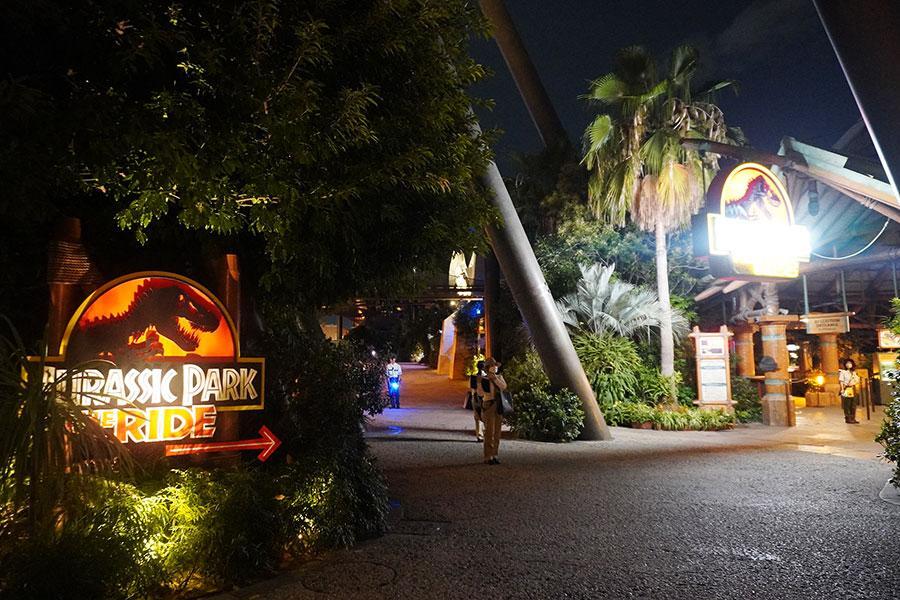
While the standard ride leans heavily on visual animatronics, Universal Studios Japan reimagines the experience during its seasonal autumn programming. Detailed by domestic Japanese press, the park introduced Jurassic Park: The Ride ~In the Dark~ as an exclusive nighttime attraction for its Halloween lineup, stripping away nearly all interior show lighting.
This blackout format changes the psychological equation entirely. In standard daytime operations, riders use the visual sightlines of the industrial ceiling and the visible silhouette of the lift mechanism to anticipate the drop. In the Dark removes these visual markers completely. The cavernous lift hill becomes a sensory void filled only with echoing industrial alarms, guttural dinosaur audio tracks, and cold mist. Riders cannot see the approaching summit, track descent, or splash basin below.
Deprived of sight, the vestibular system becomes hyper-sensitive. Every slight sway of the boat is magnified, and the final plunge arrives without visual warning. The classic T-Rex jump scare shifts from an illuminated visual centerpiece to a sudden burst of audio and motion emerging from pitch blackness. Veteran riders frequently report that the blackout overlay feels significantly faster and more disorienting than the daytime version, despite operating at the exact same physical speed.

USJ Thrill Hierarchy: Comparative Ride Intensity
To accurately gauge where Jurassic Park: The Ride sits on the park's intensity scale, riders must separate physical track forces from sensory and psychological dread. A direct comparison against other signature Universal Studios Japan attractions illustrates this balance clearly:
| Attraction Name | Maximum Drop / Height | Primary Fear Source | Splashdown Soak Factor |
|---|---|---|---|
| The Flying Dinosaur | 37.8 meters (124 ft) | Extreme positive G-forces; face-down flying posture | None (Dry) |
| Hollywood Dream, The Ride | 43.0 meters (141 ft) | Sustained airtime; backward motion on Backdrop | None (Dry) |
| Jurassic Park: The Ride | 25.9 meters (85 ft) | Sudden vertical drop; animatronic jump scares | Extreme (Front rows 90, 100% wet) |
| Harry Potter & Forbidden Journey | Robotic arm articulation | Sensory disorientation; motion sickness; Dementors | Minor mist spray |
Compared to The Flying Dinosaur, which exerts up to 3.7 Gs on riders suspended horizontally, Jurassic Park does not subject the body to sustained physical stress. However, its fear profile works differently. While roller coaster enthusiasts brace easily for visible track layouts, water rides build anticipatory anxiety. The long, tranquil floating sequence acts as a psychological pressure cooker, making the final drop feel far more sudden than the drops on conventional steel coasters.
Safety Guidelines, Height Protocols, and Managing Dread for Kids
Navigating the fear threshold is especially important when visiting with younger guests. Universal Studios Japan enforces strict safety regulations to manage the physical forces exerted during the terminal drop. The baseline height requirement is 122 cm (48 inches) to ride unaccompanied. Children between 107 cm and 121 cm may board, provided they are accompanied by a supervising companion capable of assisting them during an evacuation.
Meeting the height requirement does not necessarily mean a child is emotionally ready for the attraction. Parents frequently underestimate the psychological weight of the environmental storytelling. The interior sequence leans on realistic animatronics, loud alarms, red emergency beacons, and an aggressive creature attack. For children sensitive to dark spaces or loud mechanical noises, this sequence can cause genuine panic long before the physical drop takes place.
For visitors weighing whether to step into the queue, the decision comes down to personal triggers:
- Who will enjoy it: Thrill-seekers looking for classic narrative rides, visitors who love water rides, and fans of practical cinematic animatronics who can handle a brief, intense stomach-drop.
- Who should reconsider: Anyone with severe aquaphobia, inner-ear vulnerabilities sensitive to rapid vertical drops, or young children prone to intense night terrors from realistic creature designs.
The 25th Anniversary Era: The Cultural Longevity of Osaka’s Prehistoric River
As Universal Studios Japan celebrates its 25th anniversary, the Jurassic Park section of the park remains a cultural heavyweight. The anniversary season features major intellectual property cross-collaborations, including co-branded merchandise lines pairing ONE PIECE with Jurassic Park, and Detective Conan with Back to the Future. These anniversary initiatives show how USJ continues to integrate world-renowned anime icons directly into its classic cinematic worlds.
Theme parks increasingly favor digital projection screens and trackless dark ride vehicles, but Jurassic Park: The Ride endures because of its tactile reality. The massive weight of displaced water, the hiss of pneumatic actuators, and the chilling mist of an actual flume cannot be replicated on an LED wall. That physical reality is precisely why the attraction retains its bite. The water is real, the drop is genuinely steep, and the fear remains entirely authentic.
Frequently Asked Questions (FAQ)
Q1: Exactly how wet do you get on USJ's Jurassic Park: The Ride?
A1: Riders in rows 1 and 2 should expect to be thoroughly drenched, often absorbing the full crest of the 800-gallon displacement wave. Rows 3 through 5 experience moderate to heavy spray, while the back rows catch mostly vertical mist as the spray collapses. Purchasing an official park poncho or bringing a rain jacket is highly recommended if visiting during cooler months.
Q2: How does the fear level compare to The Flying Dinosaur?
A2: They trigger completely different phobias. The Flying Dinosaur relies on sustained physical intensity, intense G-forces, and extreme heights in a prone flying position. Jurassic Park: The Ride has minimal physical strain throughout its gentle river cruise, concentrating its fear into psychological suspense, sudden animatronic jump scares, and a single, sharp 85-foot drop.
Q3: Is the drop comparable to a traditional drop tower?
A3: No. A drop tower produces an unconstrained, pure vertical free-fall at 90 degrees. Jurassic Park descends along a 51-degree angled water flume. While you will definitely experience a pronounced stomach-drop sensation, the raft maintains constant friction contact with the slide, meaning the fall feels directed rather than entirely weightless.
Q4: Can guests skip the final drop if they become too frightened inside?
A4: No. Once the boat departs the loading dock, riders must remain seated for the entire journey. There are no intermediate exit platforms during standard operations, as emergency evacuation walks are reserved solely for mechanical ride stops.
The Enduring Mechanics of Terror
The staying power of Jurassic Park: The Ride comes down to its classic mechanical execution. In an era dominated by digital screens and virtual simulations, this 25-meter plunge delivers real gravity, real hydraulic mass, and hundreds of gallons of actual water. Whether riding under the bright Osaka sun or plunging into the pitch-black void of Halloween Horror Nights, that sudden drop into the misty basin remains one of the most effective, visceral shocks in the global theme park landscape.
