Visual Guide to Wearing Ryokan Yukata: Step-by-Step Steps for a Flawless Traditional Look

Checking into a traditional Japanese hot spring inn involves a ritual that has remained virtually unchanged for centuries: swapping street clothes for a crisp cotton robe. Across Japan, historic spa destinations are experiencing a cultural resurgence centered around this garment. Kimono maker Yamato launched its Yadotsunagi upcycling project to transform retired inn robes into bespoke apparel, highlighting the deep heritage of historic destinations like Kinosaki and Kagurazaka, as detailed in an MSN report on thermal bath hospitality.
Yet for first-time visitors stepping onto tatami mats, the unlined robe presents an immediate puzzle. Wrapping it backward violates an ancient cultural taboo, and an insecure sash will leave you adjusting your layers halfway through dinner. Wearing a hot spring inn yukata requires mastering a few straightforward physical mechanics. With the right technique, you can transition smoothly from your room to public baths and willow-lined canals with total confidence.
📌 Key Takeaways:
- The Golden Rule: Always cross the left collar over the right side (migimae); reversing this folds the robe in hidarimae, which is reserved exclusively for dressing deceased bodies at Buddhist funerals.
- Sash Placement: Men secure the obi low across the hips below the belly, whereas women anchor the sash higher at the natural waistline.
- Public Boundaries: Simple room yukata serve as loungewear and sleepwear, while structured outdoor yukata paired with haori jackets are tailored for public bath-hopping.
The Revival of Onsen Town Strolling and Outdoor Yukata
In thermal hamlets like Hyogo Prefecture's Kinosaki Onsen and Ehime's Dogo Onsen, the town itself functions as a sprawling ryokan. The streets are the corridors, the inns are the guest rooms, and the standalone public bathhouses (sotoyu) serve as the main attraction. A survey published by Oricon News revealed that 33% of women aged 20 to 49 actively seek opportunities to wear yukata outside of summer fireworks festivals, identifying hot spring towns as their primary destination of choice.
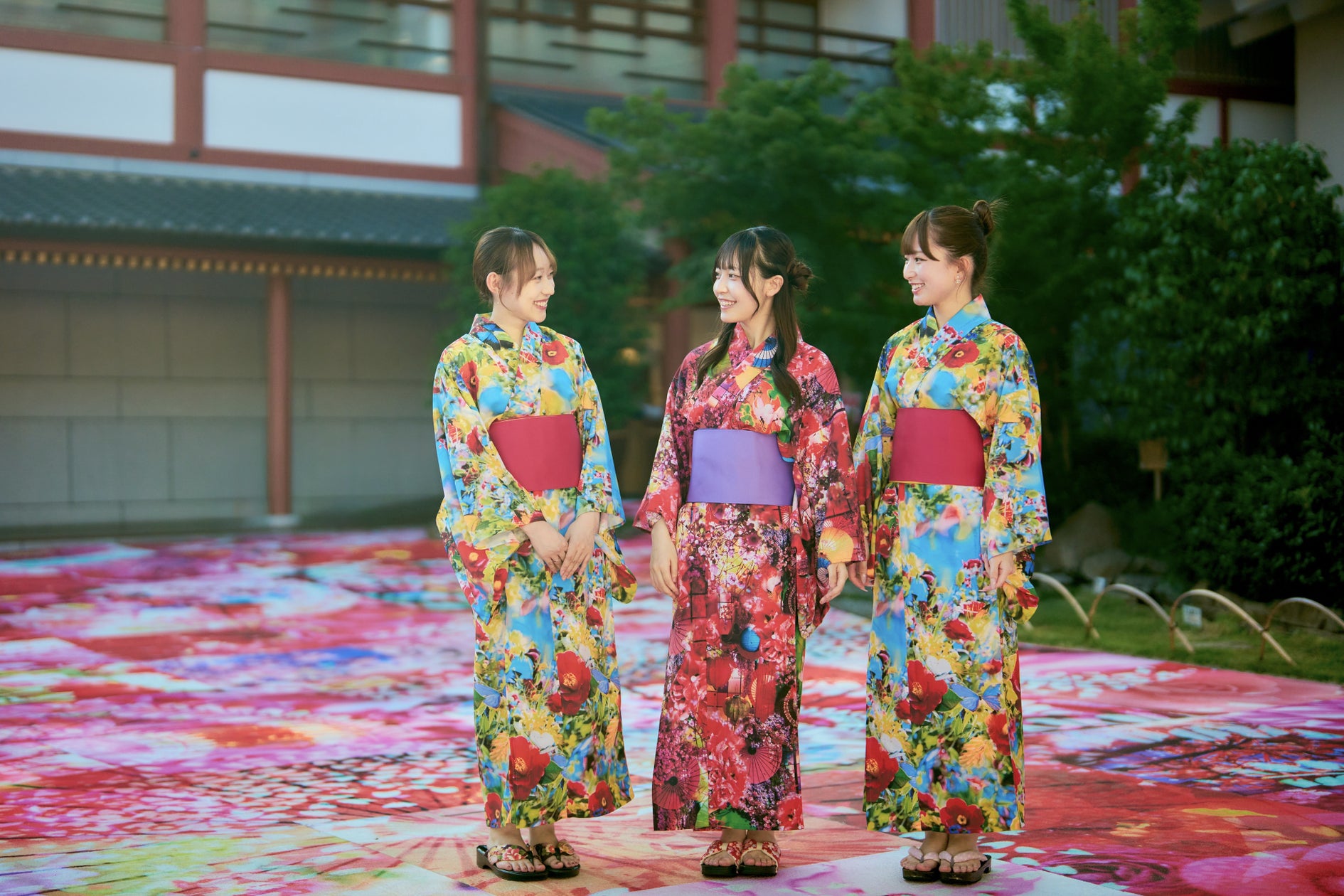
This public demand has spurred creative collaborations across regional Japan. In Matsuyama, the ongoing Dogo Onsen DOGO ART project featured vibrant, custom-designed robes created by artist Mika Ninagawa and creative studio EiM. These modern releases complement the rhythmic clatter of wooden footwear on stone pavement, turning an evening stroll into an immersive cultural experience.
Participating in this environment requires understanding the distinction between room wear and street garments. Basic inn robes are soft, lightweight garments designed for lounging after a soak. When stepping out into public streets, guests wear sturdier, decorative outdoor yukata, layering them with outerwear to match the evening temperature.
Collar Geometry and Avoiding the Funeral Fold
Putting on a ryokan yukata begins with centering the back seam directly along your spine. Slip your arms through the wide sleeves, pull the collar edges evenly in front of your chest, and lift the hem slightly above your feet. The bottom should brush just above your ankle bones, ensuring your sandals will not snag the fabric as you walk.
At this stage, collar positioning determines whether your look is correct or culturally offensive. Bring the right panel across your torso toward your left hip first. Next, fold the left panel over the top of the right panel toward your right hip. This configuration is known as migimae (left-over-right). It forms a natural "y" shape at your throat, allowing right-handed individuals to slip a hand inside the chest fold.
Never reverse this fold. Folding the right side over the left creates hidarimae, a styling reserved exclusively for wrapping corpses before Buddhist burials. Walking through an inn or onsen town with a right-over-left fold will immediately draw quiet concern from staff and locals. Remember this simple cue: your left hand should always rest on the outside layer over your heart.
Proper inner wear makes a significant difference in how the garment sits. Wearing heavy T-shirts with high crew necks ruins the clean lines of the neckline. Choose deep V-neck undershirts, tank tops, or seamless undergarments in neutral skin tones to keep the focus entirely on the garment's traditional silhouette.
Obi Sash Tying Methods for Men and Women
Securing the robe comes down to the placement of the obi. The narrow sashes provided by hot spring inns are softer and easier to manipulate than stiff festival belts, but placement varies depending on your center of gravity.
For men, position the sash low across the pelvic bone, resting well below the stomach. Wrap the band around your waist twice, keeping the tension firm but comfortable. Tie the ends using a clean square knot, or tuck the tails into the layers of the sash in a compact kai-no-kuchi (clam mouth) style. Shift the finished knot slightly off-center toward the right hip. Placing the knot directly on the spine causes discomfort when sitting back against chairs or floor cushions.
Women should anchor the sash higher, wrapping it directly around the natural waistline above the hip bones. Pull the fabric taut across the back to prevent bunching, wrap twice, and tie a crisp bow knot (cho-musubi). Adjust the loops so they lay flat, then rotate the entire bow smoothly to the small of your back. This keeps the front clean, cinches the silhouette, and maintains balanced tension throughout the day.
| Garment Element | Men's Styling | Women's Styling |
|---|---|---|
| Obi Placement | Low along the hip line, under the navel | High at the natural waistline, above hips |
| Standard Knot Style | Flat square knot or folded kai-no-kuchi | Double loop ribbon knot (cho-musubi) |
| Final Knot Position | Shifted slightly off-center to the right side | Centered precisely in the small of the back |
| Hem Clearance | Rests directly at top of the ankle bone | Hovers 1, 2 inches above the ankle |
Layering Outer Jackets and Utilizing Sleeve Pockets
Ryokan guest rooms are stocked with practical accessories tailored to fluctuating mountain temperatures. Resting on the low table or inside the closet, you will typically find an outer coat. During cooler autumn evenings, inns provide a hip-length jacket called a haori. In deep winter, this is swapped for a thicker, padded coat known as a tanzen or dotera.
Wear these outer layers loosely over your tied yukata without fastening them tightly with an additional belt, letting the front open naturally. A small set of cord ties (haori-himo) on the lapels keeps the coat from slipping off your shoulders as you walk between the inn's bath halls.
Your yukata sleeves also hide a clever design element: the rounded, hanging pocket pouch known as the tamoto. The bottom seam of each sleeve is sewn shut, transforming it into a secure storage pouch. When stepping out for dinner or visiting hot springs, slip light items like your room key, wooden bath pass, or coin purse directly into this pocket. Avoid loading it with heavy smartphones, which pull the sleeve downward and throw off your shoulder line.
Bath-Hopping Etiquette and Walking in Traditional Geta
Stepping out of the ryokan lobby brings you to the footwear rack, where modern sneakers are exchanged for traditional geta wooden sandals. These clogs rest on one or two wooden slats called "teeth," which produce a distinctive hollow clicking sound against the stone streets.
Walking in geta requires a slight shift in mechanics. Pushing off from the heel can cause you to trip or fling grit upward onto the back of your robe. Instead, take shorter steps, shifting your weight gently toward the balls of your feet. Let your feet brush forward with a natural, steady rhythm. Keep your toes slightly pointed inward to prevent the hem of your robe from parting as you walk.
When participating in public bath culture, keep your accessories minimal. Inns provide small fabric bags (kinchaku) containing a modest modesty towel and your entry tokens. Carry only these essentials. Remember that public baths do not permit large bath sheets in the bathing area. Keep the small modesty towel dry as you move between pools, resting it on the edge of the stone bath or folding it neatly on top of your head.
Frequently Asked Questions (FAQ)
Q1: What should I wear underneath a ryokan yukata?
A1: Wear lightweight, breathable underwear beneath the robe. Men generally wear boxer briefs or trunks with a low-cut undershirt, while women opt for wireless underwear, seamless bras, or a camisole. Avoid bulky garments that disrupt the clean drape of the fabric.
Q2: Can I wear the ryokan's yukata outside in every onsen town?
A2: In dedicated bath-hopping towns like Kinosaki, Dogo, Kusatsu, and Kurokawa, walking outside in your inn's yukata and geta is actively encouraged. However, in urban hot spring hotels or modern resort complexes, basic room yukata are intended strictly as indoor loungewear. Confirm with the front desk before heading outdoors.
Q3: How do I keep the yukata from loosening while I sleep?
A3: Ensure the inner fold across your hips is pulled snug before wrapping the outer layer and tying your sash. If the chest area still tends to gap open overnight, tie the sash around your natural waistline and cross the lapels higher up on your neck before tucking into bed.
Embracing the Ritual of the Ryokan Wardrobe
Slipping into a ryokan yukata is more than changing into comfortable loungewear; it marks a deliberate transition into the calm, slow-paced rhythm of Japanese hot spring life. The simple cotton weave breathes easily in humid bathhouse air, shedding the tension of highway drives and train commutes.
By observing the fundamental rules, anchoring your left collar over the right, tying your sash at the correct height, and adjusting your stride for wooden geta, you honor a living craft tradition. The next time you find a folded robe laid out on a tatami table, tie your sash with confidence and step out into the evening mist.
