Visual Proof and Menu Secrets: Dissecting the Iconic Bowls of Tokyo's Heritage Noodle Shops
Tucked along residential arteries and quiet suburban rail stops in western Tokyo, a culinary counterculture that began nearly seven decades ago continues to redefine Japanese fast-casual dining. The phenomenon of soupless noodles, anchored by neighborhood institutions like Aji no Hachintei Tokyo, Chinchintei Musashisakai, and modern champions like Tokyo Menchintei Honpo, proves that ramen does not require liters of simmering bone broth to command fervent devotion. As highlighted in a PR TIMES Report documenting Tokyo Menchintei Honpo's expansion into western Japan, the brothless style pioneered in mid-century Tokyo is undergoing its largest national geographic footprint increase to date.
📌 Key Takeaways:
- Origins and Lineage: Brothless ramen began in Tokyo's Tama region during the mid-1950s, evolving from university-adjacent student fuel into a revered metropolitan craft.
- Flavor Mechanics: The genre strips away soup volume, relying on an emulsified base of high-density secret tare sauce, refined lard, hot chili oil, and brewed grain vinegar.
- Modern Expansion: Decades after dominating classic machi chuka counters, dedicated specialty chains are standardizing and exporting Tokyo's soupless heritage across Japan.
The Postwar Counter Culture of Soupless Ramen
The standard definition of ramen insists on an aromatic, complex soup base extracted over hours from pork marrow, chicken carcasses, dried sardine, or kelp. During the rapid urban reconstruction of the Showa era, budget-strapped cooks across western Tokyo began reconsidering this formula. Boiling massive cauldrons of stock required significant gas and labor. By eliminating the liquid soup, shop owners could shave operational overhead while offering workers and college students a dense, carb-heavy meal at a fraction of the standard retail price.
Chinchintei, established in 1957 near Musashi University and Asia University in Musashisakai, is widely recognized as the originator of the term aburasoba (oil noodles). What started as a low-cost, late-night snack for hungry students evolved into an institutional draw across Musashino. Patrons sat on modest red-vinyl stools, watching seasoned cooks pull heavy wheat strands straight from boiling water into bowls lined with a shallow pool of seasoning oil and concentrated soy sauce. The dish looked stark, almost unfinished. It lacked the theatrical broth cascade of standard ramen, yet the tactile pleasure of hot wheat coated in rich fat created an enduring template.
The Visual Anatomy of an Iconic Brothless Bowl
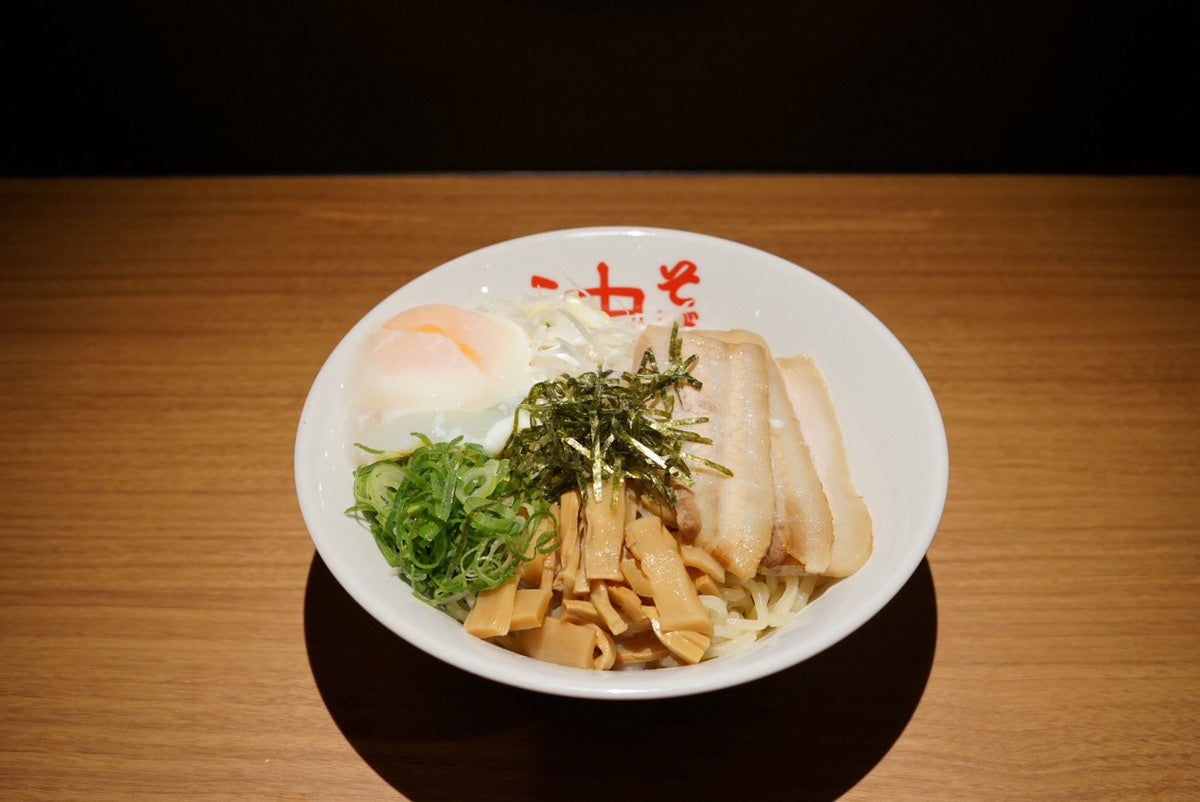
A true vintage Tokyo aburasoba presents an aesthetic that prioritizes functional eating over ornate presentation. When a bowl hits the counter at historic establishments like Aji no Hachintei Tokyo or Chinchintei, the contents look deceptively minimal. At the surface, diners see freshly boiled noodles crowned with sliced chashu, a cluster of simmered bamboo shoots (menma), finely shredded scallions, and perhaps a square of crisp nori or a slice of pink-swirled narutomaki. The secret remains out of sight beneath the noodles.
Photographic records of traditional Machi Chuka kitchens reveal the precise operational hierarchy of this assembly:
First, the base fat goes into the ceramic bowl. Traditional shops use lard rendered in-house from pork belly trimmings, sometimes spiked with garlic cloves or spring onion bulbs to impart baseline savoriness. Second, cooks ladle a measured shot of secret tare sauce, a dark, reduced soy concoction brewed with mirin, sake, sugar, and dried seafood extracts. Third, thick-gauge wheat noodles drop hot from the boiling vat. This heat serves a mechanical purpose: the thermal energy of the unrinsed noodles melts the underlying animal fat and activates the tare aromatics the instant the customer plunges chopsticks to the bottom to toss the bowl.
Milestones in the Evolution of Brothless Noodles
The transition of oil noodles from modest neighborhood diners to dedicated metropolitan retail powerhouses marks one of the most stable evolutionary arcs in postwar Japanese food history.
| Era & Milestone | Pioneering Establishments | Operational & Cultural Impact |
|---|---|---|
| 1950s, 1970s: Suburb Inception | Chinchintei (Musashisakai), Sanpoutei (Kunitachi) | Introduced soupless seasoned noodles as budget-conscious dining for western Tokyo university students. |
| 1980s, 1990s: Machi Chuka Hybridization | Aji no Hachintei (Nerima), vintage neighborhood diners | Integrated aburasoba alongside stir-fries, gyoza, and fried rice, cementing the dish within community dining. |
| 1997, 2010s: Dedicated Counter Formats | Tokyo Menchintei Honpo (Waseda) | Standardized aburasoba as a standalone retail specialty, removing broader Chinese menus in favor of rapid dining. |
| 2020s, 2026: Regional Expansion | Tokyo Menchintei Honpo (Tenjin, Fukuoka) | Exported Tokyo's thick-noodle oil brothless profile into traditional tonkotsu strongholds across Western Japan. |
The Science of Emulsification: Rayu, Vinegar, and Starch Water
Eating aburasoba requires diner participation. Unlike standard soup noodles, which arrive fully balanced by the chef, a soupless bowl remains chemically incomplete until the customer adds condiments.
Every traditional counter features large glass cruets of su (brewed rice or grain vinegar) and rayu (sesame chili oil). The sequence matters. Veteran diners drizzle two or three concentric circular passes of vinegar and chili oil directly over the piping-hot noodles while steam rises from the bowl. Applying the vinegar to cold noodles ruins the texture; applying it immediately while hot cuts through the rich pork lard and lowers its viscosity.
Rapid agitation with chopsticks creates mechanical sheer stress. The residual surface starch from the boiling water binds with the hot rendered fat, the soy tare, the acetic acid of the vinegar, and the capsaicin-infused sesame oil. Within ten seconds of stirring, the liquids transform into a glossy, clingy emulsion. Every square millimeter of the thick-cut noodle surface picks up seasoning without leaving puddles at the base of the ceramic dish.
The Resilience of Nerima and Musashino Counter Culture
While slick commercial chains streamline this process for dense subway commuters, vintage institutions maintain the physical memory of earlier culinary eras. Shops like Aji no Hachintei in Nerima operate as neighborhood anchors, keeping the communal spirit of mid-century suburban Tokyo intact. These operations bridge Chinese-style family eateries with hyper-specialized noodle hubs.
Inside, the sensory markers remain untouched by corporate branding. Stainless-steel range hoods hum above open burners. Hand-written wooden menu plaques line faded walls. Regulars sit alongside multi-generational families eating fried dumplings alongside heavy bowls of brothless noodles. While trend-driven ramen outlets in Shibuya chase viral garnishes, these suburban kitchens demonstrate how simple combinations of unadorned wheat, pork fat, and fermented soy outlast seasonal dining fads.
Frequently Asked Questions (FAQ)
Q1: What is the main difference between aburasoba and mazesoba?
A1: Aburasoba is the original Tokyo soupless style originating in the late 1950s, relying primarily on pork fat, tare sauce, vinegar, and chili oil with basic garnishes like pork and bamboo shoots. Mazesoba, popularized later by Nagoya's Taiwan mazesoba variations, typically incorporates spiced ground pork, raw garlic, raw egg yolk, and fish powder for a heavier profile.
Q2: Why do traditional aburasoba shops use thicker noodles?
A2: Without liquid soup to suspend the noodles, thin strands clump together rapidly as the starch cools. High-hydration thick noodles maintain an elastic bite and provide sufficient surface area for the emulsified oil-and-vinegar sauce to coat without becoming soggy.
Q3: How many calories are in aburasoba compared to regular ramen?
A3: Counterintuitively, traditional aburasoba typically contains 20% to 30% fewer calories and significantly less sodium than a bowl of soup ramen. Because the dish lacks hundreds of milliliters of sodium-heavy broth, diners consume less total liquid fat and salt during the meal.
The Enduring Appeal of Tokyo's Brothless Craft
The persistent strength of soupless ramen culture across metropolitan Tokyo confirms that culinary depth does not rely on elaborate plating. By stripping the ramen experience down to its raw structural elements, elastic wheat, rendered animal fat, and high-grade soy seasoning, pioneering postwar shops created a resilient dining format. As these heritage formulas migrate beyond the borders of Tokyo into regional culinary capitals, the basic satisfaction of hot noodles tossed in seasoned oil remains as practical and compelling as it was in 1957.
