Watch and Learn: Visual Do-Re-Mi Guide to Playing 'Awatenbou no Santa Claus'

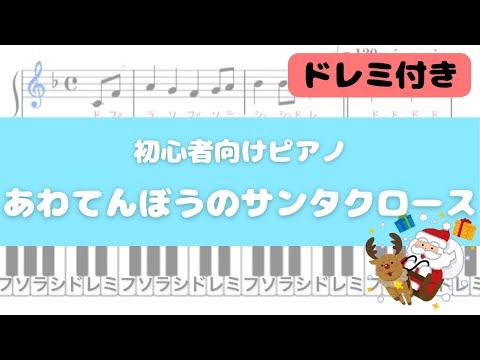
Every December across Japan, nursery classrooms and community centers erupt with the upbeat, syncopated bounce of "Awatenbou no Santa Claus" (The Forgetful Santa Claus). Composed by the late pop and commercial scoring master Asei Kobayashi with lyrics by Osamu Yoshioka, the 1971 holiday standard remains one of the country's most cherished kindergarten Christmas songs. For adult beginners and parents looking to learn the piece quickly without deciphering complex Western staff notation, digital creator communities have sparked a massive pedagogical shift. Guided video breakdowns like the widely referenced YouTube (ばーんミュージック) Report have popularized color-coded solfege playback, proving that complete beginners can conquer the piece within days.
The rush to learn the song online peaks every winter as amateur keyboardists search for practical, low-barrier entry points. By ditching traditional clefs in favor of direct Do-Re-Mi note names, visual roll guides, and step-by-step hand decoupling, these modernized arrangements make an otherwise frantic, syncopated melody playable on almost any home keyboard. Understanding how to break down the composition reveals why this particular Japanese Christmas song has become a staple of modern beginner keyboard instruction.
📌 Key Takeaways:
- Accessible Solfege: Translating the melody into fixed Do-Re-Mi note names allows complete novices to bypass traditional sheet music and begin playing instantly.
- Asei Kobayashi's Catchy Cadence: Written in C Major with a steady 4/4 meter, the song relies on rhythmic repetition rather than intricate harmonic shifts.
- Phased Hand Coordination: Starting with a one finger piano tutorial before introducing basic single-root bass notes prevents rhythm collapse and finger fatigue.
How Kobayashi's Fast-Paced Holiday Classic Found New Life Online
Asei Kobayashi wrote thousands of memorable melodies, spanning commercial jingles, anime themes, and enduring pop compositions. When he crafted "Awatenbou no Santa Claus," he captured a distinctly chaotic character: a flustered Santa who arrives before Christmas Eve, falls down a chimney, drops his gifts, and dances clumsily before the festivities even begin. The tempo moves at a clip, often running between 120 and 132 beats per minute, creating immediate intimidation for first-time pianists trying to read standard sheet music.
Over the past five years, instructional channels across YouTube, TikTok, and digital sheet music repositories like Piascore began rethinking how the track should be taught. Creators discovered that the composition's structure is remarkably symmetrical. Stripping away ornate classical arpeggios revealed an engine built on fundamental diatonic steps. When instructional video creators like ばーんミュージック and かのん presented the right hand melody notes alongside Japanese phonetic solfege, view counts surged. The song transformed from an intimidating preschool recital showcase into a universally accessible entry point for adult self-learners.
Deconstructing the Melody: Do-Re-Mi Solfege and Finger Mapping
The original melody is rooted squarely in C Major, which means players avoid dealing with sharp or flat black keys during early practice. The visual learning approach maps the notes directly to the piano's natural white keys. Learning the song requires dividing the piece into five distinct rhythmic motifs that reflect Santa's misadventures.
The opening verse establishes the bouncy theme using clear scalar leaps:
Verse Theme: | So - Mi - Do - Re - Mi - Fa - So - | So - Mi - Do - Re - Mi - Re - |
Lyrical Phrase: A-wa-ten-bou no San-ta Ku-ro-o-su / I-so-i-de do-ji fu-n-de
The trickiest element for beginners is not key selection, but finger replacement. Starting with your thumb (Finger 1) on middle C, your hand naturally rests across C-D-E-F-G. When the melody leaps upward to high A ("Fa-So-La"), beginners often freeze. Online visual systems solve this problem by showing students how to shift the third finger over the thumb or transition into an open five-finger span. By breaking the melody into bite-sized three-bar phrases, students establish muscle memory before attempting the iconic chorus bells sound effect.
Practice Milestones: From Single-Finger Runs to Coordinated Hands
Beginners who jump straight into playing with both hands simultaneously almost always hit a wall around the syncopated chorus. Mastery requires following a structured progression path. The table below outlines how instructional creators structure the learning curve to keep practice sessions manageable and rewarding.
| Learning Stage | Target Technique & Hand Role | Recommended Tempo |
|---|---|---|
| Stage 1: Monophonic Line | Right hand melody notes using index finger tracking or fixed 5-finger position. | 60, 75 BPM |
| Stage 2: Single-Bass Roots | Left hand strikes root notes (C, F, G, Am) on downbeats only (whole/half notes). | 70, 85 BPM |
| Stage 3: Quarter-Note Harmony | Left hand plays steady two-note shell chords (root + fifth) beneath the vocal line. | 85, 105 BPM |
| Stage 4: Performance Tempo | Full polyphonic rhythm, dynamic bell accents ("rin-rin-rin"), and bouncing staccato. | 115, 128 BPM |
Moving across these four stages prevents the common mistake of practicing mistakes at high speeds. Teachers consistently recommend setting an electronic metronome to half-speed, roughly 65 beats per minute, until the transitions between phrases feel effortless.
Demystifying the Chords: Simple Left Hand Accompaniment
A major barrier for self-taught pianists is the left hand. Traditional conservatory arrangements crowd the bass clef with walking bass lines and ragtime jumps that simulate Kobayashi's theatrical brass arrangements. For an easy piano tutorial, that level of density is completely unnecessary.
The entire harmonic foundation of "Awatenbou no Santa Claus" rests on four basic chords: C Major (tonic), F Major (subdominant), G Major (dominant), and A minor (relative minor). Instead of playing full three-note triads that muddy the sound in lower octaves, beginner arrangements strip the accompaniment down to its purest form. Playing a single bass C on beat one, shifting to F on beat three, and anchoring the cadence on G gives the right hand room to breathe.
Once single bass notes feel solid, adding a simple "oom-pah" rhythm gives the piece its signature march-like bounce. Strike the root note on beat one, then tap a gentle fifth or simple chord tone on beats two and four. This minimalistic approach provides full harmonic context without forcing beginners to perform complex wrist movements.
Choosing Your Path: Digital Video Tutorials Versus Sheet Music
Prospective learners often wonder whether they should invest in formal beginner piano sheet music or rely exclusively on visual streaming tutorials. Both approaches serve distinct learning goals, and understanding their practical trade-offs saves time and frustration.
Visual piano roll guides and slow practice keyboard guides, especially those hosted on YouTube, excel at visual association. They highlight the keys in real time, display note letters clearly, and allow learners to pause and mirror hand shapes directly. For someone who simply wants to perform one specific song at a family gathering or preschool event within 48 hours, these visual breakdowns are unbeatable.
Printable scores sourced from digital distributors like Piascore offer a different set of advantages. Professional PDF charts provide clear finger numbering, formal measure bars, and precise dynamic markings that videos sometimes gloss over. For players who plan to build genuine, transferable piano literacy, combining a verified Piascore sheet music arrangement with a visual slow-motion tutorial creates the most balanced, durable learning routine.
Frequently Asked Questions (FAQ)
Q1: Can I learn 'Awatenbou no Santa Claus' if I have never played a musical instrument before?
A: Yes. Because the core arrangement is in C Major and uses common white-key patterns, beginners can learn the primary right-hand melody within two to three 30-minute practice sessions using visual Do-Re-Mi guides.
Q2: Is a full 88-key weighted piano required to play this song?
A: Not at all. The entire melody and beginner bass line span roughly two and a half octaves. A standard 61-key keyboard or even a portable 49-key synthesizer is more than sufficient for practicing this arrangement.
Q3: What is the most difficult section for beginners to master?
A: The rapid sound-effect chorus ("chirin-chirin", "don-don-don") features quick repeated notes and staccato accents. Beginners should slow this section down to 50% speed and practice tapping the keys lightly with the fingertips rather than hammering down with the entire hand.
Building a Sustainable Repertoire Beyond the Holidays
Working through "Awatenbou no Santa Claus" using solfege notation offers an effective gateway into practical piano playing. The physical mechanics built while practicing Kobayashi's lively tune, such as finger independence, tempo control, and fundamental I-IV-V chord transitions, lay the ground for tackling dozens of other Japanese holiday songs and global standards. Approached step-by-step with patient, slow-tempo repetition, learning this energetic classic proves that complex sheet music is no longer a prerequisite for making music at home.
