When Dry Skin Isn't Just Dry Skin: Medical Truths Behind Persistent Back Itching

Every winter, millions reach blindly over their shoulder blades, struggling to smooth thick emollient into tight, irritated skin. For decades, consumer culture treated this awkward physical contortion as a lighthearted grooming nuisance. During a cosmetics launch covered in a Sports Nippon Report, Japanese television personality Aki Hoshino joked publicly about how impossible it was to reach her own mid-back when applying skin serum. Yet clinical dermatologists and oncologists view that anatomical blind spot through a far more sober lens.
When chronic pruritus takes hold between the scapulae, reaching for a longer handle rarely solves the underlying crisis. Patients routinely purchase ergonomic wands and medicated salves to combat what they assume is dry skin. Months later, many discover that their unresponsive symptoms had nothing to do with dry weather. The spine and upper back serve as primary manifestation zones for trapped sensory nerves, autoimmune flares, and subtle early warnings of internal malignancy.
📌 Key Takeaways:
- The Diagnostic Boundary: Standard winter itch relief yields to barrier emollients within two weeks, whereas neuropathic and systemic pruritus resist topical hydration entirely.
- Neurological Triggers: A hyper-localized, burning itch beneath the shoulder blade often signals notalgia paresthetica, a spinal nerve compression rather than an epidermal defect.
- Systemic Warning Signs: An unresponsive back rash or sudden unilateral eruption demands a formal dermatologist skin check to rule out paraneoplastic syndromes and deep internal disease.
The Ergonomics of Dorsal Skin Barrier Repair
The human back features some of the thickest skin on the body, paired with an exceptionally dense network of sebaceous glands along the midline. Despite this natural oil reserve, the central thoracic zone remains notoriously vulnerable to barrier breakdown. Low ambient humidity, scalding showers, and friction from tight winter clothing strip surface lipids faster than the stratum corneum can replenish them.
When dryness strikes hard to reach spots, proper application becomes a legitimate biomechanical challenge. Most adults exhibit limited shoulder mobility, leaving a distinct diamond-shaped zone between the lower trapezius and mid-thoracic vertebrae largely untouched. This physical barrier spawned an entire sector of topical cream application tools, ranging from curved ergonomic handles to dense foam rollers.
Mechanical assistance helps, but applying cream blindly creates its own clinical liabilities. Patients frequently slather heavy, occlusive petroleum jellies over micro-tears without cleansing the area first. Trapping ambient sweat, residual laundry detergent, and dead keratinocytes against compromised skin triggers secondary folliculitis, complicating what began as simple irritation. Correct body moisturizer techniques require gentle cleansing, patting the skin damp, and using measured, even pressure across the dorsal surface rather than aggressive scraping with plastic handles.
Notalgia Paresthetica and the Neuropathic Itch Loop
Not all persistent back itching originates in the epidermis. When an intense, stinging sensation concentrates just medial to the scapular border, most commonly between the T2 and T6 spinal nerves, patients frequently suffer from notalgia paresthetica. This localized sensory neuropathy occurs when chronic postural strain, degenerative disc disease, or musculoskeletal impingement pinches posterior primary rami nerve fibers.
The brain registers this localized nerve trauma as an unscratchable, ferocious itch. Patients instinctively reach for a back lotion applicator or scratch tools, scraping the skin raw in an attempt to short-circuit the neurological signal. Over months or years, this relentless friction creates a distinct clinical marker: a hyperpigmented, brown or gray patch caused by macular amyloidosis and post-inflammatory melanin deposition.
Hydrating lotions, steroid creams, and thick barrier ointments produce zero measurable relief for notalgia paresthetica. The epidermal barrier is not dry; the nerve sending signals to the brain is irritated. Effective management abandons traditional moisturizers in favor of topical capsaicin, transcutaneous electrical nerve stimulation (TENS), targeted physical therapy to decompress the thoracic spine, and prescription neuromodulators like gabapentin.
Differentiating Surface Irritation From Deep Pathology
Determining whether dorsal irritation requires a richer emollient or an oncology referral hinges on pattern recognition, symmetry, and responsiveness to treatment. True xerosis develops symmetrically, responds predictably to humectants, and lacks focal neurological pain. The following diagnostic breakdown outlines how distinct back conditions present in clinical practice:
| Condition | Clinical Presentation | Primary Mechanism | Emollient Response |
|---|---|---|---|
| Winter Xerosis | Diffuse flaking, bilateral tightness, mild erythema across mid-back | Lipid depletion from low humidity and hot water exposure | Resolves within 7, 14 days of ceramide application |
| Notalgia Paresthetica | Unilateral infrascapular burning, hyperpigmented oval patch | T2, T6 spinal sensory nerve root compression | Zero relief; responds only to neuromodulation |
| Nummular Eczema | Coin-shaped, crusted or weeping plaques across dorsal plane | Immune dysregulation following epidermal injury | Temporary soothing; requires high-potency topical steroids |
| Paraneoplastic Pruritus | Unilateral papules or deep intractable itch without obvious primary rash | Systemic cytokine release, tumor necrosis, or occult malignancy | Completely resistant to topicals and standard antihistamines |
Understanding these distinctions prevents dangerous delays. An individual treating nummular eczema as simple seasonal dryness risks secondary bacterial infection from open weeping lesions. Mistaking paraneoplastic manifestations for winter itch wastes valuable months during which an early-stage malignancy continues to progress unchecked.
Unilateral Back Rashes as Early Systemic Warnings
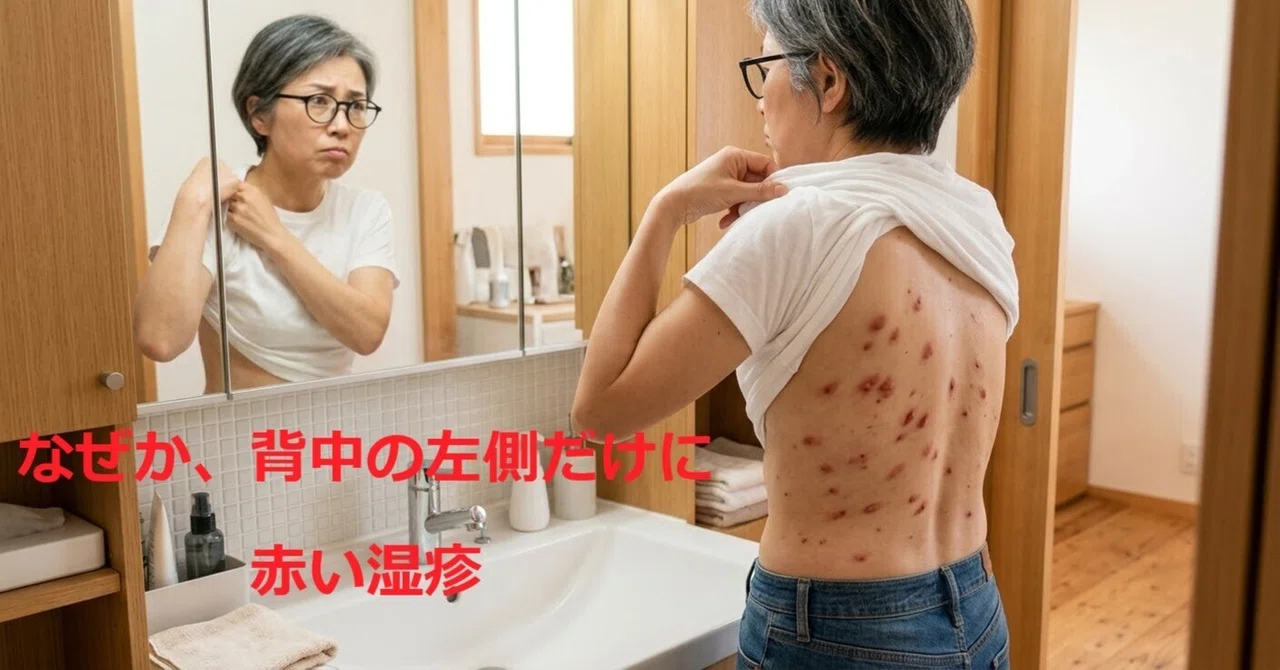
The most dangerous assumption a patient can make is that all skin rashes reflect external irritants. When a rash appears strictly on one side of the dorsal midline and resists conventional medical ointments, clinical suspicion must shift inward.
In personal clinical accounts published on Japanese health platforms, patients have described subtle bodily anomalies that preceded formal oncological diagnoses. In one documented case, an individual who experienced manageable, bilateral winter itching for years noticed a distinct shift: a stubborn, 2-to-3-millimeter papular red rash formed exclusively across the left side of the upper back. Standard moisturizers and prescription anti-inflammatory ointments failed to alter the eruption. Months later, clinical evaluations revealed that this persistent, localized dermal reaction was an early physical manifestation tied to an emerging breast cancer diagnosis.
Systemic malignancies, including lymphomas, solid breast tumors, and hepatic carcinomas, frequently provoke paraneoplastic dermatoses. Malignant cells release systemic pro-inflammatory cytokines, neuropeptides, and eosinophilic mediators into the vascular stream. These signaling molecules often trigger localized pruritus or inflammatory eruptions in dermatomal patterns long before a primary tumor becomes palpable or symptomatic.
When an unresponsive back rash appears without a clear mechanical cause, applying more lotion simply delays necessary diagnostics. Unilateral stability, lack of flaking, failure to heal within three weeks, and resistance to medium-potency topical corticosteroids represent firm clinical red flags.
Practical Protocols for Managing Hard to Reach Spots
For genuine winter xerosis and compromised skin barriers, strategic execution matters far more than purchasing expensive miracle balms. Skin barrier repair requires the deliberate reintroduction of physiological lipids: ceramides (specifically 1, 3, and 6-II), cholesterol, and free fatty acids in an optimal 3:1:1 ratio.
Start by auditing the daily shower routine. Water exceeding 104°F melts away intercellular lipids, stripping moisture deep within the stratum corneum. Limit showers to under eight minutes and abandon coarse mechanical loofahs, which create micro-fissures across the back.
Apply body moisturizers within three minutes of exiting the shower while the skin remains slightly hydrated. When using a back lotion applicator, choose non-porous silicone pads rather than absorbent sponges. Sponges trap dead skin cells and harbor fungal pathogens in humid bathroom environments. Sanitize the applicator surface with isopropyl alcohol twice a week to avoid seeding bacterial folliculitis across open pores.
Select formulas containing at least 5% to 10% urea or colloidal oat for severe winter itch relief. Urea serves as an exceptional humectant that gently breaks down cross-linked keratinocytes, allowing moisture to penetrate thickened back skin without harsh physical scrubbing.
Frequently Asked Questions (FAQ)
Q1: How can I tell if my back itch is dry skin or notalgia paresthetica?
A: True dry skin produces widespread flaking, feels rough to the touch, and improves significantly within seven days of applying rich ceramide moisturizers. Notalgia paresthetica produces a localized, burning, or pins-and-needles sensation, typically underneath one shoulder blade, without visible flaking, and it fails to respond to any hydrating lotion.
Q2: When should an unresponsive back rash be evaluated by a physician?
A: Schedule a dermatologist skin check if a rash is strictly unilateral, bleeds easily, forms firm nodules, or fails to clear after two to three weeks of prescription topical care. Immediate evaluation is essential if the eruption is accompanied by unintentional weight loss, night sweats, or localized lymph node swelling.
Q3: Are long-handled topical cream application tools safe for inflamed skin?
A: They are safe only when equipped with smooth, medical-grade silicone pads that are disinfected after every use. Avoid wooden scratchers, rough sponge heads, or abrasive rollers, which cause mechanical micro-trauma, drive bacteria into hair follicles, and worsen chronic pruritus.
Dorsal Health: Looking Beyond the Blind Reach
Treating the upper back as an afterthought is an easy habit to fall into. The area remains invisible without dual mirrors, and reaching it demands uncomfortable physical effort. Yet dismissing persistent back itching as simple winter xerosis ignores the complex dialogue between the dorsal skin, the spinal column, and internal organ systems.
Skin serves as a real-time monitor of internal physiological balance. When high-grade emollients, disciplined hydration protocols, and specialized tools fail to quiet a dorsal itch, the problem rarely lies in the dryness of the air. Listening to the skin requires recognizing when self-care has reached its limit and allowing clinical diagnostics to look deeper.
