Why Are Benesse Deviation Scores So High? The Truth Behind Tokyo University Cutoff 84
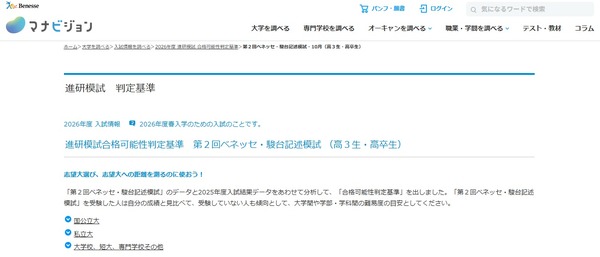
Every autumn, Japanese high school forums and social media feeds light up with the same collective gasp: Benesse no hensachi, okashii, "Benesse's deviation scores are completely broken." The trigger is almost always the release of qualification thresholds for elite national institutions. According to coverage from a リセマム Report documenting the 2026 admissions cycle's second Benesse-Sundai descriptive mock exam, securing an 80 percent passing probability criteria benchmark for the University of Tokyo demanded a deviation score of 80 across Humanities I, Humanities II, and Natural Sciences I. For the ultra-selective Natural Sciences III (Todai Ri-San), that cutoff reached an eye-watering 84.
To Western observers or newcomers to Japan's rigorous university entrance ecosystem, an 84 hensachi sounds statistically implausible. In a standard normal distribution, a score of 84 sits more than 3.4 standard deviations above the mean, representing roughly the top 0.03 percent of all examinees. Yet inside the domestic prep-school market, these sky-high numbers appear every single year. The phenomenon is not a clerical error, nor does it mean Japanese admissions standards suddenly broke historical records. Instead, it exposes how sample demographics, institutional testing models, and mathematical formulas warp the public perception of academic readiness.
📌 Key Takeaways:
- The Distortion Mechanism: Massive test taker population distribution spanning hundreds of non-selective high schools depresses the mean and inflates standard deviation scores for top performers.
- Descriptive vs. Common Test Variance: While the descriptive mock exam pushed Tokyo University Natural Sciences III to an 84 cutoff, Benesse's December Common Test mock exam settled at 79 due to compressed scoring ranges.
- Diagnostic Reality: A Benesse score generally runs 5 to 10 points higher than identical performances on Kawaijuku or Sundai standalone exams, creating false security for mid-tier university applicants.
The Anatomy of an 84 Cutoff at Todai Natural Sciences III
The University of Tokyo does not publish raw cutoff percentages before tests take place; private test administrators step in to forecast those barriers. When Benesse Corporation and Sundai Bunko released their joint descriptive mock exam criteria, the numbers seemed almost punitive. Natural Sciences III, widely regarded as the most demanding academic department in Japan, required an 84 to lock in an "A" judgment (an 80 percent or higher probability of acceptance).
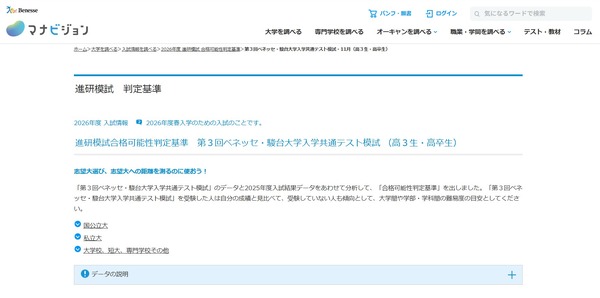
The shock intensified just weeks later. When Benesse rolled out the December evaluation based on its third Common Test mock exam, Todai Natural Sciences III fell to 79, while Humanities I sat at 78. This stark variance between the descriptive mock exam accuracy metrics and the standardized Common Test simulation left thousands of applicants questioning which benchmark to trust.
The discrepancy stems from format constraints. Descriptive exams (kijutsu) force students to write out complex mathematical proofs and expansive essays, spreading scores across a vast spectrum from single digits to near-perfection. Standardized multiple-choice tests, by contrast, bunch raw scores tightly together at the top end. When a descriptive exam separates candidates aggressively, the statistical tail stretches outward, pushing the highest thresholds into uncharted territory.
How Test Taker Demographics Warp the Standard Deviation Curve
The root cause of this hensachi score inflation lies in who actually sits for the test. Unlike specialized prep-school exams that cater strictly to college-bound teenagers, Benesse's Shinken Moshi series partners directly with high schools across all 47 prefectures. Entire student bodies take the exam during regular classroom hours, including vocational tracks, commercial academies, and regional institutions where few graduates ever apply to four-year universities.
Over 400,000 students frequently sit for a nationwide Benesse administration. Kawaijuku's Zentsu exams, by comparison, draw roughly 250,000 to 300,000 participants who self-select and pay individual fees out of pocket. Sundai's proprietary exams draw an even narrower, hyper-elite slice of roughly 50,000 to 70,000 students, alongside seasoned ronin (gap-year cram school students).
Because Benesse measures an applicant against a cohort that includes hundreds of thousands of students not targeting competitive national universities, the cohort mean drops significantly. The standard deviation widens. When an aspiring Tokyo University applicant posts an elite raw score against a subdued national average, their calculated percentile rank launches into the stratosphere.
The Mathematics Governing the Hensachi Score Inflation
The standard deviation calculation formula used throughout Japanese education is straightforward:
Hensachi = 50 + 10 × ((Raw Score - Mean) / Standard Deviation)
In an idealized cohort of uniformly prepared students, raw scores cluster around the center. The standard deviation stays compact. If an exam is given to a wide-open demographic, the score distribution flattens. Students who leave blanks on advanced calculus problems drop the group mean ($\mu$), while elite students who clear every challenge pull away toward maximum raw marks ($X$).
If the test mean hovers at 38 out of 100 with a standard deviation of 15, a student scoring 89 registers a calculation of $50 + 10 \times ((89 - 38) / 15)$, yielding an exact hensachi of 84. The student did not perform superhuman feats; the underlying distribution simply stretched. Put that same applicant in a Sundai-only room where the mean is 58 and the standard deviation is 12, and that same 89 raw score yields a deviation of 75.8. The student's knowledge did not change, but the yardstick did.
Kawaijuku Versus Benesse: A Benchmark Comparison
Japanese college counseling offices routinely maintain conversion matrices to translate Benesse results into realistic odds. Kawaijuku's Zentsu Mock Exam is widely treated as the domestic industry baseline because its demographic most closely mirrors the actual four-year university applicant pool. Sundai, meanwhile, functions as the stress test for elite national candidates.
| Examination Metric | Benesse-Sundai Mock Exam | Kawaijuku Zentsu Exam | Sundai National Mock Exam |
|---|---|---|---|
| Participant Pool | Broad high school cohort (350,000, 450,000) | College-bound mainstream (250,000, 300,000) | Elite national & medical track (50,000, 70,000) |
| Todai Ri-San Acceptance Threshold | 84 (Descriptive) / 79 (Common Test) | 72.5 | 68.0, 70.0 |
| Kyoto Univ. Cutoff Range | 72, 78 | 65.0, 67.5 | 60.0, 63.0 |
| MARCH / Kansai-Gaidai Baseline | 60, 65 | 55.0, 57.5 | 48.0, 52.0 |
A score of 65 on a Benesse Shinken Moshi does not mean an applicant is performing at the top tier of competitive four-year university applicants. In Kawaijuku terms, that performance translates to roughly 57. In Sundai terms, it drops to the low 50s. The test does not miscalculate; it merely reflects the high school national percentile rank of a broader, less competitive baseline.
The False Comfort of Inflated Progress Reports
The divergence creates genuine tactical problems for students inside Japan's public school system. Many regional public high schools exclusively administer Benesse mock exams to keep testing fees low and monitor general curriculum compliance. Private prep schools, conversely, guide their charges through Kawaijuku and Sundai batteries starting in their sophomore year.
A student seeing a 68 on their Benesse report card often assumes they have competitive odds for prestigious private consortiums like MARCH (Meiji, Aoyama Gakuin, Rikkyo, Chuo, Hosei) or top-tier national programs. When winter arrives and they face university-specific descriptive entrance papers (kobetsu shiken), they discover their diagnostic score was inflated by roughly 8 points.
Experienced cram school counselors routinely advise subtracting 5 to 8 points from any Benesse Shinken Moshi score when benchmarking private universities, and subtracting 8 to 10 points when targeting former Imperial Universities like Tokyo, Kyoto, or Osaka.
Interpreting Mock Exam Data for Actual Admissions Odds
Mock exams serve two distinct functions: measuring mastery of school curriculum and predicting selection outcomes. Benesse excels at the former. Its diagnostic printouts offer detailed breakdowns of sub-unit weaknesses across high school algebra, classical Japanese grammar, and basic chemical equations.
For admissions probability, raw hensachi values should take a back seat to rank order and cohort volume. When reviewing score cards:
First, disregard the headline deviation score and look at the absolute candidate rank among those who listed the target university as their primary choice. If 1,200 applicants listing Tokyo University Natural Sciences I take an exam, and the department accepts 1,100 students nationwide, an applicant ranking 300th holds an authentic competitive position regardless of whether their score reads 76 or 82.
Second, compare descriptive mock exam accuracy against university-specific open exams (Todai Open, Kyodai Jitsuryoku). These boutique simulations, administered by Kawaijuku and Sundai each autumn, mirror the exact length, question style, and grading strictness of the actual February entrance papers. Their candidate pools consist entirely of genuine applicants, stripping out the statistical noise of nationwide high school cohorts.
Frequently Asked Questions (FAQ)
Q1: Why does Benesse assign an 84 deviation score to Todai Natural Sciences III while Kawaijuku lists it around 72.5?
Benesse tests a much wider national pool that includes vocational and non-college-preparatory schools, depressing the overall cohort mean. Kawaijuku tests a self-selected population of college-bound students, resulting in a higher group average that naturally compresses the upper score limits.
Q2: Does a 60 deviation score on a Benesse exam guarantee admission to a mid-tier university?
No. A Benesse score of 60 typically translates to a 52 to 55 on Kawaijuku exams and below 50 on Sundai exams. Admissions odds must be calibrated against the specific testing pool rather than the isolated deviation number.
Q3: Which mock exam should applicants rely on for real admissions judgments?
For general benchmarking across national and private universities, Kawaijuku's Zentsu series offers the most balanced national cohort. For top-tier national institutions, university-specific open mock exams provide the highest predictive accuracy.
Navigating Admissions Realities in 2026
Deviation scores are relative yardsticks, not absolute measures of human intellect. The recurring shock over Benesse's 84 cutoff for the University of Tokyo highlights how easily statistical representations can be misread without context. When evaluating entrance odds, look past the inflated headline numbers. Focus on rank within your specific target cohort, adjust for sample demographics, and test your skills against the actual difficulty of the entrance exam you intend to conquer.
