Why Are Low-Flying Helicopters Buzzing Tokyo Right Now? The Secret Roppongi Route Revealed
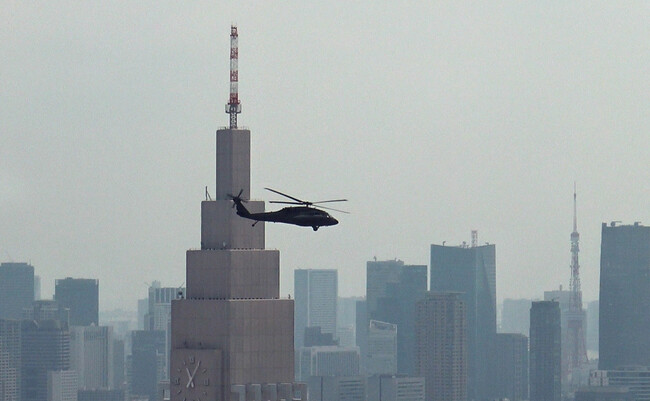
If you stepped outside in Minato Ward, Roppongi, or Shibuya recently and felt the glass pane of an office window vibrate from low-frequency rotor wash, you experienced a routine anomaly of the capital's skyline. Thousands of residents search flight trackers each month after watching olive-drab rotary craft bank sharply past commercial towers. Most assume these flights represent domestic emergency drills or Metropolitan Police Department patrols.
They do not. As chronicled in an investigative 毎日新聞デジタル Report, those low passes are predominantly US military helicopters shuttling through central Tokyo. The theatrical release of the feature documentary 300 Meters Above Tokyo (東京上空300メートル), directed by Atsushi Ogaki and co-produced with the Mainichi Shimbun investigative team, has brought this seventy-year-old arrangement back into sharp public focus, exposing how foreign military aviation maneuvers above one of the world's densest urban centers outside normal domestic flight laws.
📌 Key Takeaways:
- The Direct Destination: Most low-altitude flights over Minato Ward route straight to Hardy Barracks (the Akasaka Press Center) in Roppongi, an active US military installation with a dedicated rooftop and surface helipad.
- The Legal Mechanism: Under the Japan-US Status of Forces Agreement (SOFA) and the associated Act on Special Measures of the Civil Aeronautics Act, US military flights are exempt from Japanese urban altitude minimums.
- The Investigative Record: A two-year tracking project by Mainichi Shimbun revealed regular UH-60 Black Hawk flights operating down to 300 meters, and sometimes lower, along corridors where Japanese civil helicopters face strict restrictions.
The Roppongi Flight Route and the Hardy Barracks Enclave
The geographic epicenter of central Tokyo helicopter noise is not an airport or an Self-Defense Forces base. It is a three-hectare plot situated in Roppongi 7-chome known formally as the Akasaka Press Center, or Hardy Barracks. The compound houses offices for the US Army, the military newspaper Stars and Stripes, and an operational helipad situated mere footsteps from the National Art Center and Roppongi Hills.
American UH-60 Black Hawk and occasionally larger transport helicopters use this concrete landing pad as an urban air terminal. They shuttle military brass, visiting diplomats, and personnel between Yokota Air Base in western Tokyo, Naval Air Facility Atsugi in Kanagawa Prefecture, and the heart of the Japanese capital. Because Hardy Barracks sits nestled inside a valley surrounded by high-rises, approaching aircraft must fly low along designated visual corridors, often skimming just over the tops of apartment towers in Minato, Meguro, and Shibuya wards.
For office workers and local residents, the sensory disruption is instantaneous. Twin turboshaft engines generate intense air pressure variations between tightly packed glass-and-steel high-rises. Unlike Japanese police or medical evacuation helicopters, which circle high until clearing emergency zones, Pentagon transit flights slice through Roppongi at high speed on fixed transfer vectors.
How Postwar Treaties Exempt US Aircraft from Japanese Flight Regulations
Under Article 81 of Japan's Civil Aeronautics Act, aircraft operating over densely populated cities must maintain a minimum safe altitude: at least 300 meters (roughly 984 feet) above the tallest obstacle within a 600-meter radius. For Japanese commercial charter flights, news helicopters, and private operators, dipping below that threshold invites immediate regulatory penalties from the Ministry of Land, Infrastructure, Transport and Tourism (MLIT).
US military helicopters operating in Japan, however, do not answer to MLIT. When the Treaty of Mutual Cooperation and Security took shape alongside the Japan-US Status of Forces Agreement (SOFA), Japan enacted the Special Measures Law Concerning the Civil Aeronautics Act (航空法特例法). This legal carveout explicitly exempts US military aircraft from major portions of domestic aviation safety code, including standard minimum altitude baselines, flight plan pre-clearance requirements, and acrobatics restrictions.
American pilots follow their own internal service branches' visual flight guidelines. While US Army regulations specify safety envelopes, they permit low-level urban approaches when maneuvering into tight tactical or urban LZ pads like Hardy Barracks. Japanese air traffic authorities have no legal jurisdiction to inspect, redirect, or ground these aircraft over downtown Tokyo.
Civilian Aviation Rules vs. US Forces Flight Reality
The gap between domestic flight standards and military privileges produces two parallel skyways above Tokyo. While a civilian media chopper must hover well above downtown skyscrapers, foreign military transports routinely cruise at eye level with observation decks.
| Operational Factor | Japanese Civil Aviation Standard | US Military Operations (USFJ) |
|---|---|---|
| Urban Altitude Floor | Minimum 300m above the highest obstacle within a 600m radius | Exempted under SOFA Special Law; internal service limits apply |
| Landing Facilities | Certified public/private heliports with strict weight & noise permits | Exclusively controlled facilities (e.g., Hardy Barracks heliport) |
| Airspace Jurisdiction | Tokyo Tower Control / MLIT Civil Aviation Bureau | Yokota Air Base RAPCON & unmonitored visual flight rules (VFR) |
| Transponder Broadcast | Mandatory continuous ADS-B transmission for tracking | Transponders occasionally disabled or set to tactical non-public modes |
Inside "300 Meters Above Tokyo": The Two-Year Investigation
Public debate around central Tokyo helicopter flight routes shifted from neighborhood rumors to verified documentation through a long-term reporting project by the Mainichi Shimbun. Titled "Questioning Privilege" (特権を問う), the newspaper deployed telephoto lenses, laser rangefinders, and flight logs to monitor US military helicopter flights around Hardy Barracks and Tokyo over a two-year investigative cycle.
The findings formed the core of the documentary feature 300 Meters Above Tokyo, directed by Atsushi Ogaki. Premiering in October 2026 at the independent cinema Pole-Pole Higashi-Nakano before rolling out across Japan, the film documents multiple instances where US Army UH-60 Black Hawks flew well below 300 meters above surrounding buildings during approach runs into Minato Ward.
Ogaki's cameras captured aircraft threading gaps between residential buildings, flying close enough for observers on balcony decks to spot pilot helmet markings. By juxtaposing central Tokyo flights with conditions around military installations in Okinawa, the documentary frames urban helicopter noise not as an isolated neighborhood nuisance, but as an ongoing sovereignty question 81 years after the end of World War II.
Yokota Airspace and Why Civilian Commercial Flights Route Around the Capital
The low-level Roppongi shuttle is part of a much larger geographic footprint known as Yokota Airspace. This immense block of sky, controlled directly by US Air Force air traffic controllers at Yokota Air Base, encompasses Tokyo and parts of eight surrounding prefectures.
Commercial flights departing Tokyo Haneda Airport or Narita International Airport must navigate around or climb rapidly over this military ceiling. Even when commercial airliners fly domestically, their flight paths are shaped by agreements negotiated with US Forces Japan. Because the US military exercises primary air control across these sectors, its transport helicopters move through capital transit routes with minimal interference from Japanese civil traffic managers.
When low flights trigger noise complaints from ward assemblies in Minato or Shibuya, municipal officials have few practical remedies. Local governments regularly pass petitions demanding the closure or relocation of the Hardy Barracks helipad, citing disaster risks and school-zone proximity. These formal petitions travel up to the Ministry of Foreign Affairs and the Ministry of Defense, where discussions typically stall within the bilateral US-Japan Joint Committee.
How to Identify and Track Low-Flying Tokyo Helicopters
When heavy rotor thumps shake your living room, consumer technology can help clarify what is passing overhead. A quick look at standard flight radar applications will often tell the story, though sometimes by what does not appear on screen.
First, check platforms like Flightradar24, RadarBox, or ADS-B Exchange. Japanese media helicopters operated by NHK, TV Asahi, or Kyodo News broadcast standard civil transponder codes, displaying tail numbers, cruising altitude, and home helipads (typically Tokyo Heliport in Koto Ward). Emergency medical flights and Tokyo Fire Department Air Corps choppers appear with clear agency identifiers.
If you see a low-flying, dark helicopter directly overhead but the radar map shows empty space, you are likely looking at a military flight. US Army aircraft departing Yokota or Atsugi heading for Roppongi regularly switch off public Mode-S or ADS-B output while running visual flight routes. Crowd-sourced networks like ADS-B Exchange, which do not filter military tracks, occasionally catch their transponder hex codes, confirming UH-60A/L Black Hawks or VIP-configured C-12 Hurons banking low across the metropolis.
Frequently Asked Questions (FAQ)
Q1: Why are US military helicopters landing in Roppongi instead of an airfield?
A1: Hardy Barracks (the Akasaka Press Center) in Roppongi provides the US military and diplomatic officials with a direct transit terminal into downtown Tokyo, avoiding congested metropolitan highways when moving between Yokota Air Base, the US Embassy in Toranomon, and regional naval facilities.
Q2: Is it legal for foreign military helicopters to fly lower than Japanese civil aircraft over Tokyo?
A2: Yes, under current Japanese law. The Special Measures Act of the Civil Aeronautics Act, enacted to implement the bilateral Status of Forces Agreement (SOFA), explicitly exempts US military aircraft from the urban minimum flight altitudes that Japanese pilots must obey.
Q3: What should I do if a low-flying helicopter causes property disturbance or extreme noise?
A3: Japanese local police and civil aviation offices cannot issue citations to US military flight crews. Residents can file formal disturbance reports with their municipal ward office (such as the Minato Ward Resident Safety Division) or contact the Ministry of Defense's South Kanto Defense Bureau, which compiles flight disturbance records for bilateral committee meetings.
The Changing Visibility of Tokyo's Partitioned Skies
The rotor noise echoing across Roppongi is not a temporary military drill or an isolated emergency response. It is the audible footprint of an administrative framework that has governed the skies of Tokyo for decades. With the release of 300 Meters Above Tokyo and ongoing reporting by investigative teams, the operational details of these flights have moved from obscure local complaints to national public dialogue. As high-density residential towers continue to rise across Minato Ward and Shibuya, the physical clearance between downtown rooftops and military flight paths will keep shrinking, ensuring the debate over who controls capital airspace remains front and center.
